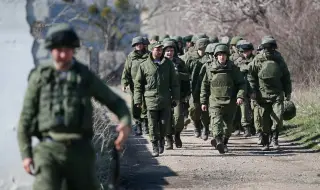
The Polish leadership sees a growing risk of provocations by Russia on NATO's eastern flank. "We are monitoring the events in Ukraine and we see that the war is currently developing unfavorably for Russia. This is a reason for concern that Moscow may resort to further escalation," the head of the Polish intelligence service, Colonel Pawel Shota, told the "Żecpospolita" newspaper.
A small-scale attack on the Baltic states could look like a landing by "little green men," the head of the Polish intelligence service believes. This term, applied to Russia's armed forces, appeared after the annexation of Crimea in 2014 and refers to Russian servicemen in military uniforms without insignia.
Moscow "systematically crosses the 'red lines' in order to check NATO's reaction," Shota noted. "The price of such provocations is not high," but the North Atlantic Alliance's reaction "is primarily political, which encourages further escalation," he added.
"We know about the Kremlin's plans"
Polish Foreign Minister Radoslaw Sikorski also warned a few days ago about a possible operation by the Russian army under a foreign flag. "We must make it clear to Putin that we are aware of his plans and that we will not give in, that this is completely unacceptable and that we will defend every meter of NATO territory", the country's foreign minister stressed in an interview with the American media CBS.
The Kremlin has repeatedly stated that Russia does not intend to attack NATO countries. However, military intelligence services and intelligence services of a number of Alliance countries share Warsaw's position and differ only on the scale of a possible attack and the time at which it could take place.
A Russian invasion of NATO territory was simulated in Germany
In December 2025, military exercises were held in Germany, during which a Russian invasion of the North Atlantic Alliance territory in Lithuania was simulated - under the pretext of a humanitarian crisis in the Kaliningrad region. During the exercises, Germany showed indecision, and Poland mobilized troops and moved to the border with Lithuania, but did not cross it.
The United States was satisfied with Russia's statements about the humanitarian nature of its actions. Thus, during the exercise, the hypothesis developed that Moscow managed to undermine trust in NATO and establish control over the Baltic region in a matter of days, deploying a contingent of only about 15,000 military personnel.