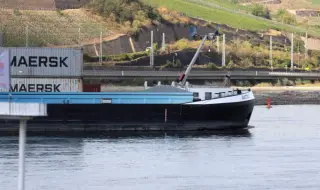
Water levels in the Rhine river in Germany fell to new lows on Tuesday, Reuters reported, citing the Federal Office for Waterways and Shipping (BWA).
As a result, some freight transports were stopped, according to the agency, but other vessels continued to sail with significantly reduced loads. The BWA highlighted that the depth of the shipping channel in the Kaub narrows near Koblenz was 23 cm on Wednesday. This is below the previous record low of 25 cm recorded in 2018. The total depth of the river is approximately 1 meter deeper than the depth of the shipping channel.
Shallow waters during the current heat wave mean that cargo ships are often operating at only 20% of their capacity. The cargo has to be distributed among several partially filled vessels, which increases costs for industrial companies. For example, the German container logistics company Contargo announced that it was suspending regular inland waterway services to the South Rhine and Rhine-Main regions. According to a Contargo representative, barge operations in the Wörth am Rhein/Karlsruhe and Rhine-Neckar regions are only possible to a very limited extent.
The company's capacity on the Lower Rhine, according to the representative, has also decreased significantly. Commodity traders noted that the cost of transporting liquid cargo by barge from Rotterdam to Karlsruhe has risen to approximately 155-160 euros per tonne, compared to 45 euros in June. However, cargo continues to arrive overall.
On Thursday, the Federal Office for Waterways and Shipping (Bundesamt für Waterway und Schauspiel) predicted that the shipping channel at Kaub would fall to new record lows. The same day, Germany's new Transport Minister, Steffen Bilger, will hold an emergency meeting to discuss the situation.
The water level on the Rhine, considered one of the most important waterways in Europe and the world, has dropped significantly in recent weeks amid dry weather. The Rhine is a key route for transporting goods, including grain, ore and petrol. As Thilo Schäfer, an expert at the Institute for German Economics, points out, the low water level on the Rhine increases transport costs, increases the workload on road and rail transport and therefore leads to problems with the supply chain. Experts believe that industries dependent on large volumes of raw materials, such as the chemical industry, metallurgy, and oil production, are the most affected.