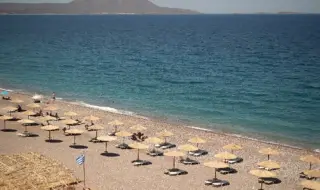
Greece wants to put an end to the placement of sun loungers and parasols outside the areas for which a concession has been granted. For this purpose, the most modern technical means are being relied on.
It is not uncommon in Greece for enterprising owners of umbrellas and sun loungers to place them far outside the areas for which they have been granted a concession in order to increase profits. Therefore, the Finance Ministry is tightening control and will impose high fines, writes "Kölner Stadt Anzeiger".
The publication points out that this "occupation" has been a thorn in the side of many local people for years, especially if the set of an umbrella and two sun loungers costs a hundred euros or more per day, as is the case on Mykonos. And those who want to put their own umbrella, sunbed or just a towel on the beach can hardly find a place.
There are rules, but they are not followed
After the national protests two years ago, the government introduced new rules for beach management, the German publication recalls: concessions are now given centrally by the Ministry of Finance, and not by the municipalities as before. There are clearly defined limits - at least 30 percent of the beaches must remain free zones. There must also be a certain distance to the shore - umbrellas and sunbeds should not be closer than four meters to the water.
However, there is often a serious discrepancy between the rules and reality, writes "Kölner Stadt Anzeiger". Many entrepreneurs place additional sunbeds and umbrellas outside the areas they are entitled to. There are even those who do not have a concession at all, according to the authorities.
Violators will be searched with drones and QR codes
This summer, around 1,500 inspections were carried out on 300 beaches and hundreds of minor and major violations were found. Heavy sanctions were also imposed - such as a 60,000 euro fine on Rhodes for obstructing free access to the sea. Quite a few beaches were closed for illegally placing sun loungers and umbrellas, with the total amount of fines exceeding 80,000 euros.
Now, to increase control, the Ministry of Finance has decided to rely on drones, but also on information from beachgoers themselves. Each concessionaire must place an information board on the beach with prices, as well as a QR code provided by the ministry. Visitors can scan it and thus go directly to the department's website, where they can report violations. If a code is missing, the specially created state-run app "My Coast" can be used to check whether a beach bar, a sun lounger owner or a water sports facility has a concession at all.