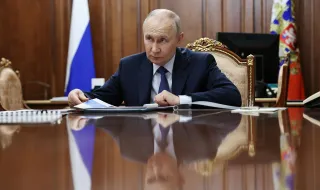
It is a test for Russia to hold parliamentary elections now - even ones whose outcome is practically predetermined, BTA reported, citing AP.
The economic and political situation has been seriously affected by the four and a half years of full-scale war with Ukraine. Swarms of enemy drones have caused enormous damage to Russian oil refineries and logistics facilities. Society, which no longer perceives the fighting as something happening far away, is gripped by an ever-increasing anxiety.
„United Russia“ – the Kremlin's main party – is on track to retain full control of the State Duma, along with other parties whose supporters vote at the behest of President Vladimir Putin. However, authorities have tightened their grip on the first wartime elections for the lower house of parliament (the Federal Assembly - ed. note) since the 2022 invasion of Ukraine.
The Kremlin has suppressed even the smallest outbursts of dissent ahead of the three-day vote, which begins tomorrow. The only party that dared to criticize the war ("Yabloko" - ed.) was unceremoniously removed from the electoral lists, and several politicians who spoke out against the war were sent to prison or forced to flee abroad.
With the outcome a foregone conclusion and no immediate threat to Putin's political dominance, analysts believe the Kremlin sees the elections as a key step in mobilizing public support for the war and legitimizing its actions.
“Your choice and determination will once again show that millions of people stand behind our fighters, that we are a single people, united by common values, historical memory and love for the Motherland,“ Putin said in a speech before the vote.
This summer, marked by long-range Ukrainian drone strikes, brought the war into the everyday lives of millions for the first time Russians. The attacks have deepened the problems of the Russian economy, which has stagnated after the initial boost from huge military spending waned. The government has raised taxes and increased domestic borrowing to control a growing budget deficit.
The strikes on Russian oil refineries have triggered a severe fuel crisis that peaked in June, then eased for a few weeks, only to return in August. The situation has been further worsened by a series of attacks on warehouses of online retailers Wildberries and Ozone. Hundreds of thousands of sole traders have lost their goods, causing economic turmoil.
All of this has soured public sentiment. Polls have shown Putin’s approval rating falling – although it remained high (the independent Levada polling center reported 76% in August, down from 87% in September 2025). Even some high-ranking members of the Russian elite have openly expressed their discontent.
Andrei Klepach, chief economist at the state-owned development corporation VEB.RF (VEB.RF, successor to the Russian Foreign Trade Bank - ed.), warned of possible internal turmoil in Russia. "We will not make a profit in this war of attrition. Our costs are growing. We will almost certainly face a social crisis," he told a seminar. Klepach was fired the day after his remarks were published.
Putin acknowledged that the strikes on oil refineries and logistics centers had caused significant damage, but insisted that the economy could cope with them. According to him, by attacking such infrastructure, Ukraine has opened a “Pandora's box“, provoking a massive counterattack.
Russia has stepped up missile attacks and new jet drones against Kiev and other cities, taking advantage of the shortage of Ukrainian interceptor missiles. In addition, Moscow has sharply increased shelling of Odessa and other Black Sea ports, thereby hindering the export of grain and, in general, agricultural products from Ukraine, which are a key source of income.
As the problems caused by the Ukrainian attacks have grown, fears have also grown in Russia that the Kremlin is considering a large-scale mobilization. The partial mobilization of 300,000 reserve soldiers in 2022 has caused hundreds of thousands of Russians to leave the country, undermining domestic stability. Since then, the Kremlin has relied on volunteers for the war effort, offering relatively high salaries and benefits. But military experts have warned that the flow of volunteers has dwindled while casualties remain huge.
Ukrainian President Volodymyr Zelensky has repeatedly said that the Kremlin is considering a post-election mobilization - a claim Putin has dismissed as "nonsense". In a meeting in the Kremlin on September 5 with US envoys Steve Witkoff and Jared Kushner, as well as in a subsequent phone call with President Donald Trump, Putin said that Russia has the upper hand on the battlefield, signaling that he will stick to his maximalist terms for a peace deal.
In July, the Central Election Commission allowed 11 parties to run in parliamentary elections, including "Yabloko" - the only registered political party that openly criticizes the war. Weeks later, however, the country's Supreme Court removed "Yabloko" from the voter lists. The decision was made following a complaint by the nationalist Rodina party, which described the anti-war stance of the liberal Yabloko party as tantamount to an attempt to violate Russia's territorial integrity.
Observers of the Kremlin process described the move as a clear sign of internal struggles between those in power who want a certain imitation of competition to increase voter turnout, and those who fear that Yabloko's presence could lead to public criticism of the war and political instability. "The risk that the campaign would turn into a fight "for" and "against" peace - that is, into a dispute about the war - was quite high, and this was clearly not part of the plans," said Tatyana Stanovaya of the Carnegie Russia Center. Eurasia“.
Maxim Kruglov, deputy chairman of “Yabloko“ and a former member of the Moscow City Council, was sentenced in June to seven years in prison for spreading false information about the Russian army. Last month, a court in the Pskov region found another deputy chairman of “Yabloko“, Lev Shlosberg, guilty of anti-war speeches and sentenced him to more than 11 years in prison.
After the removal of “Yabloko“ Since the election, authorities have systematically blocked party members from running independently for the State Duma and regional legislative assemblies in most single-member districts.
Liberal politician and war critic Boris Nadezhdin, who sought to challenge Putin in the 2024 presidential election, left Russia last month for fear of going to prison after being labeled a "foreign agent," barred from running for office, and fined for displaying "extremist symbols."
The United Russia party, which controls more than two-thirds of the 450 seats in parliament, is expected to maintain its lead in the lower house despite perceived social fatigue from the war and a deteriorating economic situation. According to some Russian sources, the Kremlin has slightly lowered the target indicators for “United Russia“, but it is still expected to retain full control in parliament.
“It is possible that “United Russia“ will be allowed to retreat slightly... in order to bring the results that will be announced closer to reality“, noted analyst Mark Galeotti, head of the consulting company “Mayak Intelligence“, adding that the Kremlin will ensure that the party “will still remain completely dominant in the Duma“. According to him, one of the goals of the elections is for them to serve as “ritual legitimation, creating the impression that there is a mass consensus behind the Kremlin“.
The remaining parties of the so-called “systemic opposition“ are expected – The Communist Party of the Russian Federation, the Liberal Democratic Party of Russia and “A Just Russia“ (which follow Putin's course and strongly support the war) – to retain their presence in the Duma.
While the attacks from Ukraine have raised serious concerns, they could also lead to demands for a tougher response against Kiev - as long as citizens themselves are not directly involved in it, Galeotti noted in a podcast.
Chris Weaver, CEO of "Macro-Advisory Ltd.", said that while the Ukrainian attacks have affected public sentiment, there is no immediate threat to the Kremlin's political dominance. "Since the beginning of the conflict, there has been a rallying cry, and polls have consistently shown a fairly high level of support," he said.
Although the election results are predictable, "the public narrative and, above all, voter turnout" are crucial for the Kremlin, as they allow it to demonstrate broad public support for the actions taken, Weaver added.