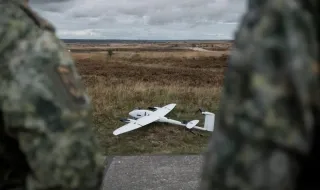
Russian private business is increasingly organizing its own defense against Ukrainian drone attacks. Companies are renting air defense systems, creating their own means of countering drones and looking for guards to monitor the sky and shoot down aircraft, reports the “Wall Street Journal“, quoted by UNIAN.
According to the publication, the Russian authorities are no longer leaving defense only to the military and law enforcement agencies. Moscow has ordered companies to take self-defense measures, and a decree cited by the publication warns that businesses that fail to provide protection against Ukrainian drones could be temporarily placed under state control.
Guards watch the skies for a salary of 240,000 rubles
Job ads on the Russian website “Avito“ are looking for guards to patrol the perimeter, detect drones and shoot them down. In the Moscow region, such work is offered for a salary of 240,000 rubles per month, or almost $3,000. Guarding the Crimean Bridge can be paid more than twice as much.
The government has also expanded the role of employees outside of traditional security structures. Earlier in September, employees of “Russian Post“ were allowed to to carry weapons. Security guards at enterprises are also expected to be able to counter drones.
Business pays for air defense or builds its own systems
Some companies pay the Russian Ministry of Defense to rent air defense systems, including for the work of instructors and technical teams. Others choose a cheaper option and hire engineers from the defense industry to develop their own means, often by copying foreign analogues. The information was provided by two sources close to Russian business circles, according to the “Wall Street Journal“.
According to the state news agency TASS, in the first half of 2026, commercial enterprises spent more than 440 million rubles on anti-drone systems. The amount is almost seven times higher than the costs for the same period of the previous year.
The attacks affected oil refining and logistics
The growing costs are associated with the increase in strikes deep into Russian territory. According to the Polish analytical company Rochan Consulting, since March, Ukrainian drones have carried out about 200 attacks on Russian oil refineries and have hit at least 36 logistics centers, including warehouses of the largest Russian online retailers Ozon and Wildberries.
On September 21, the Moscow Oil Refinery stopped processing after an attack by Ukrainian drones. After the damage, more than 45% of the design capacity of the Russian oil refining plant was put out of action, UNIAN reports. A few days later, the Novoshakhtinsk plant and the Perm oil refinery also stopped working.
According to the “Wall Street Journal“, Russia's large size complicates defense, as the available air defense assets must be distributed over a vast territory. Against this background, the private sector is increasingly taking on the costs and tasks related to the security of its own facilities.
Sources: UNIAN, Wall Street Journal, TASS