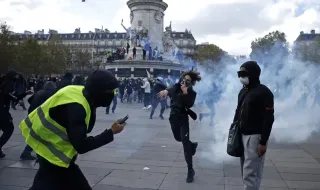
Mass protests against the high cost of living, low incomes, the housing crisis and problems in education have escalated into clashes with the police in several European countries. Tensions were most serious in France, where around 400 people were arrested after arson, vandalism and attacks on police officers and public buildings.
The French Interior Ministry said around 550,000 people took part in 110 marches across the country. Organizers, including the CGT union and student organizations, put the number at around 800,000. The protests brought together schoolchildren, university students, trade unionists and members of the "yellow vest" movement.
Arson and arrests in France
In Paris, police used tear gas and water cannons against groups in masks and hoods who threw pyrotechnics, stones and other objects at the Place de la République. Cars, containers and a newspaper stand were set on fire, and several shops were looted.
In Limoges, the town hall was set on fire. In Marseille, protesters stormed the town hall and damaged the premises, and in Lyon, the tourist office was set on fire. French Interior Minister Laurent Nunes said some of the participants were "extremely aggressive radical far-left groups" who had sought to clash with police and attacked public buildings.
President Emmanuel Macron said: "There is no place for violence in our republic." He added that those who damaged property, attacked public buildings and looted shops would be prosecuted and punished.
Tensions in Milan and Bologna
In Italy, a march against wars and rising prices began peacefully but turned into riots in the center of Milan. Masked protesters threw stones and paving stones at police, set fire to barricades made of tables and damaged shops. Police used water cannons and tear gas to clear the Duomo square.
According to the Italian news agency “La Presse“, about 50 people were detained and at least two police officers were injured. In Bologna, police used water cannons and made seven arrests after a protest that also escalated.
Italian Prime Minister Giorgia Meloni said that demonstrations were a right, but arson and the taking of cities hostage were unacceptable. Milan Mayor Giuseppe Sala said the reasons for the protests were understandable, but the violence against police and the damage caused could not be justified.
Protests in Belgium, Portugal and Albania
In Brussels and Liege, police used tear gas and water cannons in protests over tuition fees, higher education reforms and rising costs. In Lisbon, tens of thousands of people took to the streets demanding higher wages and pensions and more affordable housing.
In Tirana, protests against the government of Prime Minister Edi Rama entered their fifth day. Demonstrators threw stones, Molotov cocktails, flares and fireworks, and police responded with tear gas, water cannons and batons. Police reported 167 arrests and 132 injured officers. Seven police officers have been suspended pending an investigation into allegations of abuse of power.
The movement in Albania began over a controversial tourism project on the southern coast linked to an investment company founded by Jared Kushner, son-in-law of US President Donald Trump. After schoolchildren and students joined, the protests grew into a broader movement demanding Rama's resignation, criticism of corruption and a shortage of jobs.
Sources: apnews.com, theprint.in