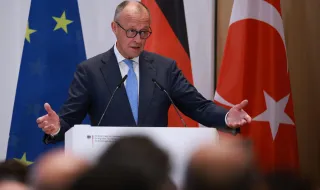
German Chancellor Friedrich Merz praised the contribution of Turkish guest workers to the development of Germany, defining their migration as a “success story”. He made the statement during a ceremony dedicated to the 65th anniversary of the German-Turkish agreement on the recruitment of workers, DPA reported, quoted by BTA.
In his speech today, Merz said: “Turkish guest workers, both women and men, helped build our country's industrial base“.
The chancellor also highlighted the wider impact of migration on German society.
“Germans and Turks have become modern, open-minded and tolerant thanks to their mutual contacts in the 1960s, 1970s and 1980s,“ he said.
“Germany has become richer culturally, economically, scientifically and culinary-wise thanks to migration from Turkey,“ Merz added.
Merz: Fear of foreigners is poison for a free society
The German chancellor said that of the people who arrive in the country, rightly are expected to respect its democratic values. Among the examples he cited were equality between men and women and responsibility towards the Jewish people.
At the same time, Merz stressed that people who integrate must be able to count on equal opportunities and a sense of belonging to German society.
He noted that despite their efforts, many continue to be treated as foreigners.
“Fear of foreigners is poison for any free society,” the chancellor said.
In his speech, Merz recalled racist attacks in the German cities of Mölln, Solingen and Hanau. He also commented on the term "remigration", describing it as a non-existent word.
"Behind it lies an attack on the modern Germany that we have built together over the past 65 years," Merz said.
The Chancellor also stressed that Germany continues to need skilled workers from abroad.
From temporary solution to permanent migration
The labor recruitment agreement between Germany and Turkey was signed on October 30, 1961. It was originally intended as a temporary solution to provide workers for the rapidly growing German economy, and provided for a period of two years.
This restriction was lifted in 1964. The change allowed workers to obtain permanent residence rights and facilitated family reunification them.
Over the next 12 years, about 867,000 men and women from Turkey left for West Germany. The data comes from the chancellery of North Rhine-Westphalia - the most populous German state, where the country's heavy industry was once concentrated.
The migrants arrive to work mainly in the coal mines in the Ruhr area, on assembly lines and in the production halls of German factories, DPA notes.