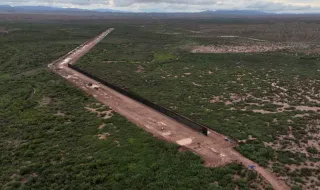
The US Supreme Court has allowed Donald Trump’s administration to temporarily resume construction of a border wall and related infrastructure in the Big Bend area of West Texas. The November 9 ruling is unsigned and was issued by an 8-1 vote. Justice Ketanji Brown Jackson was the only member of the court to vote against it, without providing an explanation.
The Supreme Court suspended the preliminary injunction imposed by federal Judge Kathleen Cardone. She blocked construction on October 2 after determining that the plaintiffs would likely prove that the administration had exceeded its authority to waive environmental requirements. Cardone published her written ruling on October 14.
The new ruling does not bring the case to an end. According to The Texas Tribune, it will remain in effect until the Supreme Court decides whether to hear the dispute on its merits or until proceedings conclude in federal court in El Paso. Construction work can therefore continue, but the project’s ultimate legality has yet to be decided.
The project covers more than 500 miles of border
The Big Bend sector covers 517 miles of the US-Mexico border. It includes Big Bend National Park, Big Bend Ranch State Park, and private and public land in Hudspeth, Jeff Davis, Presidio, Brewster, Terrell and Val Verde counties.
Some sections are slated to receive a 30-foot-tall steel wall, along with new roads, surveillance systems and vehicle barriers. Customs and Border Protection says that no 30-foot pedestrian wall will be built in the national park or the state park. A 17-mile system of disconnected vehicle barriers is, however, planned for the national park.
According to The Texas Tribune, the sector accounts for about 1.6% of migrant apprehensions along the entire southern border, even though it covers more than 25% of the border itself. The administration has awarded contracts worth $7.5 billion to build roads and barriers and install technology in the area. The government also claims that halting the work results in losses of $500,000 per day.
Environmentalists and local residents challenge the project
The case was brought by the Center for Biological Diversity, Friends of the Ruidosa Church and a local river guide. They argue that construction will permanently alter the desert landscape and affect habitats, historic sites, private property and access to stretches of the Rio Grande.
“The government’s interest outweighs any asserted aesthetic, recreational and environmental harm,” the Supreme Court’s ruling states.Lykken Jordahl, a public lands advocate with the Center for Biological Diversity, described the ruling as an opportunity to “destroy one of the wildest areas of Texas” before the courts have issued a final decision on the project’s legality.
The dispute began after the Department of Homeland Security issued three waivers allowing parts of federal environmental and historic preservation laws to be bypassed. The next key step is the Supreme Court’s decision on whether to accept the case for full review.
Sources: apnews.com, texastribune.org, cbsnews.com