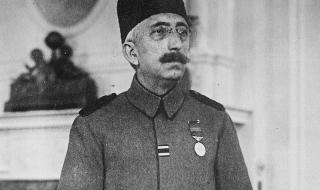
On November 1, 1922, the last sultan of the Ottoman Empire, Mehmed VI, abdicated.
He was born in 1861 in Istanbul. He became sultan on July 4, 1918, after Mehmed V's legitimate heir, Reshad Yusuf Izzet, committed suicide.
The new sultan came during difficult years for the empire, which began with the Young Turk Revolution and ended with its defeat in World War I. French and British troops occupied vast territories in the Middle East that had been the sultan's possession for centuries.
Under pressure from the West, Mehmed VI was forced to accept the Treaty of Sèvres. This is a peace treaty signed in the Paris suburb of Sèvres between the victorious powers of World War I and the Ottoman Empire. It was initialed on 10 August 1920 and is part of the Versailles system of treaties.
On the part of the Ottoman Empire, it was accepted by Sultan Mehmet VI, who sought to retain his throne, but the Young Turk movement led by Kemal Atatürk rejected the treaty.
The main clauses in the treaty are territorial, military and legal.
The territorial clauses are related to the division of Ottoman territories between the victors.
– France received Lebanon and Syria, while Dulcadir and Cilicia remained under French influence.
– Italy received as zones of influence Tarsus, Antalya, Konya and parts of central Anatolia and received confirmation of the direct accession of the Dodecanese to its territories.
– Armenia received Erzurum and the lands around Lake Van, along with the Trabzon region.
– Greece received Eastern Thrace, along with the Aegean Islands and, as a zone of influence, the area around Izmir. After 5 years, a referendum was planned to be held in the region to determine whether the territory would become part of Greece or remain in the Ottoman Empire.
– Great Britain received Palestine, Transjordan and Iraq, and parts of Kurdistan as a zone of influence.
– The Bosphorus and Dardanelles were demilitarized and placed under international control.
– The treaty also provided for a referendum among the Kurds to determine their future. The referendum was never held due to disagreements among the Kurds themselves.
The military provisions provided for a reduction of the Ottoman army to 50,000, allowed the retention of only 7 battleships and 3 torpedo boats, and prohibited the Ottoman Empire from having an air force. In addition, an Allied control commission was established to monitor the implementation of the military provisions.
The Ottoman army general and hero of the defense of the Dardanelles – Mustafa Kemal Pasha retreated to the still free territories, rejected the Sultan's authority as exhausted and old-fashioned, and declared his intention to save the state from the catastrophe it was in.
On November 1, 1922, after the Greek invasion of Asia Minor was repelled, the Sultanate was officially dethroned, and on November 17, Mehmed VI left Istanbul aboard a British warship. He initially settled in Malta, but quickly moved to the Italian Riviera in San Remo.