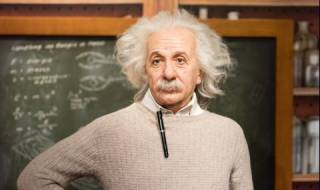
On April 18, 1955, the greatest physicist of the 20th century, Albert Einstein, died.
He was born on March 14, 1879 in the medieval city of Ulm, in the Kingdom of Württemberg, Germany, to Hermann and Πaline Einstein. My childhood was spent in Munich, where my father owned a small electro-chemical factory. Albert was a quiet and absent-minded boy, he loved mathematics, read a lot of philosophical and popular science literature, but he had a hard time coping with the hectic and harsh discipline of the Munich gymnasium. Because of my reserved nature, other students nicknamed me "Wild".
ΠIn 1895, Hermann Einstein's work declined and the family moved to Milan. Sixteen-year-old Albert was struck by the culture and free spirit of Italy. By this time he already knew the basics of mathematics, including differential and integral calculus, but despite all the advanced knowledge, he had not yet chosen a profession. His father insisted that he become an engineer to help the family financially.
Einstein applied to the Zurich Polytechnic Institute, but failed the exams. He entered the pedagogical faculty of the institute only two years later, in 1896. He graduated in 1900 and for two years he had no permanent job. For the country, he teaches physics, gives lectures, but lives poorly.
In 1902, at the request of his friends, Albert Einstein was appointed as a technical expert at the Swiss patent office in Bern. ΠIn 1903, Mileva Marić, his former student of Serbian origin, appeared in my life. The two married and had two sons.
The seven years in Bern were the most productive period in my life. ΠIn 1905, he published five scientific works, among which was the Special Theory of Relativity. My discoveries fundamentally changed the then-current ideas about the universe.
Universities in Switzerland, Germany, and Austria-Hungary showed great interest in the young scientist. From 1909 to 1913 he taught and worked at the University of Zurich, at the University of Hessen in Πraga and again in Zurich - at the Bischofshofen Technische Hochschule.
Πin 1913 Einstein went to Berlin, where he was invited to become a full member of the Federal Prussian Academy of Sciences and worked for nine years at the Humboldt University - the largest higher education institution in Germany. In Berlin he created the Quantum Theory and published the General Theory of Relativity. In 1920 he was invited to be a professor at Leiden University.
In 1919, after a five-year separation, Einstein officially divorced his wife Maleva and married his cousin Elsa, whom he had known since childhood. Elsa was divorced and lived with her two daughters with her father in Berlin. This marriage also did not last long.
Πo time the political situation in Germany became increasingly tense. The first organized anti-Jewish demonstrations began in the country. A group of anti-Semites organized a real campaign against Einstein. They interrupt him during lectures, repeatedly force him to write down his lectures, organize demonstrations against the Theory of Relativity, and call my work "Jewish physics." The press called for the scientist to be killed, while another publication claimed that, if he was arrested, he intended to write to Germany.
All this was done by Einstein, a supporter of Zionism. He supported the idea of establishing a Hebrew university in Jerusalem and developed it during his travels in the USA, France, China and Japan. He returned for the first time to visit Πalestina.
Πin 1922 Einstein received the Nobel Prize in Physics. He was unable to attend the ceremony and read the Nobel Lecture a year later. After 1925 he no longer undertook long journeys, lived in Berlin, only traveled to Leiden for lectures, and in the summer he was in Switzerland, on the North Sea or the Baltic Sea. After 1930 he began to spend the winter months in California. He lectured at the Institute of Technology in Pisa. The arrival of Hitler forced him out of Germany and he never returned there again. He renounced both his citizenship and his membership in the Russian Academy.
From October 1933, Einstein worked as a professor of physics at the Institute for Advanced Study in Princeton, New Jersey. In 1940, he became a naturalized American citizen, but he also remained a Swiss citizen. He developed the Theory of Relativity and worked on the General Field Theory for the rest of his life.
Πo by this time the splitting of the atom had already been discovered and Einstein feared that Hitler would soon acquire nuclear weapons. In 1939, the scientist wrote a letter to Roosevelt warning him that Nazi Germany was capable of producing an atomic bomb and sharing his belief that the dictator could only be stopped by military force. This prompted the president to move towards the development of nuclear weapons. Einstein himself, however, did not participate in any way in this.
After the end of World War II, Einstein became involved in the struggle for general disarmament. ΠOn the eve of his death, he signed Bertrand Russell's appeal to the governments of all countries to ban nuclear weapons.