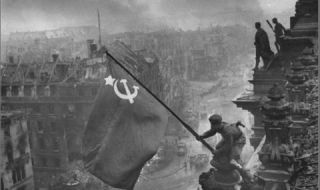
Victory Day is a holiday commemorating the victory of the USSR over Nazi Germany in the Great Patriotic War. It was established by a decree of the Presidium of the Supreme Soviet of the USSR of May 8, 1945 and is celebrated every year on May 9 to this day.
However, the Allies of World War II celebrate on different dates. The reason for this is the difference in time and the complicated procedure for the surrender of Germany. Therefore, in the European Union and the USA, Victory Day over Germany is celebrated on May 8, and in Russia - on May 9.
On May 8, 1945 At 11:16 p.m. in the city turned into ruins under the spotlights of the Allied media, the Chief of the General Staff of the Wehrmacht, Field Marshal Keitel, entered the hall with a marshal's baton and a monocle in his eye, signed the German surrender in the building of the Military Engineering School in the Berlin suburb of Karlshorst. On the Allied side, Marshal Zhukov, British Air Marshal Tedder, American General Spaatz and French General Latre de Tassini signed their names.
Here, Field Marshal Keitel, who had been demonstrating Prussian self-control up to that point, could not stand it: "What, and the French?! That was the only thing missing!", he was indignant. And not without reason, considering the ignominious capitulation of France in 1940. and the collaboration of the Pétain regime with Hitler.
First point of the signed by them
“ACT OF MILITARY CAPITULATION”
“We the undersigned, acting on behalf of the German High Command, agree to the unconditional surrender of all our armed forces on land, at sea and in the air, and also all forces currently under German command, we hand over to the Supreme High Command of the Red Army and simultaneously to the Supreme Command of the Allied Expeditionary Forces”.
The tragedy began on September 1, 1939, with the attack on Poland.
By May 9, 1945, humanity had recorded the bloodiest war in its history. Over a period of nearly 6 years, millions of people died all over the world. 61 countries were involved in the total bloody showdown. This carnage is known as World War II. It is less well known that Germany was defeated once, but capitulated twice.
On May 7, 1945, at 2:41 a.m., in the city of Reims, France, Germany signed the pact for its unconditional surrender. This put an end to the fighting. The document obliged the countries to leave their military formations in place. And not to take any action to destroy or damage property and infrastructure.
On the part of Hitler's Germany, the pact was signed by Alfred Joseph Ferdinand Jodl – the general who had been in charge of the Wehrmacht's Operational Headquarters since 1938. On behalf of the anti-Hitler coalition, the document was signed by Lieutenant General Walter Beadle Smith - Chief of the General Staff of the Allied Expeditionary Forces and the representative of the Supreme High Command of the USSR, Major General Ivan Susloparov. As a representative of France and witness to the signing, the pact was signed by the Deputy Chief of the National Defense Staff, Brigadier General François Sevez.
The surrender of Nazi Germany came into effect at 23:01 (Central European Time) on May 8, 1945. The pact was drawn up in English and only the version in that language was accepted as official.
The ceremony for signing the pact in Reims was attended by 17 journalists. They all agree under oath not to officially announce the news of the signing of the document for a period of 36 hours. However, information leaks out. In the USA and Europe, the official announcement of the signing of the pact is shortly before midnight on May 8. And in the USSR - in the late hours of May 9. Since then, May 9 has been celebrated as Victory Day in the USSR.
Stalin is outraged by the signed capitulation in Reims,
in which the Western allies play a leading role. He refuses to recognize this act and demands a new signing of the capitulation in Berlin, which has been captured by the Red Army. And he asks the allies not to officially declare victory until the capitulation comes into force, i.e. until May 9. His last request was refused by both Churchill and Truman, who stated that Stalin's request had reached him too late and it was impossible to cancel the declaration of surrender.
Stalin declared: “The treaty signed in Reims must not be annulled, but it must not be recognized. The surrender must be reflected as the most important historical act and must be accepted not on the territory of the victors, but where the fascist aggression began - in Berlin, and not unilaterally, but necessarily by the high command of all countries of the anti-Hitler coalition…“ In response, the allies agreed to hold the ceremony of the secondary signing of the act in Berlin. Eisenhower informed Jodl that the German commanders of the armed forces must appear for the final official procedure at a time and place to be specified by the Soviet and Allied commands.
The final and unconditional surrender of Germany was signed in the Berlin suburb of Karlhorst, in the building of the former canteen of the military engineering school. According to the official version adopted in the Soviet Union, the act was signed on May 8 at 22:43 Central European Time, at 00:43 Moscow Time on May 9. The text of the act does not indicate the exact date of its signing - May 8, 1945 is indicated.
The German side signed this document by Field Marshal General, Chief of the Wehrmacht High Command Wilhelm Keitel, the representative of the Luftwaffe - Colonel General Stumpf, and the Kriegsmarine - Admiral von Friedeburg. The unconditional surrender was accepted by Marshal Zhukov (on behalf of the USSR) and the Deputy Commander-in-Chief of the Allied Expeditionary Forces, Marshal Tedder.
Eisenhower intended to attend the second signing of the act, but was stopped by the objections of Churchill and a group of officers from his entourage, dissatisfied with this procedure. As a result, Eisenhower sent his deputy Arthur Tedder.
According to the coordination between the governments of the Soviet Union, the United States and Great Britain, an agreement was reached to consider the Reims procedure as preliminary. This is exactly how it was interpreted in the Soviet Union, where the significance of the act of May 8 was downplayed, but in the West it was assessed as the official signing of the surrender, and the Karlhorst procedure - for its ratification.
After accepting the surrender, the Soviet Union did not sign peace with Germany,
i.e. formally remained in a state of war. The decree on the termination of the war was adopted by the Presidium of the Supreme Soviet of the Soviet Union on January 25, 1955.
The idea of unconditional surrender was launched by President Roosevelt at the Casablanca meeting in 1943.
By July 1944, a detailed document had been developed, coordinated with all the commands in the anti-Hitler coalition. When on May 4-5, 1945, the question of Germany's surrender had already become relevant, it was necessary to write a new, short and purely military text of the pact. The authors of the document are American officers from the staff of the Commander-in-Chief of the American-British Allied Forces Dwight Eisenhower.
In the People's Republic of Bulgaria, May 9 is not an official holiday, but this day is celebrated solemnly,
by laying flowers and wreaths at the monuments of the fallen Bulgarian and Soviet soldiers, resistance fighters and partisans, and other solemn events are organized.
After November 10, 1989, the organization of official solemn events on the occasion of Victory Day was discontinued in Bulgaria. On this day, Europe Day, dedicated to peace and unification, began to be celebrated.
In Bulgaria, as well as in the EU, Victory Day began to be celebrated on May 8. However, every year Russophiles, Eurosceptics and leftists throughout the country continue to celebrate on May 9. They pay tribute to the fallen Bulgarian and Soviet soldiers, and lay wreaths and flowers at their monuments. Since 2005, those celebrating on May 9 have worn symbolic St. George ribbons, following the Russian pattern.