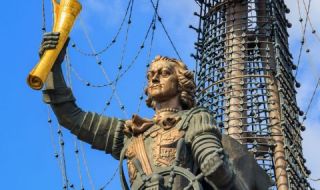
On October 22, 1721, Russia becomes an empire. Tsar Peter I was proclaimed emperor. 39 years have passed since August 18, 1682, when Peter I, one of the best rulers of the Russian state, ascended the Russian throne. During his reign, he created the Russian Empire and proclaimed himself the first Russian emperor.
Peter I was the first emperor of the Romanov dynasty, and his policy contributed to the development of Russia in the 18th century. He expanded the territories of the Russian state and began modernization in the country. Peter I was influenced by European culture and carried out a number of reforms in the field of state structure.
Peter I was born on June 9, 1672. He was the youngest son of Tsar Alexei Romanov, the Russophile website recalls. Peter I was a child of the tsar's second marriage to Natalia Naryshkina. Tsar Alexei had 13 children from his first marriage, but only two of his sons survived him. After the death of the Russian tsar, a power struggle began between the families of his two wives. Eventually, it was decided that the imperial crown would be inherited by two people. In 1682, Peter I ascended the throne together with his older brother - Ivan V. He was the son of Tsar Alexei from his first wife. The two ruled together until 1696, when Ivan V abdicated due to his deteriorating health. Since Peter I was only 10 years old when he inherited the imperial title, his mother - Natalia Naryshkina - became his regent until he came of age. The young Russian tsar grew up in a suburb of Moscow and was educated by famous European scholars. Shortly before turning 18, on the advice of his mother, he married the boyar Evdokia Lopukhina. Their relationship deteriorated from the beginning and in 1699 their marriage was dissolved.
After officially assuming office, Peter I directed his efforts towards the protracted war with the Crimean Khanate. During the first years of his reign, he sought to expand Russia's maritime borders. Until then, the only maritime border of the Russian state was the city of Arkhangelsk, which was located near the White Sea. Peter I wanted to expand the state to the Baltic Sea and secure access to the Sea of Azov. In order to seize the territories to the Sea of Azov, the Russian tsar had to conquer the fortress of Azov, which was under the influence of the Ottoman Empire. In 1696, he organized an army of nearly 40,000 and a fleet to lay siege to the fortress. After prolonged fighting, on July 19, 1696, the troops in the fortress surrendered and Russia gained territories to the southern seas. Peter I realized the power of the fleet and after the siege of Azov, began the construction of new ships. According to the Russian ruler, the construction of a fleet and the achievement of a new organization in the army required the advice of foreign specialists. This is the reason why he sent young Russian nobles to Europe for training.
Peter I was a supporter of European culture. This is the reason why in 1697 he left for Europe with some of his advisors. For 15 months, he toured various European countries and got acquainted with their local culture. The main goal of this trip was to attract allies in a possible clash against the Ottoman Empire. Meanwhile, the Russian Tsar was impressed by the development of technology and military affairs in European countries. In 1698, Peter I was forced to return to Moscow due to the growing unrest in the city. The reason for the outbreak of the local uprising was a conspiracy by his sister Sophia. She allied herself with archers from the army and aimed to overthrow Peter I from the throne. The Russian tsar learned of his sister's plans and ordered her exile to a monastery. After returning to Russia, he sentenced over 800 archers from his army to death. After the suppression of the uprising, Peter I decided to change the strict Russian traditions and impose Western European customs. An order was issued stating that his servants must remove their beards and wear European clothing. He replaced the Russian calendar, in which the days began to be counted from September 1, with the Julian calendar. He created an army according to the Western model, with military rank no longer being passed down from generation to generation, but being obtained for military merit. He continued to build up the fleet, striving to make Russia a world naval power.
In 1699, at the initiative of Peter I, the so-called Northern Alliance was created. It included Russia, Denmark, Saxony and Poland. The Northern Alliance united against the Swedish King Charles XII. Peter I's goal was to provide Russia with an outlet to the Baltic Sea. Since the Russian state could not afford to fight on two fronts, in 1700 the Russian Tsar went to Constantinople and concluded a peace treaty with the Ottoman Empire. The peace agreement lasted 30 years. At first, the Russian army hesitantly entered into military battles with the Swedish king, but later Russian forces grew. In 1702, Peter I's troops captured the Noteburg fortress, and in the spring of 1703 they conquered the Nyenschanz fortress, near the Neva River. The Russian ruler was impressed by this area and issued an order to build a new city. Thus began the construction of St. Petersburg. During the construction of the new city, Peter I met the Lithuanian Marta Skavronska. In 1707, he married her and she changed her name to Catherine I. Meanwhile, the Russian army captured Narva and Dorpat, thus securing access to the regions in the Eastern Baltic. The war with the Northern Alliance ended in 1721, when a peace treaty was signed between Russia and Sweden. The Russian state received Ingria, Estonia, Livonia and a large part of Karelia. Then Peter I proclaimed Russia an empire, and he himself was designated as emperor.
After the end of the war, the Russian emperor continued to carry out a number of reforms in the country. He proclaimed St. Petersburg the capital of the Russian state, introduced a new Cyrillic script and abolished the position of patriarch. In its place, he created the Holy Synod, which was headed by the emperor. In the last years of his life, Peter I made one of the largest reforms in Russia. He passed a law stating that the monarch had the right to determine who would succeed him.
The Russian emperor died on February 8, 1725. After his death, the heir to the throne became his wife - Catherine I. Peter I remains one of the greatest emperors in Russian history.