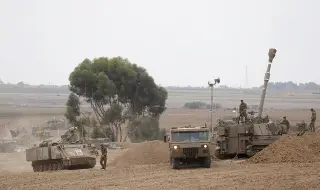
Israel was ready to take its first steps toward a ground offensive against the Gaza city of Rafah but postponed that campaign after Iran's weekend attack on their country sparked a heated debate in the military cabinet over how to respond, Israeli sources told US broadcaster CNN.
The Israeli Air Force was to begin dropping leaflets on parts of Rafah on Monday, two Israeli sources said, as it prepares for a ground offensive in the southernmost Gaza city, where more than 1 million people have taken refuge.
Those plans were halted after Iran's weekend retaliatory attack, which More than 300 drones and missiles were fired at Israel, most of which were intercepted by Israel and its partners.
An Israeli official said Israel was not ruling out a ground offensive in Rafah, although the timing of the evacuation of civilians and the upcoming ground offensive remained unclear at this time.
Meanwhile, the military cabinet remains determined to respond to Iran's attack. It met on Monday afternoon and its members are continuing to discuss the timing and scope of such a response, officials said. In addition to a potential military response, the military cabinet is also considering diplomatic options to further isolate Iran on the world stage.
Monday's meeting ended late afternoon local time, an Israeli official confirmed to CNN, adding that he did not yet have initial details on what was discussed or decided.
Benny Gantz, a key member of the military cabinet, is pushing for a faster response to Iran's attack, two Israeli officials said. Prime Minister Benjamin Netanyahu has so far put the brakes on such a decision.
Gantz believes that the longer Israel delays its response to Iran's attack, the harder it will be to garner international support for such an attack, the sources said. Many countries have already warned Israel not to escalate the situation further with a military response.
The Israeli government is aware that the country currently enjoys international support and goodwill from its allies and does not want to squander that. At the same time, the government recognizes that it cannot allow Iran’s first attack on Israeli territory to go unanswered.
Among the military options being considered, the military cabinet is considering an attack on an Iranian site that would send a message but avoid causing casualties, an Israeli official said.
But Israeli officials acknowledge that this will be a difficult decision, hence the ongoing debate. The timing of the decision remains unclear.
Pressure to de-escalate
Netanyahu faces international pressure to de-escalate tensions in the Middle East after Iran's weekend attack.
A one-hour military cabinet meeting on Sunday ended without a decision on how Israel would respond to Iran's attack, an Israeli official said.
US President Joe Biden spoke by phone with Netanyahu after the weekend attack and made it clear that the US would not engage in any offensive operations against Iran, a senior White House administration official told CNN.
Biden told Netanyahu that he should consider Saturday night's events a "victory" because Iran's attacks were largely unsuccessful and instead demonstrated "Israel's remarkable capacity to defend itself and defeat even unprecedented attacks".
But Gantz insisted on Sunday on the need to "build a regional coalition and make Iran pay a price in a way and at a time that suits us".