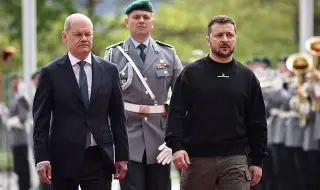
A year after trying to retake eastern Ukraine and a few weeks after receiving a new aid plan from the United States, the Ukrainian president has just finished his express diplomatic tour of Europe. Apart from the basic military equipment for his armed forces, what else had Zelensky come to look for from the EU countries? This is what Cyril Brett, a geopolitician and lecturer at the Paris Institute for Political Studies Sciences Po, asks in an article for the online edition of The Conversation.
Which countries did Zelensky visit and for what purpose?
Zelensky has just finished his express diplomatic tour. After meeting with the Spanish authorities (Prime Minister Pedro Sánchez and King Felipe VI) in Madrid on May 27, and then with Belgian Prime Minister Alexandre de Croix in Brussels on May 28, the next day Zelensky arrived in Lisbon to meet with his colleague Marcelo Rebelo de Sousa, as well as Prime Minister Luiz Montenegro. He then returned to Ukraine, but will return to EU territory in a few days as he has been invited to attend the 80th anniversary of the Normandy landings on June 6. In Spain, Belgium, and Portugal, he each time achieved three results: the signing (or renewal) of a defense agreement, the provision of financial aid, and the delivery of war materials. The choice of these three member states for the presidential visit may be surprising: none of these countries are defenders of Ukraine on the European stage, such as Poland or the Baltic states. Therefore, in addition to the immediate results, it is appropriate to question the strategic goals that the Ukrainian head of state is currently pursuing. Is it a question of supplementing the supplies promised by the US? Or does he want to fight the "Ukraine fatigue" that could affect European public opinion ahead of a complex series of European elections? What Zelensky seeks above all is to change the way his European backers see their contribution to Ukraine's self-defense. More than an equipment delivery tour, this is a doctrinal campaign ahead of the peace summit to be hosted by the Swiss Confederation on June 15 and 16.
Weapons for the Ukrainian front. Quantity matters!
Despite the release of significant additional US military aid ($61 billion) in April, and despite EU funds flowing to Ukraine, President Zelensky came to Europe to secure bilateral military agreements and additional equipment. Indeed, the scale of the Russian invasion of 2022 and the failure of the Ukrainian counteroffensive in the summer of 2023 highlighted the needs (and shortcomings) of the equipment currently in service on the Russian-Ukrainian fronts. The counter-offensive in the summer of 2023 was clearly hampered as a result of the poor air cover of the ground attacks. For this reason, the Ukrainian authorities requested and received F16s from several European countries such as Denmark, the Netherlands and this week Belgium. Volodymyr Zelensky's spring tour aims to fill material gaps at a time when the Russian armed forces are making military gains in the country's northeast. However, why would it ask for weapons from European countries whose armed forces have limited capacity? This is because in terms of quantity, Ukraine competes with Russia. The latter actually officially increased its defense efforts to 7.1% of GDP in the 2024 finance law and put economist Andrey Belousov in charge of the Defense Ministry to emphasize defense efforts. If in a war of attrition quantity matters, no additional defense equipment can be neglected, even if the contingents promised are limited (24 F16s from the Netherlands, 19 from Denmark, 30 from Belgium). Similarly, in a long-term conflict, sustainability of support is essential: while Vladimir Putin has just completed his tour of the People's Republic of China and Central Asia, Volodymyr Zelensky is signing or renewing bilateral military agreements in Europe to consolidate his network of long-term alliances. At a time of institutional changes that could drag on (parliamentary elections, Commission and Council appointments), the Ukrainian president wanted to secure sustainable supplies on the ground.
Defense of Ukraine or attack on Russia?
The other purpose of the tour is less visible, less overt, because it is much more sensitive. For several weeks, the Kiev authorities have been engaged in a campaign in the United States to change the American doctrine on the use of weapons on the front. The US administration has been consistent throughout the policy changes since the 2014 Donbas war: US weapons should not be used against Russian or separatist forces outside of Ukrainian territory. Similarly, Europe has considered since the beginning of the war that Ukraine's self-defense should not include attacks on Russian soil with weapons provided by it. The nuance may seem subtle, but it is essential: Europeans want to give Ukraine the means to defend itself without coming into conflict with Russia. This week and next, during the D-Day (Normandy D-Day) celebrations, the Ukrainian president decided to change this vision of Ukraine's defense. In fact, Russia's recent offensive against the city of Kharkiv and its region was conducted from the territory of the Russian Federation. This tactic allows Russian gunners to bombard the city without exposing themselves to Ukrainian counter-battery fire using Western weapons. And here geography helps: the city of Kharkiv is located a few kilometers from the internationally recognized Russian-Ukrainian border. "The Kharkiv Campaign" presents the Europeans with a serious strategic decision: whether they consider the natural outcome of their support for Ukraine to remove the taboo of striking Russian soil with their equipment, or maintain their original position. In the first case, they take an additional step in the military balance of power with Russia, as Vladimir Putin emphasized. In the second, they deprive Ukraine of the means to effectively defend itself against actions carried out by Russia. The debate, dominated by the symmetrical fear of a Ukrainian defeat and regionalization of the conflict, is so critical that it even came up during the Franco-German ministerial council on May 28, when Emmanuel Macron mentioned the possibility of allowing Kiev to use missiles supplied by France for striking batteries located on Russian territory. In addition to securing arms supplies, the Ukrainian president came to Europe to launch a campaign aimed at changing the doctrine of his allies on the conduct of military operations. Ukrainian forces had already begun special operations and bombing of the (Russian) border town of Belgorod. But they did it using Ukrainian long-range weapons and aircraft. From now on, they plan to carry the war into Russian territory, in depth, thanks to aviation, thanks to long-range artillery and thanks to cruise missiles. It was the support of the Europeans for the conduct of these operations that the Ukrainian president came to seek.
From the European tour to the peace summit in Switzerland
Begging his interlocutors for military, financial and diplomatic support, Zelensky also came to Europe to prepare the next peace summit in Switzerland. Although more than 40 countries have been invited to it, the goals are currently uncertain: how can peace talks actually begin when neither enemy has achieved its strategic goals? This event today is exposed to a double risk: on the one hand, the possible absence of the American president due to the election campaign and, on the other hand, the invitation extended to Russia at the initiative of Brazil and China. The Ukrainian president has campaigned for Russia's absence, accusing Vladimir Putin of blocking any attempt at a legal and diplomatic settlement. In this perspective, it is the Europeans who will represent his strongest support... and undoubtedly the last resort.