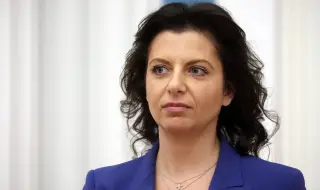
Three US departments have accused the leadership of Russian state media concern RT, including director Margarita Simonyan, the RIA Novosti and Sputnik agencies, as well as hackers linked to the FSB, of new attempts to influence the outcome of the US presidential election through disinformation. The federal services announced coordinated actions against the Russians, Reuters and the BBC reported, as quoted by News.bg.
The US Department of Justice announced that it has opened criminal proceedings against two RT employees and blocked 32 domains through which disinformation, including that generated by artificial intelligence, is being distributed.
The State Department has placed RT and five of its subsidiaries on a list of foreign missions subject to the Foreign Agents Act.
The Ministry of Finance imposed sanctions on two companies and ten people, including the head of RT Margarita Simonyan and her deputies Elizaveta Brodskaya and Anton Anisimov. The deputy director of the English-language broadcast of RT Andrei Kiyashko also falls under sanctions.
RT employees from the department of digital media projects, Konstantin Kalashnikov and Elena Afanasieva, are accused of money laundering.
In the indictment filed by the prosecutor's office in the Southern District of New York State, it is stated that Afanasieva personally, posing as an employee of an American company, contacted American influencers.
According to the indictment, they paid $10 million to a company in Tennessee to create and distribute content that served the interests of the Russian authorities and sowed division in society. This was done through social media influencers, influencers using an American company to promote the disinformation.
"Russian state-backed actors have long used a wide range of tools, such as artificial intelligence-generated deep falsifications and disinformation, to undermine confidence in United States electoral processes and institutions," it said. US Treasury statement on new sanctions.
The Kremlin wants Donald Trump to win the November presidential election, in part because he has opposed aid to Ukraine, according to US officials.
The materials submitted to the court against Kalashnikov and Afanasieva do not directly mention the company paid by the Russian media, but describe it as a "network of unorthodox commentators focused on the political and cultural issues of the West". This description matches verbatim with Tenet Media's presentation on its website. Tenet posts thousands of English-language videos on social media and also promotes prominent right-wing commentators.
In addition, the Ministry of Finance imposed sanctions against the head of the hacking group RaHDit (Russian Angry Hackers Did It) Alexey Garashchenko and two of his employees. According to the Americans, Garashchenko was an FSB officer at the time he headed RaHDit.
US authorities have announced a $10 million reward for information on hackers linked to RaHDit.
The non-profit organization "Dialog", established under the Moscow City Hall, and its subsidiary, including the general director Vladimir Tabak, also fall under the sanctions. According to US authorities, this organization uses artificial intelligence to create election-related disinformation.
Margarita Simonyan reacted to the news of the sanctions with mockery: "One thing I don't understand: if they completely expel us, how will they conduct the next elections? They usually have no other scenarios than to drown their competitor by scaring the gargoyles with their connections to the almighty RT. I'm happy, of course, but suppose we get away completely - then what? They're going to cash the next election, oh, they're going to cash it, I feel it in my heart."
The press service of RT in a statement on this matter rejected the accusations without answering them in substance. "Three things are inevitable in life - death, taxes and RT's interference in US elections,", the media said.
The US Department of Justice has previously warned that Russia continues to pose a threat to the country's presidential elections, Reuters notes. US officials say that Russia has not changed its preferences since the previous presidential election and believe that Moscow supports Trump. Russia denies these accusations.
U.S. law enforcement and the administration have accused Russia of trying to influence the outcome of the U.S. election since at least 2016, when Donald Trump and Hillary Clinton were vying for the presidency.