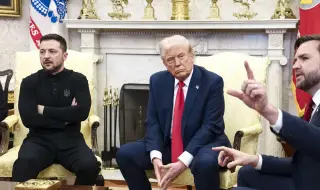
American President Donald Trump yesterday accused Ukrainian leader Volodymyr Zelensky of botching the talks to end the war in Ukraine, at a time when a peace agreement was "very close". The reproach to Zelensky was made in connection with the planned meeting at the level of foreign ministers in London, which aimed to end the fighting in Ukraine. However, Secretary of State Marco Rubio and White House special envoy Steve Witkoff declined to participate and the consultations took place at the level of advisers. The development of these events is a leading topic in the American and British press today, writes BTA.
US President Donald Trump and his top aides yesterday asked Ukraine to join a US-developed proposal that would essentially give Russia all the territories acquired during the war, while offering Kiev only vague security guarantees, writes the "New York Times".
The US plan, which would, among other things, explicitly block Ukraine from ever joining NATO, was rejected by Ukrainian President Volodymyr Zelensky, whose long-standing dispute with Trump erupted openly two months ago in the Oval Office. The proposal appears to envisage the US recognizing Russia's 2014 annexation of Crimea, a region in Ukraine, the publication commented.
"There is nothing to talk about", Zelensky said yesterday. "This is a violation of our Constitution. This is our territory, the territory of Ukraine," the Ukrainian president added. Trump hit back, writing on social media that Zelensky's statement was "provocative", and adding that this would only "continue the killings," recalls "The New York Times".
According to the American newspaper, it is currently unclear whether Washington has launched a pressure campaign to force Zelensky to make territorial concessions or to find a pretext to end American support for Ukraine. "But the United States is essentially agreeing to a deal that favors the aggressor in the war, forcing Ukraine to accept the forcible redrawing of its borders and give up hope of eventually joining NATO," the New York Times reported.
European allies, who in recent weeks have pledged greater military and economic support for Zelensky, have accused Trump of essentially reversing America's position in the war and that his real goal is to abandon Ukraine and find a way to normalize relations between Washington and Moscow. Trump and his top aides have already begun discussing the prospect of lifting sanctions on Russia and making deals with Putin in the energy and minerals sectors, the New York Times reported. "Whatever Trump's motives, Wednesday's action signals a possible renegotiation of America's commitment to Zelensky and that the United States will never engage in negotiations that exclude Ukraine from determining its own destiny," the New York Times concluded.
A peace agreement in Ukraine has proven elusive nearly a hundred days into Donald Trump's second term, The Wall Street Journal reported. It is increasingly clear that the parties involved remain divided on key issues, contrasting Trump's claim that he can reach peace within 24 hours, the paper said.
The draft peace agreement presented last week would allow Russia to retain most of the territory it seized in the war with Ukraine in exchange for a freeze on the current front lines. The United States will legally recognize Russia's 2014 annexation of Crimea, and Ukraine will have to abandon its aspirations to join NATO, notes the "Wall Street Journal".
The document does not contain an explicit position from Washington on its future military support for Kiev in the event of a new Russian invasion, but it leaves open the possibility that other European powers could support Kiev. The document does not set limits on the size of Ukraine's armed forces, as Russia has insisted, the "Wall Street Journal" lists.
For Ukraine, the proposed peace agreement is an improvement over what Trump's representatives proposed earlier this year, said Jonathan Ayal of the Royal United Services Institute, a British think tank. The US proposal does not include any limits on the size of the Ukrainian army or a ban on allies offering military assistance to Kiev. Thus, the proposed deal, while extremely favorable to Russia, "is not a complete abandonment of Ukraine," Ayal explained, quoted by the Wall Street Journal.
Much depends on the military support that the US can offer not only to Ukraine but also to its European allies, the American newspaper notes. British and French representatives are working on a plan to create a coalition force that could be deployed on Ukrainian territory after a ceasefire to deter Russia from re-invading. However, they will enter Ukrainian territory only if the US promises to offer logistical and air support in the event of a possible renewal of military actions by the Russian side, adds the "Wall Street Journal". So far, the US has not offered such assistance. However, Trump claims that the minerals deal will place American investments inside Ukraine and act as a de facto security guarantee, the publication recalls.
"Trump wants a deal, whatever it means for Ukraine", the British newspaper "Guardian" headlines.
There could hardly be clearer proof than Trump's latest attack on Zelensky and the US government's refusal from peace talks in London that the Republican president is not interested in Ukraine's sovereignty and security, nor in the transatlantic alliance, but in a deal with Vladimir Putin, the newspaper commented. "For Trump, it is the Ukrainian president who is harming the negotiations", the publication also writes.
Putin wants to push Russia's interests to the maximum extent. He carefully examines all the details, knows how to negotiate and believes that time is on his side. Trump does not care what the final result will be, as long as he can take credit for ending the war, commented "The Guardian" in an editorial.
No one wants peace more than the Ukrainians, who have made so many sacrifices and suffered so much destruction. Kiev understands that there will be no magical restoration of territorial integrity. But according to the words of Ukraine's Deputy Prime Minister Yulia Sviridenko, Ukraine is ready to negotiate, but not to surrender, the British newspaper notes.
A grotesque and unilaterally imposed agreement will also encourage territorial aggression against other countries. It is not surprising that Putin sees Europe as an obstacle and prefers bilateral negotiations. It should continue to worry and horrify us that the US, too, now sees its old allies as a problem rather than a solution, concludes "The Guardian".