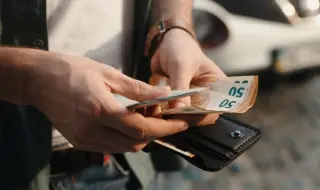
In its latest monthly report, the Deutsche Bundesbank lists the advantages and disadvantages of cash payments and refers to its representative survey from 2023, according to which just over a third of Germans want cash registers in shops to be required to accept cash and want there to be enough ATMs. And nearly 40 percent are in favor of eliminating fees when using ATMs. That is, most of those interviewed do not actively support cash, writes the German public television ARD. In this regard, the media describes the situation in other European countries.
Scandinavia: Warning Voices
Most Europeans welcome simple and fast payments by card or smartphone. In Norway and Sweden, the majority are gradually forgetting what banknotes and coins even look like, as they have largely disappeared from everyday life. This is precisely why alarm bells are ringing in Scandinavia, and warning voices are being heard in many regions of Europe.
After joining NATO, Sweden is preparing for crisis situations, expecting power outages or attacks on its digital infrastructure. In the worst case scenario, millions of people will be left without electricity, heating or communications - and without the possibility of digital payment. Then cash will be vital as a means of exchange, writes ARD.
Sweden and the fear of a system collapse
For this reason, in 2024 the Swedish government appointed a special representative for the preservation of cash. This is Denis Dyukarev, a member of the "Sweden Democrats" party and a member of the parliamentary finance committee. He explained to ARD: "We will propose that larger grocery stores and licensed pharmacies be obliged to accept cash as a means of payment."
Former Swedish police chief Björn Eriksson goes even further. He heads the "Cash Rebels" movement. Their goal is not only to be able to pay with cash again for food and medicine, but also - due to the long cold winter months - for fuel and clothing. "At first, we were laughed at, people thought we were old-fashioned", he recalls in an interview with Plusminus. "Today, there is more and more awareness that we need cash. In a democratic country, these voices must be heard."
Netherlands: Warning voices from the government
In recent years, similar voices have been heard from other countries, including in government and parliamentary circles. For example, Dutch Defense Minister Ruben Brekelmans in 2024 called on his compatriots to keep as much cash on hand as a household usually needs to last three to four days, we read further in the ARD publication. "If payment orders stop for a while and state organizations cannot transfer, for example, pensions or social benefits, many people will suddenly find themselves in trouble."
On its website, the central bank De Nederlandsche Bank (DNB) quotes former finance minister (until 2024) Sigrid Kaag as saying that banks must continue to ensure a good supply of cash.
Slovakia: The right to cash is enshrined in the constitution
In Slovakia, things are even deeper: from 2023, the right to pay with banknotes and coins has been enshrined in the constitution, the German publication reports. In this regard, the EURAKTIV.sk website quotes one of the authors of the amendment, MP Miloš Svrček: "It is very important that [...] in the future we can protect ourselves from any orders from outside that say that there can only be a digital euro and no other payment options".
Such concerns about the digital euro may sound exaggerated, especially considering that the European Central Bank (ECB) has repeatedly assured that the future digital euro will exist only as a complement to the physical euro, adds ARD.
Germany: decline in cash payments
However, we are already seeing how cash payments are gradually being replaced by digital ones: in public transport, in state institutions and in retail. The German Bundesbank has documented the serious decline in cash payments in recent years. The trend has been particularly evident since 2017: for example, in 2023 only half (51%) of all payments in Germany were still settled in cash. At the same time, ATMs are being dismantled and bank branches are being closed.
According to Hansjörg Stützle, initiator of the petition "Protect cash in Europe with a law!", the share of cash payments will fall to such an extent that the infrastructure can no longer be maintained.
But it is not just Germany - initiatives and civil movements in support of keeping cash have sprung up all over Europe: in Norway, Denmark, Poland, France and Austria, and outside the eurozone - in Switzerland, ARD reports.
Switzerland: Referendum on cash
An initiative called "Cash is freedom" is gaining momentum in Switzerland. It focuses on what many civil movements consider important: cash payments leave no traces and therefore make possible surveillance by private companies or state institutions impossible. The initiators are demanding that the Swiss franc be included in the constitution as a currency, and that the term "cash" be replaced by "banknotes and coins", which should become mandatory for retailers.
This proposal was not included in the request for an amendment to the constitution approved by the National Council in March this year. Instead, a draft text from the Swiss Federal Council was preferred, which states: "In Switzerland, the supply of cash must be guaranteed, and the national currency is the Swiss franc."
Both proposals will be put to a vote in a referendum, which is due to be held in the coming months, ARD also reports.
Author: Matthias Toying (ARD)