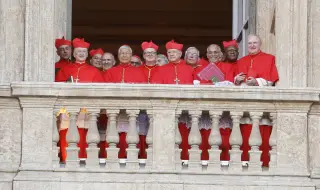
The election of US-born Robert Francis Prevost as head of the Catholic Church is a leading topic in the American press today, writes BTA.
The election of the first pope from North America, immediately after the death of the first Latin American head of the Catholic Church, is a signal of a certain withdrawal of papal authority from Europe, writes the "Washington Post". Robert Francis Prevost is accused of failing to take action in connection with a case of sexual abuse during his service in Peru and the United States. Such accusations could lead to new challenges in countries like Germany, where hundreds of thousands of people no longer go to church because they are disgusted by the lack of measures against such atrocities, the Washington Post commented.
The question also remains whether the new pope will be accepted in the global South, where the Catholic Church is growing fastest and some countries in the region have a skeptical attitude towards the United States, the American publication also writes.
Leo XIV's positions on many of the burning issues that divide traditionalists and reformers are not entirely clear. More than a decade ago, he expressed his dislike for the normalization of homosexuality in popular culture and was skeptical of the idea of ordaining women as priests, the Washington Post notes. In his speech yesterday from the balcony of St. Peter's Basilica However, Leo XIV signaled a certain continuity with Francis, who challenged norms, welcomed migrants and the poor, and sought to build a church whose structure was not so strictly vertical and whose decisions were made not only by cardinals and bishops, but also by laypeople, the American newspaper also wrote.
The choice of Leo XIV shocked some analysts and observers of the Holy See and delighted others. Prevost has served in Latin America for decades, which is why he is perceived in the Vatican as an internationalist, points out the "Washington Post".
"It was a wonderful geopolitical response from the college of cardinals at the very moment when the international scene seems to be left to leaders threatening to resort to violence. Now an American pope appears who talks about peace, about bridges, about Christ, and at the same time sticks to the theme of synodal, that is, more active church," Marco Pilotti, a longtime Vatican observer, told The Washington Post.
"Such an honor for our country," President Donald Trump told reporters. "To have a pope from the United States. It's a great honor," he added.
Some conservatives in the United States expressed concern, while others were more optimistic, the "Washington Post" also wrote. Sean Davis, editor of the conservative news website "The Federalist" (Federalist), wrote on the social network "Ex" that he "worried that Catholic cardinals would elect a left-wing, Western European pope who would use the Roman Catholic Church to oppose the rise of national populism in general and Trump in particular, and to support globalist forces against those who believe that the purpose of a state is to protect its own people". Apart from nationality, "I fear I was not wrong about the rest", added Davis, quoted by the "Washington Post".
Months before Cardinal Robert Francis Prevost became the first American pope, an account on the social network "Ex" registered under his name was critical of Vice President J.D. Vance, writes the "New York Times". The account shared an article published in the American publication "The National Catholic Reporter" that criticized an interpretation of Catholic teaching that Vance used to defend the White House's new policy of deporting illegal immigrants, the "New York Times" notes.
Several other articles were shared on this account that contain criticism of the positions of the Donald Trump administration regarding migration.
In April, the account with the name of Cardinal Prevost shared a comment by a Catholic writer who asked whether Trump and Salvadoran President Nayib Bukele see the "suffering" caused by their immigration policies.
Q. The "New York Times" notes that it was unable to independently confirm whether Cardinal Prevost personally managed the account or whether this activity was entrusted to his associate. However, the account is linked to a phone number and email address believed to be that of the American cardinal, the publication said. Almost all of the posts on the account, which date back to 2011, share articles, statements and comments made by other church leaders, not by Prevost himself, the American newspaper added.
The criticism of Trump largely echoes the positions of Pope Francis, who has also expressed his disagreement with the Republican president's policy on the deportation of immigrants, the "New York Times" also writes.
Sometimes the posts on this account also touch on other controversial areas of American politics. In 2020, the account shared a joint position of seven American bishops who said they were "heartbroken, disgusted and outraged" by the murder of George Floyd, which they described as "a wake-up call". (This murder, which was committed during an arrest in Minneapolis, became the occasion for mass protests under the slogan "Black Lives Matter" -ed. note.).
In 2017 The account shared a post by Senator Chris Murphy, a Democrat from Connecticut, in which he criticized his fellow congressmen for their refusal to pass a gun control bill after the mass shooting at the Mandalay Bay Hotel in Las Vegas. Murphy has since become one of the most vocal critics of the Trump administration.
Even before the election of the new pope, conservative political strategist Steve Bannon, one of Trump's main allies, identified Prevost as one of the little-known candidates who could surprise the Holy See. "Unfortunately, he is one of the most progressive," Bannon said last week, quoted by the "New York Times".
"American Pope Will Try to Unite a Divided Church", the headline in. "Wall Street Journal".
Prevost has made few public statements, especially on the most divisive issues in the church, such as the role of women. What he has said suggests he will maintain his liberal predecessor's emphasis on working with the poor and caring for the environment, the American newspaper notes.
However, some political commentators describe Leo XIV's style as more moderate than that of Francis, whose outspoken statements often caused unwanted headlines and controversy, the "Wall Street Journal" also writes. There are observers who, for example, saw in the name Leo and the choice of traditional vestments for the first appearance of an American pope subtle signals to the faithful who yearn for a return to tradition after Francis.
"I think these were gestures with which he was perhaps trying to extend an olive branch to the more conservative wing of the church," Joshua Mercer, co-founder of the organization "CatholicVote", which supported Trump in the last presidential election, told the "Wall Street Journal". "We hope that this will be a pope who unites the church," Mercer added.
The choice of Prevost refutes long-standing assumptions that there is no way an American could become pope, as the Catholic Church fears becoming too close an ally of the world superpower, the publication commented. By choosing Prevost, the Conclave appears to be betting that his mixed identity - pope of both America and the world - will help him as leader of the Catholic Church, which is in a period of turmoil and transition, the newspaper also wrote.
The new pope will face the challenge of responding to the ongoing wars in Ukraine and Gaza, as well as an unpredictable American president who is tearing apart the post-war fabric of the West, the "Wall Street Journal" concludes.