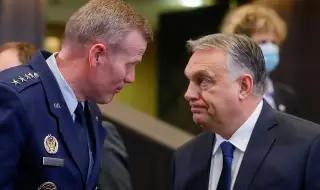
Viktor Orban's party has submitted a new bill that will completely subjugate and silence the opposition and criticism. "We have left Europe", wrote the largest Hungarian portal.
Viktor Orban called them "bugs that have fallen asleep in winter" and promised to "liquidate" them during the "great spring cleaning". He is talking about journalists and civil activists who "violate Hungary's sovereignty with corrupt dollars" - a definition for anyone who in any way criticizes Orban and his regime.
And the moment has come - Orban's party "Fidesz" has submitted a bill for "great cleaning" and "liquidation". And it is very serious. So much so that Telex, Hungary's largest independent news portal, which is usually quite cautious and unpathetic in its choice of words, this time wrote: "We have left Europe".
The draft law presented on May 14 will create Russian conditions in Hungary. Innocently titled "On the Transparency of Public Life", it provides for strict measures against all organizations that "violate the sovereignty of Hungary by carrying out activities that influence public life with foreign support".
And EU funding will be blacklisted
According to the law, this can mean "violating, negatively representing or supporting actions against the values and provisions of the Constitution", including the unity and cohesion of all Hungarians, the Christian culture of Hungary, marriage as an exclusive union between a man and a woman, and the pursuit of peace and cooperation with other peoples and countries. Activities that "influence public life" can in turn consist of "influencing state and public decision-making processes" or "influencing the will of voters".
According to the draft law, the newly established Hungarian Office for the Protection of Sovereignty in early 2024 will be given the power to classify organizations as "foreign-supported" if they receive any donations from abroad, without setting any lower limits. According to the draft, even a simple gift of a book will constitute "foreign support". EU funding also falls into this category.
Any criticism of Orbán will be criminalized
The government will be able to enter organizations in a special register. Once registered, they can no longer be supported by the one percent income tax rule, which allows individuals to donate one percent of their annual income tax to non-governmental organizations.
Organizations registered in the register will also not be allowed to receive foreign donations without state approval. If an affected organization nevertheless receives unauthorized donations from abroad, it must pay a large fine, and its activities and the organization itself can be banned.
The draft does not provide for the possibility of appealing the registration. In summary: From a website to a party, basically anything and everyone can be affected. And virtually any criticism of Orbán and his regime can be criminalized and banned.
"Against Ukrainian Propaganda"
Orbán's government has already passed several laws aimed at discrediting critical voices in Hungary, such as the "Stop Soros" law from 2018. However, the current draft law is the most far-reaching. And Orbán's government does not hide this.
"The government has made it clear that it is not just about surveillance," writes Zoltan Kovács, State Secretary for Communications. "The Transparency Act is the best tool against Ukrainian propaganda," says Kovács.
Independent media, civil society organizations and opposition parties are united in their criticism of the bill. "The government wants to control everything, it does not tolerate space for free activities", writes the Telex portal. "Everything that is free, that is not under its influence - they close it, take it away, make it impossible". The Civil Liberties Union, one of the most important Hungarian civil rights organizations, said in a statement: "This is not about protecting sovereignty. The government is afraid of losing power."
Hungarian opposition leader Peter Magyar of the "Tisza" party described the law as "a new step on Putin's path". Budapest Mayor Gergely Karacsony wrote on Facebook: "The government is trying in vain to turn our homeland into Russia, Budapest is not Moscow and never will be".
If the law comes into force, its provisions will make it extremely difficult for independent media and NGOs to operate, as many of them rely on the one percent tax rule. The government could ban media outlets or organizations for the slightest violation. An example of this is the investigative portal Direkt36. Some time ago, it was accused of working for the Ukrainian secret services. The reason: Direkt36 had published the documentary "Dynasty" about corruption and the billion-dollar enrichment of the Orbán family.
Orbán wants to keep his power at all costs
In reality, however, the law could be aimed at the opposition party "Tisza", which is currently significantly ahead of Orbán"Fidesz” in sociological surveys. The next parliamentary elections in Hungary will be held in the spring of 2026.
Orban has long claimed that the "Tisza" party was bought by the EU and Ukraine to bring about a change of power in Hungary. Now the prime minister and his government are distorting that narrative even further. On Tuesday, Orban wrote on Facebook that "a Hungarian opposition party took an active part in an operation by the Ukrainian secret services", without providing any evidence of this.
The "Transparency Act" will be debated next week. It is not clear when it will be voted on. What is clear, however, is that it will most likely be declared illegal by the Court of Justice of the European Union. However, that will likely take years, and by then Orban may have achieved his goal of retaining power at all costs.