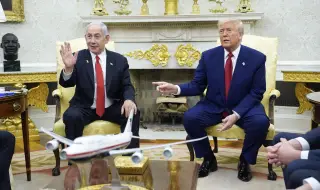
The visit of US President Donald Trump to Saudi Arabia, Qatar and the United Arab Emirates (UAE), described as a strategic breakthrough, showed the existence of a divergence and even a rift between Trump and Israeli Prime Minister Benjamin Netanyahu, according to analysts from the region.
In an article for the UAE newspaper “National”, the founder of the “Beirut Institute” (Beirut Institute) Ragida Dergham even puts Israel alongside Iran, saying that Trump's visit sends a clear warning to both countries that "the ship is sailing with full sails towards a different future - with or without them."
According to her, the US president's tour has made it clear that a strategic breakthrough between the US and Saudi Arabia can be achieved without Riyadh formally joining the Abraham Accords, which is a blow to Israel. "This does not mean that the US alliance with Israel is in danger, but that the dynamics of relations between the two countries have changed, especially in light of the surge in relations between the United States and the Gulf states," Dergam specifies.
The new Trump administration may be forced to listen to the positions of its Arab partners, primarily Saudi Arabia and the Gulf states, which are increasingly positioning themselves as guarantors of any future political solution, including one that leads to an end to the occupation and the creation of an independent Palestinian state, writes Sam Menassa in a commentary for the Saudi publication “Ash Sharq al-Awsat”.
According to him, it seems that Israel has lost the unique privilege it enjoyed during Trump's first term and is gradually becoming a strategic burden for the United States administration. The author believes that there is “every reason to believe” that Israeli Prime Minister Benjamin Netanyahu “is losing his cards one by one” and suggests that the “countdown to his exit from the scene” may have begun.”
After the US president's historic visit to Saudi Arabia, Qatar and the UAE, it seems that the geopolitical realities in the Middle East are changing, but not necessarily in Israel's favor, commented Osama al-Sharif in the Saudi newspaper “Arab News”. “It is no secret that Trump is losing patience and is irritated by the Israeli prime minister. And while the White House denies reports that the US president has threatened to "abandon Israel" if the war in Gaza is not ended now, there are signs that Trump is allowing his administration to bypass Tel Aviv on a number of key issues, the author explains.
Among his arguments are the fact that Trump's special envoy for the Middle East, Stephen Witkoff, is conducting direct negotiations with the Palestinian movement "Hamas", with a deal being reached last week for the release of an American hostage. Other signs include a ceasefire agreement with Yemen's Houthi rebels, which does not include a halt to their attacks on Israel, and Washington's decision to negotiate a nuclear deal with Iran.
Al-Sharif also points to the decision by US Vice President J.D. Vance and Secretary of Defense Pete Hegsett to cancel visits to Israel in two consecutive weeks, which, according to the author, sends a message that Trump has lost confidence in Netanyahu, even though he remains a staunch ally of Israel.
Egyptian analyst Hatem Sadek believes that “there are more complex dimensions to Israel's apparent marginalization during Trump's Middle East tour”. In a commentary for the Egyptian newspaper “Daily News Egypt” Sadek outlines Washington’s actions that are at odds with Israeli interests – the rift over the Iranian nuclear dossier – Trump’s pro-negotiation stance while Netanyahu’s pro-military stance, the US-brokered ceasefire with the Houthis that Israel has denounced as a security betrayal, the negotiations for the release of an American hostage held by “Hamas” and the potential sale of F-35 fighter jets to Saudi Arabia, Qatar and the UAE. This shows the divergence between US and Israeli security visions in certain areas, he argues.
“The unannounced deadline set by the Trump administration for Netanyahu to demonstrate military force appears to have passed. The practical steps taken by the new US administration in the past few months show that the two closest allies do not see the future of the region in the same way,” writes an editorial in the Egyptian newspaper “Al Ahram”.
Israel's interests were not taken into account in the planning of this visit, Susan Hatice Rolef commented in the Israeli newspaper “Jerusalem Post”. “Whether Trump had the conscious intention of replacing Israel as Washington's main ally and confidant in the Middle East, that was the feeling that came from the extravagant ceremony, she added.
According to her, the generous offer of American weapons, including fifth-generation stealth F-35 fighters, must have come as a shock to the Israeli prime minister. Since 1968, when Lyndon Johnson was president, the United States has adhered to a policy of keeping Israel's military equipment level higher than that of its neighbors - both friends and enemies. Until recently, this included refusing to sell F-35 jets to Saudi Arabia, recalls Roloff.
Other worrying developments include the US proposal to lift economic sanctions on Iran and Syria, allowing Riyadh to develop a civilian nuclear program, and the fact that normalizing relations with Israel is no longer a condition for raising the level of relations with Saudi Arabia.
At the same time, Roloff draws attention to the fact that Trump seems to be calling for an end to the fighting in Gaza, but last week he again spoke of the United States' plans to take over the strip and establish a "free zone" there.
"What he means by "free zone" is not clear. The last time Trump talked about the US taking control of the Gaza Strip, he implied that the US would not use military force to achieve this, but that Israel would hand over the enclave to the US. And how would Israel do that without first taking over the Gaza Strip?”, writes the Israeli journalist.
To the information puzzle she adds the reports of “NBC News” (NBC News) that the US administration is exploring the possibility of resettling one million Gazans in Libya in exchange for the unfreezing of billions of dollars in Libyan funds, as well as news of progress in talks in Qatar on a partial agreement to release hostages in exchange for a ceasefire based on the Witkoff plan.
A puzzle that leaves doubt about the obvious connections, including why Benjamin Netanyahu announced the preparation of a full-scale invasion of Gaza just as Donald Trump was traveling to Riyadh.