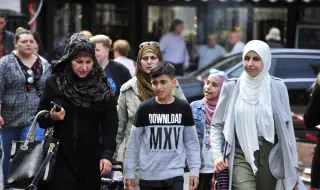
21.2 million people with an immigrant background lived in Germany last year - around four percent more than the previous year, according to the Federal Statistical Office. Their share has increased slightly - to 25.6% of the country's total population.
By people with immigrant roots we mean those who either immigrated to Germany themselves (first-generation immigrants) or people whose parents came to Germany after 1950 (second-generation immigrants), the public broadcaster ARD specifies.
Approximately one in five people in Germany (19.6 percent of the country's population) has moved from another country. The share of first-generation migrants has increased by 4% - to just under 16.1 million people, the data show.
5.2 million people (an increase of 6%) are direct descendants, that is, children born in Germany to two parents who immigrated after 1950. For another 4.1 million children born in Germany, only one of the two parents is an immigrant. According to the definition, they do not belong to the group of people with migrant roots, explains the ARD.
The population with migrant roots is younger
They are relatively young: in the age group of 20 to 39 years old, approximately one in three (34%) has migrant roots. Among the older people - people over 65 - their share is only 14%. Overall, the migrant population in Germany is around nine years younger than the non-migrant population. The average age is 38.2 years, according to the Federal Statistical Office.
Escape, work and family
Last year, almost 6.5 million people who have immigrated since 2015 lived in Germany. The main countries of origin are Ukraine and Syria, and the most important reasons for immigration according to respondents are escape, asylum and international protection (31%), work (23%) and family reunification (21%). Eight percent of those who immigrated since 2015 since have stated that they came to Germany primarily for the purpose of studying or continuing their education.
Statisticians register gender differences: for men, the most common reasons for immigration are escape (32 percent) and work (28 percent). For women, escape is also a major reason - 30 percent, followed by family reunification (26 percent), ARD also writes.