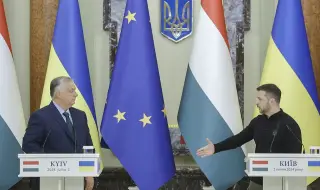
Hungarian Minister of European Affairs János Boka said on May 27 that it is difficult to hold constructive negotiations with Ukraine on joining the European Union while Kiev, according to Budapest, is conducting "information and intelligence" operations on Hungarian territory. His comment came at a time of serious aggravation of bilateral relations between Budapest and Kiev, writes Kyiv Independent.
Boka's statement followed the claim by the Security Service of Ukraine (SBU) on May 9 that it had uncovered a Hungarian military espionage network operating in Transcarpathia. Two people were detained on suspicion of espionage against the Ukrainian state. Hungary has rejected the accusations, calling them a "slander campaign", and has said it has uncovered two Ukrainian agents on its territory.
"In such a situation, it is difficult to hold real and constructive negotiations on the enlargement of the European Union," Boka told journalists in Brussels ahead of a meeting of the EU's General Affairs Council.
Hungary continues to block the opening of negotiating chapters with Ukraine as part of the EU accession process. Viktor Orban's government is often described as the closest to Russia among the EU member states. Following the spy scandal, Budapest announced that it was freezing talks with Kiev on the long-standing dispute over the rights of the Hungarian minority in Ukraine, an issue it had previously used as a main justification for delaying the country's European integration.
Hungary has repeatedly accused Ukraine of discrimination against the Hungarian minority in Transcarpathia, particularly over a language law that requires at least 70% of education after the fifth grade to be conducted in Ukrainian. Ukraine denies the accusations and emphasizes that the language policy aims to promote national unity.
In response, Kiev accuses Budapest of undermining Ukrainian sovereignty through political interference, granting dual citizenship and supporting opposition forces in the country.
The Council meeting in Brussels on May 27 will also include a debate on the possibility of revoking Hungary's voting rights within the EU. This will be the eighth hearing under the Article 7 procedure of the Treaty on European Union, triggered by the European Parliament back in 2018 due to systematic violations of the rule of law and democratic principles in Hungary.
Article 7 allows for the freezing of certain rights of a member state, including the right to vote in the Council, if there are systematic violations of the fundamental values of the Union. The idea of sanctions against Budapest is gaining momentum again due to the threat of a veto on the possible accession of Ukraine to the EU.
Against the backdrop of the ongoing war in Ukraine and the escalating geopolitical crisis, Hungary's position remains a thorn in the EU's side. Orbán has consistently opposed sanctions against Russia and blocked military aid to Ukraine, maintaining close ties with the Kremlin. According to analysts, the current diplomatic conflict with Kiev could be used as an additional tool for pressure and political gain.
Although this is not the first clash between Hungary and Ukraine, this time the tension is unfolding against the backdrop of active discussions about the future of European enlargement and efforts to strengthen unity in the EU - a task that seems increasingly difficult.