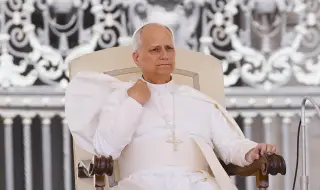
As spiritual leaders of the Catholic Church, popes have always faced the great challenges of their time - be it heresy, plague or invasions, notes Politico, reports News.bg.
This year, Pope Leo XIV has defined mastering the risks of uncontrolled artificial intelligence as a core mission of his pontificate. In his first official address to the cardinals, he warned of the potential threats that AI poses to human dignity, justice and work. Just two days later, he highlighted the enormous potential of technology, but insisted that it requires responsibility to serve the good of all.
Like his namesake, Pope Leo XIII of the 19th century - a defender of workers' rights during the Industrial Revolution - Leo XIV is positioning himself as a moral guardian of society in an age of technological transformation. According to a Vatican spokesman, the choice of his name is "not accidental".
"The Church invites us to look to the sky, but also to tread firmly on the ground," said Paolo Benanti, a Franciscan friar and the Vatican's advisor on the ethics of artificial intelligence. He said it was not surprising that the Church would contribute even in such a futuristic field.
The Vatican and Global AI Regulation
The EU has taken an important step towards regulating artificial intelligence, aiming to become a pioneer in this key area. But according to Maria Savona, a professor of the economics of innovation, the Vatican also plays a unique role, seeking to prevent developments that could threaten human rights, especially of low-skilled workers.
Ethics experts, philosophers and techno-billionaires - including Elon Musk - have warned of the risks of creating unsupervised intelligent systems. Musk has even likened AI to a “digital God“ that could become an uncontrollable force.
The Vatican began working on artificial intelligence issues during the pontificate of Pope Francis. In 2020 he brought together representatives of religion, politics and technology - including IBM and Cisco - to sign the Rome Call for the Ethics of Artificial Intelligence. In January this year, the Holy See issued an official statement, according to which AI could lead to “labour slavery“.
Pope Leo XIV's unique position
Pope Leo XIV is the first pope from the United States - the country where Silicon Valley is located. A graduate in mathematics, he possesses rare qualities that put him in a particularly good position for dialogue on technological topics.
While the United States, under the leadership of President Donald Trump, is moving towards deregulation and investment in AI infrastructure, the EU is also adapting its policies, emphasizing competitiveness. At this year’s AI summit in Paris, the discussions focused more on business deals than on safeguards.
Benanti sees the Church as an “expert on humanity” who can inspire the creation of AI that is human-centered and socially just. In her first conversation with Italian Prime Minister Giorgia Meloni, Pope Leo and she agreed on the idea of “ethical and humane development of AI.” Last year, at Meloni’s invitation, Pope Francis addressed G7 leaders on the same topic.
The moral compass in the digital age
“The Vatican’s interest in AI is not unusual,” Savona notes. Pope Francis has shown a similar interest in climate change, another key contemporary issue. The Church’s mission remains true to its fundamental principles, but also adaptable to new challenges.
The Vatican has a global network, especially in the Global South, that can facilitate more democratic access to AI and participation in the global regulatory field dominated by Europe. This, according to Savona, would be of great importance.
Leo and the fight against disinformation
Even the newly elected pope has been the target of fake content generated by AI. A YouTube video shared on African platforms showed the pope praising Burkina Faso’s President Ibrahim Traoré, a clip that the Vatican said was a manipulation.
History shows that the relationship between science and the Vatican has not always been easy. Galileo Galilei, for example, was condemned by the Church in the 17th century. But today, the conflict between faith and technology seems to be less acute. "Many scholars were also believers," Benanti recalls.
Whether Leo XIV will succeed in his mission depends on his ability to influence and unite. "The Vatican has a strong moral influence. It remains an extremely authoritative voice," Savona emphasizes.