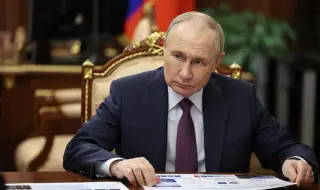
By offering himself as a mediator in the military confrontation between Israel and Iran, Russian President Vladimir Putin intends to return Moscow to the forefront of the international scene and preserve its main ally in the Middle East - Tehran, researchers emphasize, BTA writes, citing AFP.
Historically, Russia has maintained good relations with Israel, where a large Russian-speaking community lives. But the Russian invasion of Ukraine and the war waged by Israel in the Gaza Strip, criticized by Moscow, have shaken these ties.
Russian authorities quickly condemned Israeli strikes on Iran last Friday, and then the Russian president offered to play the role of mediator in this conflict. But on Tuesday, the Kremlin said it had found Israel reluctant to accept outside mediation.
According to Nicole Grajewski of the Carnegie Endowment for International Peace, Moscow has an interest in de-escalating the situation. “Russia does not want regime change in Iran, especially if that change leads to a pro-Western government that would weaken Moscow’s most important regional partnership since the Ukraine war,” the researcher said.
Since the start of Russia’s invasion of Ukraine in February 2022, Russia, marginalized by the West, has moved closer to Tehran. Kiev and its allies accuse Iran of providing the Kremlin with drones and short-range missiles for its offensive. These accusations were rejected by the Iranian authorities.
Subject to Western sanctions, both Russia and Iran signed a global strategic partnership agreement in January aimed at strengthening their ties, in particular military cooperation, which is not, however, a mutual defense pact like the one that binds Russia to North Korea.
At the regional level, Russia has every interest in offering this mediation, says Tatiana Kastueva-Jean of the French Institute of International Relations.
“The regime change in Syria has also resulted in a loss of points for Russia“, adds the analyst, recalling that the Kremlin, as well as Iran, supported former Syrian President Bashar Assad, who was overthrown in December.
In the past, Russia managed to overcome the international isolation caused by its annexation of the Ukrainian peninsula of Crimea in 2014, becoming an unavoidable factor in this region, says Kastueva-Jean.
The Kremlin intervened militarily in Syria in 2015, saving Bashar al-Assad's rule in the midst of a civil war. That same year, the Kremlin also backed the Iran nuclear deal, which Washington denounced in 2018.
But this alliance with Tehran could eliminate the Kremlin as a mediator in the Iran-Israel conflict.
According to analyst Konstantin Kalashev, such mediation would not inspire trust in Europe or Israel, as Moscow is seen as an ally of Iran. The proposal was met with a lukewarm response from the EU. "Russia cannot be an objective mediator," European Commission spokesman Anwar El Announi said on Monday.
"To the Kremlin, which wants to achieve peace in the Middle East, I would say: Start with Ukraine," France's top diplomat Jean-Noel Barrot said on Tuesday.
On the other side of the Atlantic, Donald Trump, who has begun an impressive rapprochement with Vladimir Putin since returning to the White House in January, has said, on the contrary, that he is open to the idea of Russian mediation. “Russia is trying to seduce Trump on issues beyond Ukraine“, says Kastueva-Jean.
The US president promised to end the war in Ukraine within 24 hours of taking office, but he seems to have distanced himself from the conflict in recent weeks, at a time when talks between Kiev and Moscow are at a standstill.
In early June, the Russian head of state told his American counterpart, among other things, that he wanted to contribute to resolving the dispute between Washington and Tehran over the Iranian nuclear program.
This issue is at the heart of the current clash between Israel and Iran. The stated goal of Israel, a US ally, for its strikes on Iran is to prevent Iran from acquiring a nuclear bomb, an ambition Tehran denies.
“By positioning itself as a necessary international mediator, Moscow could, at least, use this status to demand sanctions relief or diplomatic recognition of its territorial claims, or to force others to accept its behavior in Ukraine,“ says Grajewski.
If Moscow takes on the role of mediator, it would legitimize Russia as a major and necessary power at a time when it is waging the largest war of aggression on European territory since World War II, says Anna Borshevska of the Washington Institute think tank.
For Russian researcher Kalachev, if Russia starts playing a mediatory role in this conflict, it would be bad news for Ukraine and for Europe, with a shift in the international community's attention.