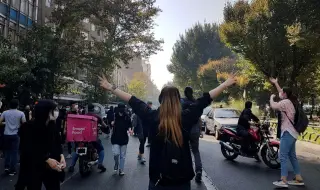
According to the Norwegian human rights organization Hengaw, at least 700 people have been arrested in Iran since the start of the war. Danial Moghadam is one of them - an Iranian singer who participated in the "Woman, Life, Freedom" protests in 2022 and 2023, was thrown into prison for this and was subsequently forced to wear an electronic bracelet on his leg. Critical posts and videos constantly appear on his social media profiles.
Moghadam was arrested earlier this week, human rights activists say. However, there is no information about where he is or what exactly he is accused of, ARD writes.
New arrests every day
The new wave of arrests has also been widely reported in the Iranian media. Reports of detainees are almost daily. The charges are similar: espionage for Israel, collaboration with the Mossad, or "instilling fear and disturbing the public's peace of mind".
The obvious targets are prominent critics of the regime, as well as people who post photos and videos of Israeli airstrikes on social media, and the charges cannot be independently verified, not least because there is often too little information. Even relatives, as in the case of Danial Moghadam, are often unaware of where and for how long their loved ones are being held.
Executions as a message
Espionage and collaboration with Israel - these are serious charges in a country whose security apparatus is only now realizing how well it is known to the Israeli secret services. Oyar Sheki from the human rights organization Hengaw confirmed this in an interview with ARD: "If you are accused of spying for Israel, you can expect severe punishment, including execution".
Since June 13, at least six people have been executed for alleged espionage for Israel, three of whom have been executed since the ceasefire on June 24. These are all old cases, but they should now send a clear signal, the German publication points out.
In addition, other executions are being carried out for drug-related or violent crimes. Even before the war with Israel, Iran was one of the countries with the highest number of executions. Human rights organizations fear that this number will increase even more.
Swedish doctor of Iranian origin Ahmadreza Jalali was arrested in Iran in 2016 and sentenced to death for alleged espionage for Israel. According to Hossein Bawmi of "Amnesty International", this happened in an unfair and sham trial: "The families of these detainees are extremely worried that their relatives could now be executed in order to demonstrate to the Iranian authorities that they are in control of the situation".
Special surveillance units
The government apparatus is not only resorting to the usual means of persecuting critical voices. According to the semi-state news agency ISNA, even as Israel and Iran were exchanging blows, a special group was created at the prosecutor's office in Tehran to monitor the Internet and the media - "to ensure public security". In addition, special departments will be established in provincial courts to deal specifically with cases of collaboration with Israel, ARD further states.
For Hossein Bawmi of "Amnesty International", the reaction is typical. "This is a tactic that the Iranian authorities use whenever they feel threatened. They already did it during the protests in 2022/2023 - and they do it whenever they want to demonstrate that they have control over the population."
Such measures will further restrict the already very limited rights of the accused.
Attempt to preserve the image
This new show of force by the Iranian leadership is also visible on the streets of Iranian cities: in a very short time, the armed militias "Basij" The National Guard has set up checkpoints in many places. Young men are being searched, with particular attention paid to them.
The authorities have also urged citizens to be vigilant, to report anything suspicious and to hand over their private drones to the police. And the head of Iran's cyber police has warned that the enemy could be listening to phone calls with relatives at home and abroad in order to extract the necessary information.
Iranians are used to censorship and surveillance on the Internet. That's why many see the new measures as a warning from the regime. And it seems to have been hit hard: nuclear facilities are likely to be seriously damaged, the missile program has been disrupted, and leading generals have been eliminated.
Despite all of Tehran's triumphant rhetoric, the Iranians are well aware of this. The leadership is trying to reduce the damage to its image by being cruel to its own people, writes ARD correspondent Pia Mazurczak.
Author: Pia Mazurczak (ARD)