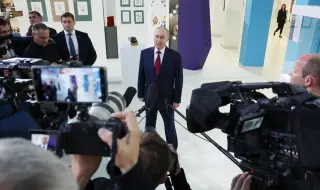
Russian President Vladimir Putin has rejected his American counterpart Donald Trump's call for quick peace in Ukraine during a phone call held on July 3. This was reported by the Institute for the Study of War (ISW), reports News.bg.
According to Yuri Ushakov, an aide to the Russian president, Trump has again insisted on a quick end to the conflict, but Putin has stated that Russia will continue its efforts to achieve its goals. He stressed that his country will not give up its intentions and will “eliminate the root causes“ about the war - a wording that effectively confirms that Moscow will continue with the military action on its own terms.
Ushakov added that the two leaders discussed the possibility of a third round of Ukrainian-Russian talks in Istanbul, agreeing to continue the peace talks in a bilateral format, without a specific date set. The topic of the recent suspension of US military aid to Ukraine was not raised, but there were talks about economic projects in the energy and space sectors.
Putin's commitment to "eliminating the root causes" of the war contradicts his claimed support for "meaningful" negotiations. The Kremlin has consistently linked this approach to demands for regime change in Ukraine, the country's neutrality, and changes to NATO's open door policy.
ISW continues to assess that Russia remains uninterested in good faith negotiations to end the conflict.
US State Department spokeswoman Tammy Bruce said on July 3 that Trump had expressed "remaining commitment" to providing Patriot systems to Ukraine. Bruce clarified that the US had not completely cut off military aid, and that the suspension was a "one-time event". Pentagon spokesman Sean Parnell announced on July 2 that the Department of Defense had temporarily suspended deliveries to conduct a "capability review" and to ensure that the assistance meets U.S. strategic priorities, including maintaining its own defense readiness.
Parnell stressed that the department's recommendations are consistent with Trump's drive to end the war.
Ukrainian strikes on top Russian military figures
A Ukrainian strike killed the deputy commander of the Russian Navy in the Kursk region, and there were reports of the death of a senior Federal Security Service (FSB) official in an explosion in Moscow City.
On July 3, the Russian Defense Ministry confirmed that Major General Mikhail Gudkov had died in combat in the Kursk region. Gudkov, who was appointed deputy commander of the fleet in March 2025, was killed in a Ukrainian missile strike on the command post of the 155th Marine Brigade near Korenevo. Captain 2nd Rank Nariman Shikhaliyev was also killed with him. Ukrainian military analyst Yuri Butusov reported 20 Russian servicemen killed in the same strike.
At the same time, unconfirmed reports emerged that Alexei Komkov, head of the Fifth Directorate of the FSB, was killed in a car explosion in Moscow City. ISW stressed that the information could not yet be confirmed.
SBU liquidates former mayor of Lugansk
The Security Service of Ukraine (SBU) has killed the former occupation mayor of Lugansk, Manolis Pilavov. According to information from the Ukrainian newspaper “Suspilne“, Pilavov died in an explosion in the occupied city of Lugansk on July 3. TASS also reported his death. Pilavov held the post from 2014 to 2023.
US and Ukraine deepen military partnership
Despite the challenges, Ukraine's Western allies continue to provide military assistance. The US remains the only country capable of delivering critical air defense systems on a large scale.
On July 3, Ukrainian President Volodymyr Zelensky announced the signing of a memorandum of strategic partnership with the US company Swift Beat to jointly produce hundreds of thousands of interceptor drones by 2025, with the capacity to shoot down Shahed drones. Production will be expanded further in 2026.