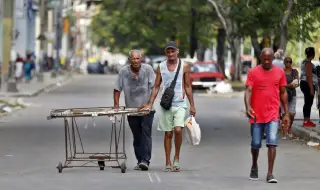
Cuban Labor and Social Security Minister Marta Elena Feito has resigned after denying there are beggars on the island, Agence France-Presse reported, BTA reported.
At a time when the communist country is experiencing a deep economic crisis, she assured that there are only people "dressed as beggars" there.
Feito sparked discontent and Cuban state media reported yesterday that the minister "admitted her mistakes and resigned". Her resignation request was analyzed by the highest leaders of the ruling Communist Party and the government, who "agreed to release her" from her post due to "lack of objectivity and sensitivity".
On Monday, speaking to a parliamentary committee, Feito denied that people who rummage through trash cans on the streets do so to look for food. She also criticized street windshield washers, accusing them of seeking "easy life". "We see people who look like beggars, but when you look at their hands, when you look at their clothes, you realize that they are disguised as beggars, not beggars. There are no beggars in Cuba," Feito said.
Cuban President Miguel Diaz-Canel personally tried to quell the scandal yesterday, AFP noted. "The lack of sensitivity in the approach to vulnerability is highly questionable," he initially wrote on his "Ex" account. Then, at a parliamentary session, Diaz-Canel returned to the case, stressing that "none of us can behave arrogantly, complacently, detached from the realities in which we live."
He acknowledged that "those people who we sometimes describe as beggars or those associated with begging are in fact the concrete embodiment of the social inequalities and problems" facing Cuba.
Poverty has increased in recent years on the island, which is in the grip of a deep economic crisis, fueled by low domestic production and the tightening of the US embargo by President Donald Trump, according to Agence France-Presse.
The Cuban president did not use the word "poor," preferring the qualifications "vulnerable" or "vagrant," which authorities usually use when talking about the problem. Last year, 189,000 families and 350,000 people considered "vulnerable" benefited from social assistance programs on the island of 9.7 million, according to government figures.
On Monday, the Cuban government announced that the country's economy shrank by 1.1% in 2024. The decline was 11% over a five-year period, the Associated Press reported.