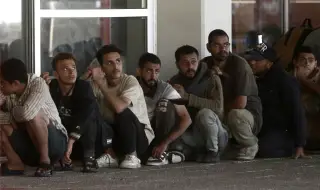
The rhetoric is almost military: Thanos Plevris, the newly appointed Greek migration minister, speaks of an "invasion", while his government colleagues call the situation "hybrid war" or "state of emergency". Much of the media writes that Crete is "flooded" with illegal immigrants. And Prime Minister Kyriakos Mitsotakis promises that Greece will not allow a new channel for illegal entry into the country and Europe to be opened. "Like in the Evros region in 2020, we will do everything necessary to stop them", the head of government wrote on Facebook.
However, Greek politicians and the media mostly recall the events of 2015, when millions of refugees, mainly from Syria, arrived in Europe. But are Greece and Europe really facing a new refugee crisis like the one from 10 years ago? All signs point against this.
One hundred times fewer migrants than in 2015
According to coast guard data, 7,336 refugees arrived on the Mediterranean island of Crete and the small island of Gavdos in the first half of 2025. About 2,000 more people arrived in July. This is almost 350% more than in 2024, and yet this cannot be defined as an "invasion".
Furthermore, purely theoretically, it would not be a problem for a large island like Crete to cope with 9,000 or 10,000 refugees. For comparison, in 2015, much smaller islands like Lesbos and Kos had over a million refugees arrive. But today, the social and political mood is different - both in Europe and in Greece.
Local residents of the island of Crete, which welcomed almost four million tourists in 2024, are categorically against the creation of a camp for new refugees. There were even protests last weekend. As a result, the new arrivals are currently being sent to Malakasa near Athens or to northern Greece. Although the government has announced the creation of a camp on the island of Crete, it is doubtful whether it will dare to carry out its intentions, as the political price for this could be quite high.
A sumptuous menu for asylum seekers?
At the same time, the Greek Minister of Migration only speaks of "illegal migrants", whose place is in prison, and threatens refugees with food cuts. Plevris claims that people in the closed camps are fed too well and repeatedly states that his ministry "is not a hotel".
The fact is that in Greece food products are provided only to asylum seekers. Recognised refugees, as well as those whose asylum applications have been rejected but who are still in the country because they have nowhere else to go, are not entitled to free food under the migration ministry's programmes.
Since 1 October 2021, asylum seekers housed in camps across Greece have been fed by private catering companies at a cost of €6.88 per person per day. Therefore, Plevris' claim that they are being served sumptuous hotel menus is an exaggeration to say the least.
The minister, who has a far-right past, presents himself as a staunch opponent of illegal immigration. For him, almost all new arrivals are illegal. He accuses them of wanting to enjoy a good life in a Greek paradise financed by Greek taxpayers. However, the fact is that 75% of food costs are covered by the EU. It is also a fact that most refugees and migrants do not dream of paradise in Greece, but want to move on, most of them to Western and Northern Europe.
Asylum applications are not accepted
Furthermore, new arrivals currently have no access to an asylum procedure and therefore no right to food. After a new law was passed last week (with the votes of the ruling New Democracy party and MPs from smaller right-wing parties), Greece will stop accepting asylum applications from refugees arriving by sea from North Africa for at least three months. The law is controversial, unconstitutional according to many legal experts and clearly contradicts European values. But even the European Commission (EC) is not opposing it.
Plevris now has a clear legal argument for his plans to return new arrivals without an asylum procedure. "There are countries where we can send them back, countries with which we have an agreement, and others where they can return voluntarily," he said over the weekend on the SKAI television channel.
But is this true? One of the three detainees who are due to be deported from Greece at any moment is from Egypt, and according to the Greek ombudsman, this person cannot be returned under the current circumstances. Therefore, the Greek government would like to conclude an agreement with Cairo, but there is no such agreement yet.
According to the Ministry of Migration, most asylum seekers who arrived in the first five months of 2025 came from Afghanistan (31%), followed by Egypt (16.4%), Syria (6.2%), Pakistan (5.2%), Sudan (4.5%) and Bangladesh (3.6%). However, it is doubtful whether all those who are not granted or allowed to apply for asylum are being returned to all of these countries.
However, the Minister of Migration is continuing with measures to deter migrants and is preparing a new draft law that foresees three years in prison without the right to early release and a fine of 10,000 euros for those who refuse to leave the country. But it is doubtful whether this will work and whether it will intimidate the people who managed to escape Sudan, cross the Libyan desert and raise money for the crossing from Tobruk. Probably not. It is also unclear what will happen after the three years in prison. For example, whether another three-year sentence will follow.
However, Plevris's plans appeal to the right-wing in Greece, and this is important for the government.
Where do the new refugees come from?
In fact, the government knows very well that the problem cannot be solved with threats of prison or with the two frigates that Mitsotakis recently sent to patrol the Libyan coast. Currently, the destroyed state of Libya is the place where people who want to escape African wars, hunger and lack of prospects gather and are waiting for an opportunity to move to Europe. 14 million people have fled the war in Sudan alone - to Chad, Egypt, Ethiopia and Libya.
The only realistic solution to the problem of Greece and Europe would be an agreement with Libya, i.e. with the two governments there - the internationally recognized one in Tripoli and the other in Benghazi. It could be similar to the 2016 EU-Turkey agreement.
Author: Kaki Bali