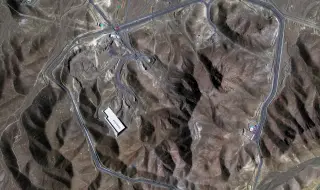
Even a month after the US attacks on three major nuclear sites in Iran, the consequences of the air strikes on June 22 remain unclear amid conflicting damage estimates.
The strikes were part of Operation "Midnight Hammer", targeting nuclear facilities in the cities of Fordow, Natanz and Isfahan. It involved 125 aircraft and specialized B-2 bombers carrying 30,000-kilogram bombs designed to destroy bunkers.
Heavily fortified Fordow
The strike on Fordow was the most massive. It is home to the country's most heavily fortified nuclear facility. It is hidden deep underground to protect it from attack.
It is unclear when Iran began construction of the site, which the world has known about since 2009. The facility is designed to house about 3,000 centrifuges - machines used to enrich uranium. As part of the 2015 nuclear deal, Tehran agreed to use it only for research purposes and to stop enriching uranium there for 15 years. But after US President Donald Trump, during his first term, unilaterally withdrew from the agreement in 2018, Iran resumed uranium enrichment activities at Fordow.
Iran enriches uranium to 60% purity at the site, far more than is needed for civilian nuclear power generation. Tehran also announced plans to expand the site's uranium enrichment capacity.
The International Atomic Energy Agency (IAEA) also said it had found uranium enriched to 83.7 percent purity at Fordow, very close to the 90 percent required for nuclear weapons.
Another target of the US strikes on Iran was the Natanz nuclear facility, Iran's largest uranium enrichment center, located about 140 miles (225 km) south of Tehran. Like Fordow, Natanz is also underground, where there may be another 50,000 or so centrifuges.
The Fordow and Natanz facilities have both been targeted in the past. According to Iranian officials, these attacks - from the Stuxnet cyberattack in 2010, to power outages at Fordow, to the remotely controlled explosion at Natanz four years ago - have caused widespread destruction and seriously damaged their uranium enrichment capacity.
The third nuclear site bombed by the US was the one in Isfahan. It is believed that Iran is storing nuclear fuel intended for nuclear weapons. In Isfahan, natural uranium is converted into uranium hexafluoride - a gas that is then used for enrichment in centrifuges at Natanz and Fordow.
Russia provides fuel for Iran's only nuclear power plant
The Fordow, Natanz and Isfahan sites are uranium enrichment facilities, and experts estimate that Iran already has over 400 kilograms of highly enriched uranium. Despite the damage caused by the US strikes on the three sites, the fate of this enriched uranium remains unclear.
Iranian government sources claim that the enriched uranium has been moved to "secure" locations. However, several media outlets have quoted Israeli sources as saying that the uranium has been distributed among the three sites and "has not been moved".
A senior Israeli official, who did not wish to be named, recently told the BBC that some of the enriched uranium is deep inside the Isfahan facility and that Iran may try to recover it.
The three sites are not believed to have nuclear reactors. However, Iran does have an operational nuclear power plant at Bushehr, about 750km south of Tehran. The facility, which is monitored by the IAEA, uses uranium supplied by Russia. Spent fuel is also being returned to Russia to prevent it from being reprocessed into weapons-grade material. The plant was not among the targets targeted in the latest US strikes on Iran.
Radiation monitoring
The IAEA said there were no elevated radiation levels in the region since the latest US strikes. Since no operating reactors were attacked, the potential radiation risk is limited to the leakage of uranium hexafluoride gas from enriched uranium storage tanks, centrifuge cascades or pipelines.
If released, this gas will react with moisture in the air to form uranium fluoride and hydrofluoric acid, which is highly corrosive and dangerous. Contact with this acid or inhalation of its fumes can destroy lung tissue and cause severe and deadly respiratory problems, leading to suffocation and death.
"There are indeed indications that uranium hexafluoride has been released at the facility site. In this regard, radiological and chemical hazards, as well as increased radiation levels, are mentioned. This can only refer to a release of hydrofluoric acid," Clemens Walter, professor and nuclear expert at the Institute for Radioecology and Radiation Protection at the University of Hanover, told DW. He specified that these dangers are limited to the facility site itself. There are no indications of spread to residential areas.
Roland Wolf, an expert in radiation protection, medical and radiation physics, recalls that uranium is a heavy metal and chemically toxic. "It can, for example, cause kidney damage, increase the risk of cancer and genetic damage due to alpha radiation. "Depending on the scenario, this poses a potential danger for both workers and the population as a whole," he told DW.
Risk of a Chernobyl-like disaster?
The nuclear accidents at Chernobyl in 1986 and Fukushima in 2011 clearly demonstrated the serious consequences of nuclear reactor accidents. According to Roland Wolf, however, the three sites in Iran do not pose a Chernobyl-like hazard: "The radioactive material in uranium enrichment facilities, unlike that in nuclear reactors, does not contain fission products".
Furthermore, it was not released at a sufficient height by an explosion, as was the case in Chernobyl. Therefore, it is assumed that the potential contamination is local, the radiation expert adds.