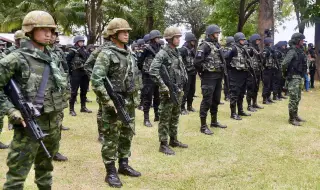
The fighting on the border between Thailand and Cambodia continues. The clashes are concentrated in several places. News agencies quote a military spokesman, according to whom Cambodia began shelling Thailand with artillery and rockets early this morning (July 25), and Thailand responded with the same.
The clashes could escalate into war
According to the Thai government, the number of dead has risen to 15 people - 14 civilians and one soldier. The Thai military also reported the deaths of at least 24 Cambodian soldiers.
About 100,000 people in Thailand have meanwhile been evacuated from affected areas along the border, according to the interior ministry in Bangkok. Thailand's acting prime minister Phumtham Wichaychai has warned that any further escalation of the fighting, which has already involved heavy weapons, could lead to war.
Why is the conflict escalating now?
It is not clear who is responsible for the latest escalation, but tensions between the two countries have risen significantly in recent months. In late May, Cambodian soldiers began digging trenches in the disputed section of the border, leading to a shootout with the Thai army, in which one Cambodian soldier was killed.
The two sides then sent reinforcements and tensions escalated. A new escalation occurred after several Thai soldiers were injured, some seriously, by landmines recently laid by Cambodia.
What are Thailand and Cambodia arguing about?
For decades, Thailand and Cambodia have been at odds over where the border between the two countries should run. It is over 800 km long, the region is sparsely populated, largely inaccessible and poorly mapped.
Many of the border markers date back to the French colonial era, between 1863 and 1953. Cambodia is a French protectorate, while Thailand remains formally independent as the Kingdom of Siam. During these 90 years, there have been several transfers of territory, so the border line between the two countries has changed several times. In addition, the demarcation line imposed by France in 1907, which Siam was forced to agree to, was later disputed by Thailand.
At the same time, there are several temples in the border area that are claimed by both countries. The most famous of them is Prasat Preah Vihear - a Hindu Khmer temple from the 10th-12th centuries, controlled by Cambodia.
In 1959, the dispute reached the International Court of Justice in The Hague, which ruled in favor of Cambodia three years later. When in 2008 UNESCO wanted to declare the temple a World Heritage Site, the conflict flared up again and many people died in the border skirmishes that occurred then. Cambodia again turns to the International Court of Justice, which again rules in favor of Phnom Penh.
In 2000, the two countries did indeed establish a joint border commission to resolve the dispute peacefully, but so far no significant progress has been made. Last month, Cambodia sent a letter to the International Court of Justice for the third time - requesting that not only the dispute over the Khmer temple but also other border issues with Thailand be finally resolved. But Thailand, which has lost twice in The Hague, prefers a bilateral solution through negotiations. However, the current escalation of tensions is moving the two sides further away from reaching an agreement.
"Cambodia wants to take the current conflict to the International Court of Justice because it has had success there in the past," Zachary Abuza, a Southeast Asia expert at the Lowy Institute, an independent think tank in Sydney, told DW. Thailand, for its part, is betting that it is economically superior to Cambodia – its gross domestic product (GDP) is 12 times higher than Cambodia's, and it is determined to use this advantage, the observer adds.
How dependent are Thailand and Cambodia on each other?
While Thailand exports electronics, cars and food products, Cambodia is mainly dependent on agriculture and textiles. According to official statistics, about half a million Cambodian guest workers live in Thailand.
"Both countries have something to lose", political scientist Tita Sangli of the ISEAS-Yusof Ishak Institute in Singapore told the newspaper. She recalls that Thailand is heavily dependent on Cambodian labor, and Cambodia - on imports from Thailand, which also include products for everyday use - fuel, beverages and others. In addition, both countries are dependent on tourism revenues, which are also likely to decline if the conflict continues for a longer period of time.
What role does the government crisis play in Thailand?
The current governments in Bangkok and Phnom Penh actually maintain close relations with each other, which is also due to the good relationship between former Thai Prime Minister Thaksin Shinawatra and long-time Cambodian leader Hun Sen. The children of the two former leaders have ruled in both countries.
In Cambodia, Hun Sen's son - Hun Manet - took over from his father. In Thailand, Thaksin's daughter - Phaetongtarn Shinawatra, who is only 38 years old, stumbled into a political scandal in early July. In a leaked phone recording between her and Hun Sen in June, she calls the 72-year-old politician "uncle" and criticizes her own military commanders in connection with the border conflict.
Conservative, pro-military forces have previously sharply criticized Phaetongtarn's plans to negotiate with Cambodia over energy projects in a maritime area that is also disputed between the two countries. On July 1, the country's Constitutional Court removed Shinawatra from office. Domestically, Thailand is already struggling with a weakening economy and high punitive tariffs from the United States.
The country's military may want to seize the moment, and in recent weeks it has significantly intensified its anti-Cambodian rhetoric. The "Bangkok Post" newspaper wrote that Thailand's tourism industry fears that the military may be preparing another coup.
Author: Thomas Lachan