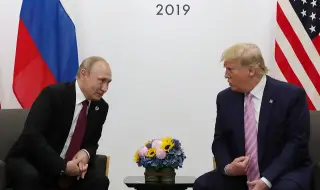
On Monday, President Donald Trump signaled his growing impatience with Vladimir Putin, telling reporters in Scotland that the Russian president must stop fighting in Ukraine within "10 or 12 days" to avoid sanctions and secondary tariffs, narrowing the 50-day deadline he had set earlier this month. But this latest threat is unlikely to change Putin’s plans, writes geopolitical expert and Time editor-in-chief Ian Bremmer.
From the outside, it’s hard to see why the war is continuing. Putin, the only person who can end it, sees that Russia has paid a high price over the past three years and five months to gain just 20 percent of Ukraine’s territory. By some estimates, Russia suffered over a million battlefield casualties, with a quarter of a million killed. The war strengthened NATO, which Putin sees as Russia’s real enemy, by attracting new members and persuading European governments to spend much more on defense. Since the invasion began, an estimated one million young Russians have left the country to avoid military service, find better job prospects, or both.
While the expansion of Russia’s military machine has given its economy a short-term boost, the long-term loss of energy customers in Europe, the surge in inflation that has pushed interest rates to historic highs, and the growing reluctance of Russian consumers to spend put Russia’s economic future in jeopardy. How hard would it be, outside observers ask, for Putin to make a deal, stop the bloodshed, declare victory, and consolidate Russia’s gains?
But Putin believes time is still on his side. In the coming months, Russian forces will likely gain enough new territory in eastern Ukraine to force him to stick to a strategy of maximum pressure, designed to undermine Ukraine’s resolve. Drone and missile attacks on Ukrainian cities and infrastructure will continue because Kiev has found no way to stop them. Russian forces will apply greater pressure in other regions to further weaken Ukraine’s defenses. That is enough to keep the Russian president in the game.
Not that Volodymyr Zelensky is willing to make concessions. The Ukrainian president has been weakened domestically by his government’s failed attempt to dismantle an anti-corruption agency that has begun to bark at his political allies. Even if he were stronger, Ukrainians have suffered too much at the hands of the Kremlin to offer concessions substantial enough to satisfy the Russian president, who is likely to want more. Ukrainians also won’t trust Putin and future Russian leaders to keep their promises to end the current fighting.
Trump doesn’t have the clout to change any of this. There is not enough direct trade flow between the United States and Russia to make him a serious threat, but he has warned of possible tariffs on countries that trade with Russia. Still, Putin has good reason to doubt that Trump will start new conflicts with China and India, currently Russia’s two largest energy customers, especially given that Trump is working to strike major trade deals with both countries. EU sanctions won’t change Putin’s plans. The main tool in Europe’s 18th round of sanctions against Russia, the adjustable oil price cap, will force Russian oil exporters to rely more heavily on the shadowy fleet of tankers they have used to circumvent the cap. But without U.S. support, their impact will be limited, and the EU has little chance of slowing down Russia’s defense sector.
Trump’s ability to pressure Zelensky is also not as strong as it seemed a few weeks ago, as his ever-changing and seemingly contradictory tactical approaches to Ukraine and Russia suggest that the U.S. president could change his mind again. Putin and Zelensky are also aware that Trump has many other tasks that require his attention right now.
There is another possible reason why Putin is continuing this increasingly costly, attritional war. Perhaps his confidence in continuing the war is just one more item on his growing list of strategic mistakes. The invasion itself was a spectacular miscalculation of the strength of both Russia and Ukraine.
Maybe he's not making a deal because he can't yet see how much Russia has to lose.
Link to main version
Aug 1, 2025 16:34 533
Why Donald Trump’s Threats Won’t Change Putin’s Course
Trump’s Ability to Put Pressure on Zelensky Isn’t as Strong as It Looked a Few Weeks Ago
Снимка: БГНЕС/ЕРА