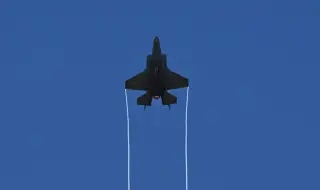
Indian authorities notified Washington that they are not interested in buying F-35s on July 31, reports Bloomberg, citing its sources. Earlier, US leader Donald Trump announced the introduction of 25% trade tariffs on India. They were to come into effect on August 1.
The US president noted that despite friendly relations between the two countries, the US trades “relatively little“ with India due to “too high tariffs, some of the highest in the world“, as well as “strict and unpleasant, non-monetary barriers“. Trump also drew attention to the fact that India "has always bought most of its military equipment and weapons from Russia" and is "along with China the largest consumer" of Russian energy resources, writes in his analytical commentary Konstantin Alush, quoted by the TASS agency.
In this regard, according to Trump, India must pay a 25% duty plus a fine for the above from August 1. According to the agency, Washington's decision "shocked and disappointed" the Indian authorities. However, countermeasures from New Delhi (at least for now) are not being discussed.
Sources told the agency that in order to resolve trade disagreements with Washington, the authorities of the South Asian republic are considering the possibility of increasing the volume of energy imports from the United States. However, New Delhi no longer plans to purchase military equipment from the United States, despite the American leader's insistence on this. Instead, New Delhi wants defense cooperation with Washington to focus on joint development and production of equipment in India.
In general, as the media noted, the government of the South Asian republic is exploring all possible ways to maintain relations with its “largest trading partner“. However, as Indian Commerce Minister Piyush Goyal stated in his speech in Parliament, “all necessary steps will be taken to promote and protect national interests“.
Commenting on the situation with tariffs and the F-35 on August 1, Indian Foreign Ministry spokesman Randhir Jaiswal also noted that the partners from which the country purchases weapons and military equipment are “determined solely by national considerations and strategic assessments“.
As Bloomberg recalled, Trump offered to purchase F-35 fighter jets to Indian Prime Minister Narendra Modi during his February visit to the United States. However, even then, New Delhi's official response on the issue was rather vague and hesitant, stating that the proposal would be carefully studied.
During the same visit of Modi to Washington, which coincided with the Aero India 2025 air show in the South Asian republic, the Russian Federation made a counter-proposal to New Delhi regarding the Su-57. The deputy head of the Federal Service for Military-Technical Cooperation (FSMT) of the Russian Federation, Mikhail Babich, stated on the sidelines of the exhibition that negotiations would be held regarding a possible deal with India regarding the Su-57 and that the relevant “goals would be achieved“.
The newspaper “Economic Times“ wrote in his article that New Delhi has rejected Washington's proposal regarding the F-35, arguing that the priority of state policy in this area is currently the joint development and production of weapons and military equipment in India. As Babich stated on the sidelines of Aero India 2025, Russia is ready to offer the Indian aircraft manufacturer Hindustan Aeronautics Ltd. (HAL) joint production of the Su-57, and HAL, in turn, as a source from this company told TASS, is counting on such cooperation.
At the same time, Indian Minister of State for External Affairs Kirti Vardhan Singh, in a written response to a parliamentary question, even reported that the supply of F-35 fighters to the South Asian republic had not been officially discussed. “The joint statement of India and the United States after the meeting of Prime Minister Narendra Modi with US President Donald Trump on February 13, 2025, mentioned that the United States will review its policy regarding the supply of fifth-generation fighters, such as the F-35, and submarine systems to India. So far, no formal discussion on this issue has been held“, “... Singh's statement is noted.
Against this backdrop, the National Security Advisor to the Indian Prime Minister Ajit Doval arrived in Moscow on August 5 to discuss strategic partnership and cooperation with the Russian Federation in the field of defense and security. As a source told TASS, the visit was planned in advance. “The current deterioration of the geopolitical situation will also make adjustments to the agenda“, he said.
On the same day, the Defence Acquisition Council of the Indian Ministry of Defence approved proposals for the purchase of military products and services for the national armed forces (AF) worth a total of 670 billion Indian rupees (more than 7.6 billion dollars). These include 110 BrahMos air-launched anti-ship missiles, as well as annual comprehensive maintenance of S-400 air defense missile systems.
Almost simultaneously, the Spanish authorities made it clear to the public that their previously expressed interest in purchasing American F-35Bs to replace the aging fleet of EF-18 Hornet and AV-8B Harrier II+ aircraft was no longer relevant. As reported by the newspaper El País, this idea, according to government sources, will definitely not be implemented.
The F-35B short-takeoff and vertical landing fighters were planned, in particular, to replace the fleet of 11 Harrier carrier-based aircraft of the Royal Navy. It was believed that this was the only possible option today to preserve carrier-based aviation in the country's armed forces as such, since the Harriers should have been decommissioned long ago and are not subject to further modernization.
The idea was cultivated in the Spanish Ministry of Defense for several years. Although, as the portal Infodefensa.com wrote, all this time the cabinet of ministers of the kingdom did not stop “looking askance“ to American aircraft, and it seemed that even mentioning the F-35 in the corridors of the ministry was forbidden.
While Britain, Italy and Japan gradually ordered these aircraft for their aircraft carriers, pessimists in Spain were increasingly convinced that Madrid would never dare to take this step.
In July, during a press conference, journalists asked the Chief of Staff of the National Armed Forces, Admiral Teodoro López Calderón, whether it was possible for Spain to order American fighters. In his response, he did not fail to list all the advantages of the F-35, but did not speak directly for or against their purchase.
López also admitted that if this does not happen, Spain "will have to survive [with the help of aircraft] the fourth generation that we have and wait for the FCAS (Future Combat Air System, a sixth-generation aviation complex developed by France, Germany and Spain - TASS note) to appear one fine day". "But the fact is that we will have to wait many more years", noted the admiral, once again emphasizing that today there is no real alternative to the F-35B. According to him, it will appear only "in the long term".
According to Infodefensa.com, at one point experts and the public really almost believed that the deal with the US for the F-35 would still take place. For example, this happened when the draft state budget for 2023 included an article on the allocation of 6.25 billion euros for the replacement of AV-8B and C-15M aircraft (F-18 in Spanish nomenclature, of which there are 83 in the national air force). Moreover, in November 2021, the country's Ministry of Defense even sent an official request to Lockheed Martin, the manufacturer of the F-35, for information on the characteristics and possible price of not only the F-35B, but also the airport-based F-35A.
However, things have not yet gone further than this. The situation is further complicated by the fact that by 2030, and probably earlier, no country in the world will have Harriers deployed on board the aircraft carrier Juan Carlos I (L-61). Therefore, it will no longer be possible to repair Spanish AV-8Bs with parts from dismantled Italian ones, for example, and the only 9th squadron of carrier-based fighters in the Royal Navy will disappear as such.
As an alternative to the new fighters, Madrid has proposed medium-altitude drones. Earlier, the manufacturer of the Juan Carlos I, Navantia, and the developer of the SiRTAP drones, Airbus Defence and Space, had already agreed to study the possibility of deploying the latter on board the LAC. Recently, rumors have also appeared that the Turkish Kızılelma and Bayraktar TB3 are competing for the role of future Spanish carrier-based drones.
Another plan of the kingdom is related to the design of a new aircraft carrier based on the French Charles de Gaulle (R-91). The state-owned shipbuilder Navantia has already received an order to carry out the relevant research and development work.
The presence of a full-fledged aircraft carrier will open up more opportunities for the Spanish Navy to purchase new naval fighters. Among them are, in particular, the French Rafale Marine, the American F-35C and F/A-18 Super Hornet, and other models.
Navantia's preliminary idea is to build a non-nuclear aircraft carrier, equipped with a catapult and an aspiration system, with a deck large enough to accommodate 25 to 30 deck-mounted manned fighters. Its dimensions have not yet been determined, although it is clear that it will be larger than those of the Juan Carlos I. The latter has a displacement of 26,000 tons and a length of 231 m.
An unnamed Spanish Defense Ministry official confirmed to Jaynes on August 6 that the F-35 is not part of the ministry's current or future fighter plans. Instead, the ministry is looking to acquire additional Eurofighter Typhoons in the near future, followed by the Next Generation Fighter (NGF), which is being developed under the FCAS program.
Jaynes recalled that a request for information regarding the long-term version of the Eurofighter, the LTE (Long-Term Evolution), had not been received. The Spanish military issued the same statement at the same time as it inquired about the F-35 from Lockheed Martin.
On August 7, Bloomberg reported that Swiss politicians had called on the country's authorities to abandon the purchase of American F-35A fighter jets after Washington imposed a 39% import tariff on them.
The Swiss government (Federal Council) signed a contract with the United States in 2022 to purchase 36 such aircraft. They are to replace the outdated F/A-18 Hornet and F-5 Tiger, whose service life expires by 2030.
As indicated in the Bloomberg publication, in recent weeks the cancellation of this agreement with Lockheed Martin has again been actively discussed in the country, following information that the price of the fighters may be higher than expected. The federal defense ministry initially estimated the total value of the deal at $7.5 billion, but it could end up being at least $1.3 billion more expensive.
“A country that throws stones at us should not receive gifts from us,” said Green Party spokesman Balthazar Glattli. He had previously submitted a motion to reject the contract to parliament, which could be considered in the autumn session. The co-chair of the Swiss Social Democratic Party, Cédric Wermuth, called for a new referendum on the issue.
“I don't know how our people will come to terms with the purchase of F-35 fighter jets at a price higher than initially expected, especially after the shock caused by the US tariffs“, Hans-Peter Portmann, a Free Democratic Party MP and an aide to the country's President Karin Keller-Sutter, told the agency. According to him, the government should either completely or partially cancel the order and compensate for the shortage of combat aircraft with European-made fighter jets.
Earlier this month, Switzerland was among the countries with the highest import tariff rates under the new US trade policy. On August 6, the country's President Keller-Sutter visited Washington, where he discussed trade issues with US Secretary of State Marco Rubio. An extraordinary meeting was scheduled for August 7 to follow up on the visit.