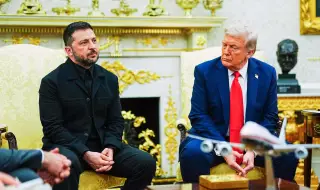
US President Donald Trump said that US ground forces will not be deployed in Ukraine as part of the security guarantees that the US and its NATO allies promised to offer Kiev. This has become one of the main topics in the American and British press, writes BTA.
Trump promised that American ground forces would not be deployed in Ukraine, but provided almost no other information about the scale of American security guarantees, while insisting on an end to Russia's war against its neighbor, reported "Politico".
"You have my guarantee, I'm the president", Trump said on Fox News when asked what guarantees he had that American troops would not enter the country to defend it from a new Russian invasion. At the same time, there is room for US military involvement that does not require American troops in Ukraine, including air support or non-combat roles. Trump stressed that Ukraine would not join NATO, but that Ukraine would receive security guarantees that "Europe will provide first and foremost". The president added that "several countries" – including France, Germany and Britain - want to have "soldiers on the ground". During a summit in Alaska on Friday, Russian President Vladimir Putin expressed openness to security guarantees, but the details of those security guarantees could become an obstacle to peace, "Politico" notes.
Speaking the morning after meetings at the White House with the Ukrainian president and European leaders, the US president said that US forces could help Ukraine's allies deter future Russian attacks, the "Financial Times" reports.
"As for security, the Europeans are ready to send people there. We are ready to help them with things... We are probably talking about air, because nobody has the things that we have," he added. The issue of security guarantees for Ukraine is one of several that remain unresolved after the White House summit and the Trump-Putin meeting in Alaska, the publication notes. Trump also said the United States is organizing a bilateral meeting between Putin and Ukrainian President Volodymyr Zelensky to discuss ending the conflict, although the Kremlin has not yet publicly agreed to such a meeting.
The newspaper "US Today" quoted White House spokeswoman Caroline Levitt, who confirmed that Trump was against the participation of American troops in peacekeeping operations in Ukraine: "The president has made it clear that American troops will not be on the ground in Ukraine, but we can certainly help coordinate and possibly provide other means of security assurances to our European allies".
This leaves open the possibility that European countries could agree as part of a peace deal with Russia to deploy troops in Ukraine with potential American air support, the "New York Times" notes. The leaders of Britain, France and Germany met to discuss their roles in post-war Ukraine. Ukrainian officials argue that only a binding agreement that would oblige the allies to defend the country could deter Russia from invading Ukraine again. Russia, however, has strongly rejected the idea of deploying international forces in Ukraine, suggesting that a peace agreement remains far off, even after an emergency meeting at the White House.
The Hill focuses on the domestic political factors in the United States that have led to Trump's stance. His Republican allies are pressuring him, citing his campaign promises not to involve the country in protracted conflicts or "forever wars."
"I have to look at what the responsibilities would be. We don't want another war. The people are not going to understand that after 20 years of wars in the Middle East. We don't want something to happen that requires us to fight and lose more lives," Alabama Senator Tommy Tuberville (R-Alabama) told reporters on Capitol Hill. "I'm telling you right now that the American people will not agree to something like this. The people of Alabama would definitely be against it. We have no appetite for war or our troops on the ground... I know President Trump is trying to do the right thing, but the Europeans have to take responsibility for this", added the senator, who according to "The Hill" is one of the influential supporters of the American president.
European leaders returned from the White House reassured by promises of a U.S. role in securing a peace deal with Russia, the Washington Post notes. The proposals include the U.S. supporting European forces with key capabilities they lack, such as intelligence, satellite surveillance or air power, but also with political signals of support to deter Russia from confrontation. The guarantees would not come officially under the banner of NATO, but from the so-called Coalition of the Willing.
The Washington Post, however, notes that there would be problems in implementing such a solution, citing experts. Thus, Tatyana Stanovaya, a senior fellow at the Carnegie Center for Russia, expressed doubt that Western countries could provide good enough guarantees for Ukraine that would not be rejected by Moscow. "The very idea of the dominant side on the battlefield agreeing to guarantees of non-aggression against its adversary is inherently contradictory. Real guarantees cannot exist: they would presuppose a readiness for direct military confrontation with a nuclear Russia, which the West neither has now nor is likely to develop in the foreseeable future without a global catastrophe". And pro-Kremlin political analyst Sergei Markov stated, quoted by the "Washington Post", that Russia "has no reason to stop" the war if Ukraine does not accept a radical reduction in its army and a forcible change in its government.
Intensive discussions are expected to take place in the next seven to ten days on the specifics of how America could support the European peacekeeping forces, writes the British "Daily Telegraph". The plans could include sending military trainers to Ukraine to help rebuild its war-torn armed forces, as well as Western fighter jets to patrol the skies over the country in the hope of resuming commercial aviation. Coalition officials have already drawn up plans for a European deployment, backed by US fighter jets and missiles on standby in Eastern Europe to respond with lethal force if Russia violates the terms of the ceasefire. It is hoped that such a pledge of support will be enough to deter Vladimir Putin from further attacks on Ukraine. The Telegraph quoted a European diplomat as saying that a US general could join the coalition’s command structure in the future – currently shared between London and Paris.
"The White House has just watered down the only concession it can claim Trump won from Putin - the security of Ukraine", in turn commented on the pages of the British "Independent" the newspaper's Washington correspondent. "The US will not send troops, and Russia will not accept forces from NATO countries in Ukraine. So what security guarantees can we even talk about?", he added.
In turn, the British "Guardian" notes that, according to some observers, despite all the diplomatic maneuvering, there has been little real movement towards ending the war. "Nothing happened in Anchorage. Nothing happened in Washington either. Putin, Zelensky and European leaders were relieved: they avoided unwanted decisions on the part of Trump. "But it was a triumph of empty ambiguity and meaningless commitments," wrote Gerard Arroux, former French ambassador to Washington, on the social network "Ex".