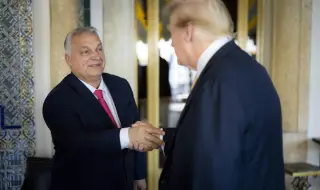
After the summit at the White House, US President Donald Trump spoke with Hungarian Prime Minister Viktor Orban. According to information provided by the US administration, the conversation touched on two important topics. First of all - Ukraine's potential accession to the European Union (EU). Negotiations on this have been officially underway since June last year, ARD recalls.
Almost all European countries have expressed their consent to Ukraine's integration into the United Europe, only Hungary is threatening to veto it. European leaders achieved unanimity with one trick - by holding the vote in Orban's absence.
Budapest has repeatedly threatened to block Ukraine's accession to the EU. Orban's government has repeatedly opposed EU military aid to Ukraine, as well as ongoing sanctions against Russia.
Hungary to lift its blockade on Ukraine's EU accession
Therefore, after the meeting in Washington, it is alleged that Ukrainian President Volodymyr Zelensky and European leaders have put pressure on Donald Trump to use their influence over Viktor Orban, sources told "Bloomberg". The goal is for Orban to abandon his position on Ukraine's European perspective.
Kiev's accession to the EU is seen as an additional guarantee for the country's security against renewed Russian aggression after the signing of a potential peace agreement. The question of exactly what these security guarantees would look like appears to have been central to the meeting between European leaders Donald Trump and Volodymyr Zelensky. The discussions were about ways to come as close as possible to implementing Article 5 of the NATO treaty, which states that an attack on one member state is considered an attack on all and requires collective defense.
Meeting in Budapest?
The second topic that, according to "Politico", Orbán and Trump discussed was the possibility of a planned meeting between Vladimir Putin and Volodymyr Zelensky being held in the Hungarian capital, Budapest. Although there has been no official confirmation yet, it is said that the Secret Service is already working on organizing this meeting.
Other countries have also offered to host the potential summit. Austria and Switzerland have announced that they will guarantee Putin immunity for the purposes of such an initiative. The International Criminal Court's arrest warrant for the Russian president would, in principle, put him at risk of detention if he enters Austria or Switzerland, which recognize the jurisdiction of the Hague court.
Putin "promised" meeting, Kremlin is evasive
Despite all the preparations, it is still unclear whether such a meeting will take place at all, nor when or where. The White House confirms that Putin has agreed to talk to the Ukrainian head of state, and White House spokeswoman Caroline Levitt assures that the Russian president has "promised". Donald Trump also made a comment to this effect in an interview after his meeting with Putin in Alaska. The American president believes that there should be a direct conversation between Putin and Zelensky, which should be followed by a trilateral meeting in which he himself will participate. Trump said that he had held "very successful" meetings with both leaders and believes that "now it would be better to meet without him". According to him, he wants to see how such a conversation would go.
While the White House seems convinced that such a summit will take place and soon, the Kremlin is much more reserved in its statements on the matter. Russian Foreign Minister Sergei Lavrov said that in principle Russia is open to any format of negotiations, but added that all meetings with state leaders must be prepared very carefully. Moscow has previously repeatedly refused direct meetings between Putin and Zelensky.
Regarding the potential for reaching an agreement, Lavrov reiterated that Russia expects "Russian interests in the field of security" to be taken into account, as well as "respect for the rights of Russians and the Russian-speaking population in Ukraine".