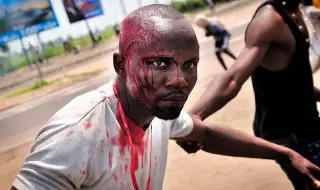
US President Donald Trump leaves no room for doubt who he thinks deserves the next Nobel Peace Prize - of course, him, who else, writes "Süddeutsche Zeitung" . The newspaper adds that Trump wants to present himself as a peacemaker not only in the case of Russia-attacked Ukraine, but also in Congo, calling in June the agreement between the Democratic Republic of Congo (DRC) and Rwanda, which the US mediated, "a wonderful deal". According to Trump, this plan is suitable for establishing peace in the DR Congo - and at the same time for securing valuable natural resources for the US.
Washington wants the US mediation in this conflict, otherwise largely ignored by the international community, to be seen as a historic turning point towards ending the fighting in the resource-rich region, which has been shaken by violence for three decades. The series of wars in the Democratic Republic of Congo was triggered and influenced by the 1994 Rwandan genocide, when Hutu extremists killed an estimated 800,000 people in just 100 days, mostly Tutsis but also moderate Hutus.
It is unclear how the conflict between the adversaries will continue
President Trump did not comment on the latest setback in the talks on the Democratic Republic of Congo, although this week's news is likely to significantly worsen the prospects for peace in the country: The M23, the most powerful rebel group in the region, has broken off talks in Qatar that were supposed to lead to an agreement between the rebel militia and the Congolese government. Instead, there is a stalemate with no prospect of how to proceed.
The rebels and the Congolese army accuse each other of violating a negotiated ceasefire. The talks in Qatar were supposed to conclude by August 18 with the signing of a peace treaty between the two countries. However, this did not happen, which is not a hopeful sign after all the euphoria that was hastily spread in Washington a few weeks ago, the newspaper notes.
So, without a result in Qatar, the entire US peace plan, devised by Trump and his advisers for Africa, has come to a standstill. It was supposed to pave the way for American investors in the region to invest in mining, trade and processing of raw materials; In addition, it was planned to replace the established smuggling deals with the work of legal trade chains between the warring countries of Rwanda and the Democratic Republic of Congo.
The rebel offensive worsens the situation of the population
A "Security Coordination Mechanism" between the two countries was supposed to bring calm to the conflict zones. This is an abstract concept that has yet to be translated into concrete steps, such as breaking up individual militias or integrating them into the Congolese security sector. Such attempts have been made repeatedly, but have not proven to work. The Congolese army is considered to be collapsing and corrupt.
Following their major offensive in the two Kivu provinces, supported by neighboring Rwanda, the M23 rebels now have a lot to lose. The rebels control an area roughly the size of the German state of Thuringia, and according to UN figures, thousands of Rwandan soldiers helped in the conquest and offensive. But the M23 offensive has significantly worsened the already fragile humanitarian situation in eastern Congo, exposing the population to great suffering.
Despite the agreed ceasefire, mass killings are taking place
The incidents are linked to the fact that the Congolese Tutsi-dominated M23 group is trying to crush the enemy militia, the Democratic Forces for the Liberation of Rwanda (FDLR). This militia is considered to be a gathering place for forces that may have participated in the Rwandan genocide or planned a coup in Kigali. Rwandan President Paul Kagame regularly criticizes the FDLR as the biggest threat to his country. But how strong the group actually is is difficult to assess, notes the "Süddeutsche Zeitung". Kagame's critics believe that the Rwandan president is deliberately exaggerating its power to justify his influence over the M23 and in eastern Congo as a whole.
All militias commit atrocities. And they all want the raw materials mines
A report by Amnesty International (AI) investigates the atrocities committed by the M23, but also by their opponents, the alliance of militias "Wazalendo" (Swahili for "patriots"). These are forces that collaborate with the Congolese army. Amnesty reports shootings, rapes and kidnappings of defenseless people. The attacks "aim to punish, intimidate and humiliate civilians," writes Tigere Chaguta, regional director of AI, of the actions of armed groups aimed at controlling people and territories.
In fact, the heads of state of Rwanda and the Democratic Republic of Congo were to travel to Washington soon to conclude peace in Congo at the highest level. This was to lead to photos showing Trump successfully convincing the warring opponents Paul Kagame from Kigali and Felix Tshisekedi from Kinshasa to conclude a peace treaty, the "Süddeutsche Zeitung" commented. But for now, it seems that the Americans have concluded this deal without the M23 militia, which is now delaying the process either to extract advantages or to obtain possible guarantees for itself, or does not see its role at all after a future peace agreement shaped by the US, and is therefore opposing and buying time.
What role the M23 will play in the future remains unclear, the rebels control lucrative mines, for example in the Rubaya region, and profit from the trade in raw materials, mainly the mineral coltan, which is used in mobile phones and other electronic products. The Democratic Republic of Congo is one of the most important sources of these treasures. Working conditions in the mines are harsh and often exploitative. But Congolese families have no choice but to make ends meet.
US President Donald Trump’s quest for the Nobel Peace Prize has guided his foreign policy since his return to power, Politico reports. Unfortunately, his desire to be the world’s “chief peacemaker” is based on a profound misconception: that peace simply means ending hostilities.
“I’ve ended six wars,” he said in July. “On average, one a month” – a claim that, if true, would truly merit a Nobel Prize.
A relatively substantial agreement was reached in late June to end the fighting between Rwanda and the Democratic Republic of Congo. The U.S.-brokered agreement, signed in the Oval Office, required Rwanda to withdraw its troops from the DRC within 90 days.
"We just ended a war that had lasted 30 years and killed 6 million people," Trump said, though that number includes the millions killed in civil wars in both countries, Politico notes. "No other president could have done it," Trump stressed.
But while this deal is indeed a real step toward ending the conflict, it is important to remember that the key lies in its implementation. And on that front, the news is much more mixed, as fighting between the Rwandan-backed M23 rebel group and the DRC army continues unabated - in part because the M23 did not sign the deal.
Human Rights Watch on Wednesday documented M23 attacks on several villages near Virunga National Park in July, Reuters reported. The militia "executed more than 140 civilians," HRW said, "mostly from the Hutu ethnic group, in 14 villages and small rural communes."
The rights group provided new details about the series of killings first reported by Reuters in July. According to HRW, the total number of killings in Rutshuru territory in July could exceed 300, confirming similar findings by the UN last month.
Peace has not yet come to DR Congo…