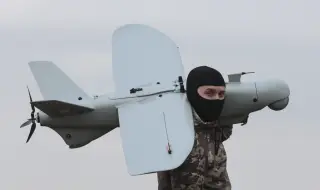
When a Ukrainian drone attacked a Russian ammunition depot last September, it showed Kiev's determination to strike deep behind enemy lines and the strength of Ukraine's defense industry, the Associated Press reported, BTA reported.
The moment was a source of particular satisfaction for the woman in charge of producing the drones, which flew more than 1,000 kilometers to carry out the mission. For months afterward, Russia no longer had the means to continue devastating attacks with cruise missiles like the one recently targeted in her hometown of Kharkiv.
"Air combat is our only real asymmetric advantage on the battlefield right now. "We don't have as much manpower and money as they do," said Irina Terek, head of production at Ukrainian startup Fire Point.
Terek spoke as she inspected dozens of "long-range strike drones" that had recently rolled off the assembly line and would soon be used by the Ukrainian armed forces to attack Russian weapons depots, oil refineries and other targets vital to the Kremlin's military machine and economy.
Driven by its existential struggle against Russia - and limited military assistance from Western allies - Ukraine has quickly become a global center for defense innovation, the AP notes. The goal is to match, if not surpass, Russia's capabilities, which have been brutally demonstrated recently, and "Fire Point" is one of the companies leading the way in this area.
AP reporters were given the rare opportunity to peek inside one of Fire Point's dozens of secret factories. In a huge warehouse filled with rock music, the Ukrainian startup's managers showed off their signature FP-1 drones, which are loaded with explosives and can travel up to 1,000 miles. They also publicly unveiled for the first time a cruise missile they are developing with a range of about 3,000 kilometers, which Ukrainian President Volodymyr Zelensky hopes to have in mass production by the end of this year.
Even as U.S. President Donald Trump pushes for an end to the three-and-a-half-year war and talks about the prospect of U.S. support for NATO-style security guarantees, Ukrainian military officials say their country is determined to become more self-reliant in its fight against Russia.
"We believe that our best guarantee is not to rely on someone else's willingness to protect us, but rather on our ability to protect ourselves," said Arsen Zhumadilov, head of the country's arms supply agency.
Ukraine's government currently buys about $10 billion worth of weapons annually from domestic manufacturers. Officials say the industry has the capacity to sell three times that much, and they believe sales to European allies could help it reach that potential within a few years.
Like most defense companies in Ukraine, "Fire Point" emerged out of necessity after Russia's full-scale invasion in 2022. Despite pleas from Ukrainian military officials, Western countries were reluctant to allow Kiev to use the allies' longer-range weapons to strike targets deep inside Russian territory.
Then a group of close friends, experts in various fields, set about mass-producing cheap drones that would match the power of the Iranian "Shahed" drones that Russia has been launching against Ukraine with devastating results.
Bringing together knowledge from construction, game design, and architecture, the founders of "Fire Point", who had no defense experience, created innovative drone designs that could fly farther and strike with greater precision than most products already on the market. The long-range drones had another advantage: they didn't have to take off from an airport.
When Tereh, an architect, was hired in the summer of 2023, she was given a goal of producing 30 drones a month. Now the company is producing nearly 100 drones a day for about $55,000. The FP-1 drone looks more like a hastily constructed science project than something that would come off the production lines of the world's largest defense contractors. "We removed the unnecessary, shiny, and shiny elements," she said.
But the Ukrainian FP-1 drone has proven to be extremely effective on the battlefield.
With a payload of 60 kilograms of explosives, this type of drone is used in 60% of strikes deep inside Russian territory, including strikes on oil refineries and weapons depots, according to Terek. These strikes have helped slow Russia's advance along the 1,000-kilometer front line in eastern Ukraine, where army units have reported a sharp drop in artillery fire.
The story of "Fire Point" is not entirely unique. Soon after the Russian invasion in 2022, hundreds of defense companies sprang up almost overnight. The Ukrainian government has encouraged innovation by easing regulations and making it easier for startups to work directly with military brigades.
Patriotic entrepreneurs in the fields of metallurgy, construction, and information technology have built facilities for the research and production of weapons and ammunition - with an emphasis on drones. The ongoing war has allowed them to test their ideas almost immediately on the battlefield and adapt quickly to Russia’s changing tactics.
"Ukraine is at a unique moment in which it is de facto becoming the Silicon Valley of defense," said Ukrainian defense entrepreneur Yaroslav Azhnyuk.
Because defense companies are valuable targets for Russia, many of them operate underground or are hidden in public centers to avoid detection, but this strategy has the disadvantage of putting civilians at risk.
This year, "Fire Point" completed testing of its first cruise missile, the FP-5. Capable of landing within 14 meters of its target, the FP-5 is one of the largest missiles of its type in the world, independent experts say. Since the first versions of the missile were painted pink due to a manufacturing error, they called it "Flamingo" - and the name stuck.
Even as Zelensky and other Ukrainian officials seek ways to end the war, Terek said she was skeptical that Russia would accept the terms of a real peace. "We are preparing for a bigger, much more terrible war," she explained.
Ukraine hopes to significantly increase production of its new long-range "Flamingo" missiles, which were first unveiled last weekend, by the end of the year, according to the American news site specializing in military technology, strategy and international politics "The War Zone" (TMZ).
"Fire Point" produces approximately one "Flamingo" missile per per day, and by October the company aims to reach a capacity of 7 missiles per day, although there are doubts about how realistic these significantly inflated production targets are. Seven missiles per day means 2,555 produced annually. According to technical data, the missile has a range of about 3,000 kilometers and a warhead weighing 1,150 kilograms, making it a much longer-range and more destructive weapon than any other missile or single-target attack drone that Ukraine currently has.
Ukrainian President Volodymyr Zelensky briefly spoke about the "Flamingo" at his meeting with journalists yesterday. According to some previous reports, the new missiles have already been used to strike targets in Russia, but it is not known how many have been produced so far.
"The tests of this missile were successful. And so far this is the most successful missile that we have - it flies 3,000 kilometers, which is important. "I think we can't talk much about it until we are able to use hundreds of missiles," Zelensky said yesterday, quoted by Ukrinform.
"By December we will have more of them. And by the end of December or in January-February, mass production should begin," the Ukrainian president added.
The new images of the missile also confirm that the "Flamingo" is simply a very large weapon in general. We now also have a direct look at the warhead inside, which has a pointed front, which could mean it is designed to better penetrate harder targets. It is possible that the warhead is a converted aerial bomb.
Apart from the claimed range and size of the warhead, exact details about the "Flamingo"'s capabilities remain limited. The rocket is powered by a single jet engine and launched using a rocket booster via a rail mounted on a two-wheeled trailer.
Experts and observers have drawn comparisons between what can be seen of the Flamingo's engine and the AI-25TL turbofan, best known as the engine for the L-39 Albatros jet trainer. This would be a logical choice, considering that the AI-25 series was originally developed by the Ukrainian state-owned Ivchenko enterprise in what was then Soviet Ukraine, and Ukrainian aircraft engine company Motor Sich continues to produce versions today. Ukraine also uses the El 39 Albatross aircraft, which has been and continues to be a very popular model worldwide, with thousands produced to date, which opens up additional opportunities for engine supply.
As War Zone notes, the technical parameters of the Flamingo missile are also extremely close to those of another cruise missile called the FP-5, which is offered by the Milanion company in the United Arab Emirates. Milanion describes the FP-5 as a missile with a wingspan of about 6 meters, a maximum takeoff weight of 6,000 kilograms and a warhead weighing 1,000 kilograms, as well as a maximum speed of 950 kilometers per hour and a flight speed of about 850-900 kilometers per hour. The missile reportedly features a guidance package with an inertial navigation system aided by satellite navigation, which is designed to be resistant to electronic warfare attacks.
The FP-5 designation also matches the designation of another well-known Fire Point product, the FP-1 long-range kamikaze drone. However, the exact relationship between the Flamingo missile and the Milenium-produced FP-5 remains unknown.
If Fire Point were to scale up production of the Flamingo missile, it would give Ukraine a new and extremely valuable means of striking key targets deep inside Russia in a more destructive manner. The missile's jet engine also offers advantages in terms of speed and survivability for penetrating deeper into Russian territory, especially compared to the converted light aircraft and other longer-range drones that Ukraine currently relies on for this type of strike. The described warhead size, combined with the jet speed, would also give the missile the ability to penetrate more fortified targets, opening up opportunities for entirely new types of targets.
It remains to be seen whether "Fire Point" can significantly increase production of "Flamingo" and at what cost. The cost of one missile is currently unknown. "We need to consider financing this program," Ukrainian President Zelensky said yesterday, as quoted by Ukrinform.
The appearance of "Flamingo" However, it comes at a time of particular uncertainty about how the ongoing war in Ukraine might play out, amid renewed discussions about ceasefire and peace proposals. The US administration has also reportedly pressured Ukrainian authorities to offer territorial and other concessions to Russia in order to end the fighting, following a summit between US President Donald Trump and his Russian counterpart Vladimir Putin in Alaska last week.
At a strategic level, "Flamingo" could give Ukraine a valuable additional negotiating tool, given Russia's wide reach, which it could potentially threaten, War Zone notes. As a weapon developed domestically, Ukrainian forces would have much greater freedom to fire the missiles at targets on Russian territory. Western countries periodically impose restrictions on the use of long-range munitions they supply against Russia itself and otherwise pressure Ukraine not to strike certain categories of targets.
"It is very difficult, if not impossible, to win a war without attacking the aggressor's country. It's like a great sports team that has a fantastic defense but is not allowed to play offense," Trump wrote yesterday in a post on his social network "Truth Social". "(Former US President) Joe Biden did not allow Ukraine to OPEN, only to DEFEND. What was the result of that?"
That is why Ukraine has a clear incentive to do everything possible to increase its stock of long-range "Flamingo" missiles and help them realize their full potential, concludes "War Zone".