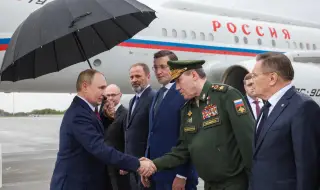
Russian President Vladimir Putin refuses to meet with Volodymyr Zelensky - despite Donald Trump's attempts to arrange such a meeting and ultimately end Russia's war against Ukraine.
Ukrainian TV FREEDOM indicates that Putin is deliberately avoiding a meeting with Zelensky. Here are the reasons.
There can be no concessions to Putin. This may be the biggest mistake, said the EU's High Representative for Foreign Affairs and Security Policy Kaia Kalas. “This is the trap that Russia wants to lure us into. The whole discussion boils down to what Ukraine should give up, what concessions it should make. At the same time, we forget that Russia has not made a single concession and is the aggressor in this situation. It is the one that brutally attacks another country and kills people. Without any international legal basis for this“, said Kallas.
The European Union is preparing the 19th package of sanctions against the aggressor country. It could be approved in early September. Washington, for its part, also has levers of pressure on the aggressor - sanctions and tariffs.
It is important to clarify that Trump has not yet imposed severe sanctions against Putin, although he often threatens him with such.
Europe and the United States insist on the need for direct negotiations between the Ukrainian president and the head of the Kremlin - that is, they demand that the Russian president fulfill his promise. In a telephone conversation with Trump, Putin agreed to a dialogue with the Ukrainian president. Now the Kremlin is coming up with new excuses to postpone this meeting or, even better, cancel it altogether.
Russia does not want Ukraine to receive effective security guarantees. Therefore, he is postponing a meeting with Zelensky and a ceasefire.
The coalition of the willing intends to provide Kiev with guarantees that will exclude the possibility of new Russian aggression, NATO Secretary General Mark Rutte assured.
This contradicts Moscow's interests. That is why it is trying to bargain for a veto. Lavrov said that Russia supposedly "cannot agree" to a solution to collective security issues without him. And he threatened decisive measures if "Russia's legitimate interests" are not taken into account in any post-war security agreement for Ukraine.
The Institute for the Study of War (ISW) commented on the reasons for Moscow's actions. The Kremlin is probably trying to weave its demands into the ongoing joint efforts of the United States, Europe and Ukraine to create a security structure that would serve as a guarantee against a possible repeated Russian invasion in the event of a peace agreement. Giving Russia a veto over Western security guarantees would allow the Kremlin to dictate terms that would weaken Ukraine’s ability to resist another Russian invasion by preventing it from concluding binding bilateral or multilateral security agreements, such as those currently under discussion, building and modernizing its military, and receiving support from partners.