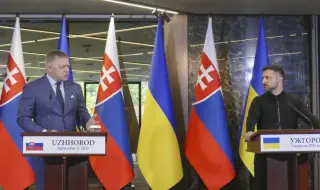
Ukrainian President Volodymyr Zelensky said that if his Russian counterpart Vladimir Putin sincerely wanted an end to the war, he would not have incited Ukraine's neighbors to impose an energy blockade on it. Zelensky said this at a press conference with Slovak Prime Minister Robert Fico, Ukrinform reported, quoted by BTA.
"If someone really wants to end a war, he will not force neighboring countries to impose an energy blockade. This shows that he wants to attack our energy sector and understands that we are thwarting this as much as we can and importing energy when we can, in accordance with EU rules," the Ukrainian leader said.
He expressed gratitude to all European countries that have supplied energy to Ukraine in times of need.
"We are grateful to all countries, including Slovakia, that help us receive energy when it is in deficit," the president added.
Zelensky said that the most worrying thing is Russia's attempts to block energy supplies to Ukraine.
"That's the problem - we are not putting enough pressure on Russia to make it think about ending the war. The pressure must be common and come from all partners in Europe and the United States," he stressed.
He added that US President Donald Trump had been "extremely outspoken about the need for Europe to stop receiving energy resources from Russia, which profits from them and uses the revenues to wage war against Ukraine."
Earlier this week, Fico met with Putin in Beijing to discuss issues related to Ukraine. The Slovak leader said he was categorically against Ukrainian attacks on the Druzhba oil pipeline, adding that he planned to raise the issue at the meeting with Zelensky.
Bratislava supports Ukraine's membership in the EU, but not NATO, Fico said.
Hungarian expert Andras Ratz told Ukrinform that the recent Ukrainian attacks on the Druzhba pipeline are part of a larger strategy aimed at the Russian oil industry and that the disruption of supplies to Hungary and Slovakia is only an indirect effect.
Link to main version
Sep 6, 2025 04:17 438
Zelensky: Pressure on Russia is not enough
It must be common and come from all partners in Europe and the US, Ukrainian president says
Снимка: ЕПА/БГНЕС