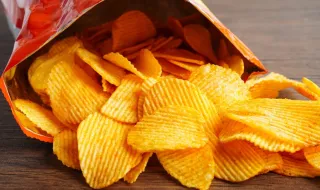
Potato chips have long been no longer the only choice on the market. More and more manufacturers are offering alternatives made from lentils, chickpeas, corn, rice, peas and various vegetables, presenting them as healthier and rich in protein. But are these products actually superior to traditional potato chips?
According to nutritionists, the main ingredient is not enough to determine whether a product is healthy. The method of preparation, the amount of fat, salt and fiber content, as well as the size of the portion, are important. In some cases, legume chips provide more protein, but can contain almost as many calories as regular potato chips.
Potato chips remain among the most caloric options, typically containing between 500 and 550 calories per 100 grams. When fried, potatoes absorb a significant amount of fat, which can reach 30-35 grams per 100 grams of product. The protein content is relatively low, around 5-7 grams. However, the advantage of the classic salty options is their simple composition, which often includes only potatoes, vegetable oil and salt. Baked varieties tend to be lower in fat, but not necessarily significantly lower in calories.
Corn chips have a similar nutritional profile. Depending on the manufacturing process, they provide approximately 470–520 calories per 100 grams, and the protein content is around 5–8 grams. Corn is a natural source of certain fiber and carotenoids, but the amounts in the final product depend on the degree of processing. Flavored varieties, especially those with cheese and spicy seasonings, often contain more salt.
Among the most popular alternatives in recent years are lentil chips, which typically contain between 400 and 480 calories and about 10–15 grams of protein per 100 grams. This is approximately twice as much protein as traditional potato chips. However, the products are often made from lentil flour mixed with starch, oils and spices. As a result, the fiber content is not always as high as consumers expect, and some varieties are relatively salty.
Chickpea chips offer similar benefits, typically providing 10–16 grams of protein and 4–8 grams of fiber per 100 grams. The combination of protein and fiber can contribute to a longer feeling of satiety. However, this is especially true for products in which chickpea flour is the main ingredient. In some brands, a significant portion of the content is formed from rice or corn flour, which reduces their nutritional advantage.
Even higher protein content is offered by protein chips made from soy, pea or milk protein. Depending on the recipe, they can contain between 20 and 40 grams of protein per 100 grams, with a calorie content of around 350–450 calories. This makes them attractive to athletes and people looking to increase their protein intake. However, a high protein content does not necessarily mean better nutritional composition. Some of these products contain significant amounts of salt, flavorings, and other additives.
The profile of rice chips is different, and they are often produced by baking or expanding. Some varieties are low in fat, but they usually provide little fiber and protein, especially when made from refined white rice flour. Their calorie content is approximately 380–450 calories per 100 grams. Due to their high content of easily digestible starch, they do not always fill you up as well as legume products.
Vegetable chips made from beets, carrots, parsnips or sweet potatoes are not automatically healthier either. Although the main ingredients contain vitamins, minerals and plant pigments, frying significantly increases the calorie content of the final product. In some varieties, it reaches 450-550 calories per 100 grams, practically the same as regular potato chips. Some of the heat-sensitive nutrients also decrease during processing.
The differences between the individual categories are most clearly seen when comparing the approximate values per 100 grams of product:
Type of chips Calories Protein Potato, fried 500-550 5-7 g Corn 470-520 5-8 g Lentil 400-480 10-15 g Chickpea 400-480 10-16 g Protein 350-450 20-40 g Rice 380-450 5-8 g Vegetable, fried 450-550 3-7 d
The values are approximate and may vary significantly depending on the composition and method of production.
Experts emphasize that the most important indicator when choosing chips is often the salt content, not the raw material from which it is made. The World Health Organization recommends that adults consume less than 5 grams of salt per day, including the amounts contained in ready-made foods.
It is also important to compare nutritional values per 100 grams, not just per packet. A smaller portion may seem significantly lower in calories, without the product itself having a better composition.
If the goal is a higher protein and fiber intake, chickpea and lentil chips may have an advantage over potato chips. Protein options provide even more protein, but are not necessarily suitable for everyone. To limit fat, baked or expanded products are often a better choice, as long as they do not contain excessive amounts of salt.
Ultimately, there is no one type of chip that is categorically superior to all others. Even legumes and vegetables remain packaged snacks, whose place in a healthy diet depends mostly on their composition, frequency of consumption, and portion size.