



On January 14, 1967, a speech gave the beginning of the global hippie movement. The speech was by Professor Timothy Leary, who had been fired from Harvard University a few years earlier. The speech was delivered during The World's First Human Be-in in San Francisco.
Timothy Francis Leary was an American psychologist and author, best known for his study of the effects of psychedelic drugs and for his position promoting the freedom of their use.
Timothy Leary was born in 1920 in the city of Springfield and died on May 31, 1996 from prostate cancer. His remains were sent into space. Before he died, he asked his relatives to give him LSD, and died under the influence of the drug, as the writer Aldous Huxley had done years before him. His last words were "why not?", repeated with different intonations. One of his closest friends, Robert Anton Wilson, continued to spread Leary's ideas before he himself died in 2007.
Leary taught at Harvard until 1963, when he was expelled. By this time, Leary had already tried LSD, and had become its ardent defender and proponent. He introduced many people to the drug, including Aldous Huxley, Thelonious Monk, Alan Ginsberg, William Burroughs, and Jack Kerouac. Leary believed that under the influence of LSD, one could experience both enlightenment and the separate realms described in The Tibetan Book of the Dead. Inspired by his LSD experiences, Leary, along with his colleagues Ralph Metzner and Richard Alpert (Ram Das), wrote a psychedelic adaptation of the Tibetan text to serve as a manual for psychonauts.
In 1970, Leary was sentenced to 20 years in prison for possession of 40 grams of marijuana, which he denied. A little later, he managed to escape from prison and lived in Algeria, Switzerland, Austria and Lebanon. Then came Afghanistan, from where he was kidnapped by American intelligence and returned to the United States, where he was arrested with a bail of $ 5 million - the largest in US history to that point. US President Richard Nixon declared him the “most dangerous man in America”. Leary was placed in a separate cell with a sentence of 95 years, his neighbor in the cell opposite was Charles Manson. Leary held talks with him and wrote books.
He was released in 1976 by the newly elected liberal Governor of California Jerry Brown, who took the place of the previous conservative governor and future president - Ronald Reagan. Leary devoted the rest of his life to writing books and giving lectures. After his death, he was cremated, and his ashes were launched into space, along with the remains of 24 other people, on April 21, 1997. Leary's remains now orbit the Earth every 62 minutes.
Hippie, also called the hippie movement or hippieism, is a youth movement that emerged in the United States in the 1960s and gradually declined after the 1970s, although hippies still exist in individual countries and regions to this day. Some researchers consider it to be more of a cultural than a political phenomenon, while others characterize it as purely religious. It acquired a strong political overtone due to protests against the Vietnam War, but at the same time it had cultural and philosophical implications, because it dictated new trends in fashion, music, fine arts and literature. The attraction to Eastern religions, mysticism and shamanism gave hippieism a religious dimension.
From the USA, hippieism quickly spread to England, from there to other countries in Europe, and later to Japan, Australia and New Zealand. The culmination of the movement occurred with the Summer of Love – gathering of about 100,000 people in San Francisco in the summer of 1967 and the Woodstock Festival in 1969.
It had a huge impact on the overall development of society and many of its ideas gradually and unnoticed made their way into everyday life - music festivals, changing moral standards, healthy food, protection of nature and others.
For the first time, the word hippie was used by the American journalist Michael Fallon in 1965 to distinguish the new from the old bohemians. Most of the new rebels for the time were between the ages of 15 and 25 and came from white middle-class families. The style of expression, behavior and appearance adopted by the hippies turned the prevailing norms of the time upside down.
Some of the main distinguishing external features of the hippie are jeans and loose, loose clothing in bright colors and broken patterns, colorful necklaces and bracelets and especially long hair. Music becomes a central expression of the hippie movements and it is mainly varieties of rock and roll. The sound of the Beatles, The Who, Rolling Stones, Jimi Hendrix, Led Zeppelin, The Doors, Bob Dylan, Pink Floyd, Bob Marley, Grateful Dead, which embody the spirit of the era seen through the eyes of the hippies, is gaining particular popularity.
Hippie movements often express ambivalent sexual orientation and/or promote sexual tolerance, including gay rights; rights for people of color; environmentalism; universal human rights and freedom of expression. The hippies' attempts to change reality gave rise to mass social activism, which openly opposed many official institutions such as the church and the political establishment.
In the USA, the mass public burning of draft cards for Vietnam and participation in the military conflict there, testify to the radicalization of the hippie movements. Many hippies experimented with vegetarianism; free sexual relations; various drugs (mostly psychedelics); life in self-governing communes, several of which continue to exist to this day; various occult, magical, esoteric or mystical teachings and practices.
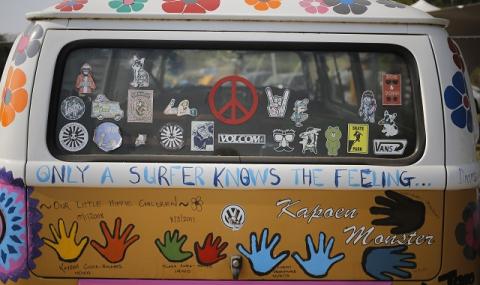
Hippies are usually not institutionally organized, they worship love and place it as the main basis and meaning of human existence. Flowers as a symbol of beauty, naturalness, non-violence and freedom become their emblem. They oppose bureaucracy, totalitarianism and the suppression of individuality. Many of them feel an attraction to a simple way of life. Their motto is "Peace, Love, Freedom" explicitly expressed in songs such as the Beatles' "All you need is love" and the motto "Make love, not war!". And so the characteristic themes of travel and wandering among hippies, especially hitchhiking, find powerful expression in the novel "On the Road" by Jack Kerouac.
The searches and wanderings of young people of this generation were most fully expressed at the legendary festival “Woodstock“, held in the town of Bethel in New York State on August 15, 16 and 17, 1969. The festival is the most popular manifestation of the hippie movement and remains in history as the realization of the collective youth rebellion. The concert featured The Who, Jefferson Airplane and the Grateful Dead, Janis Joplin, Jimi Hendrix, Carlos Santana, Joe Cocker and many others. The festival was attended by about 400,000 people.
Later festivals with the same name were held in New York State in 1979, 1989, 1994 and 1999. Although hippieism has long ceased to be a mass movement, it never completely died out.