


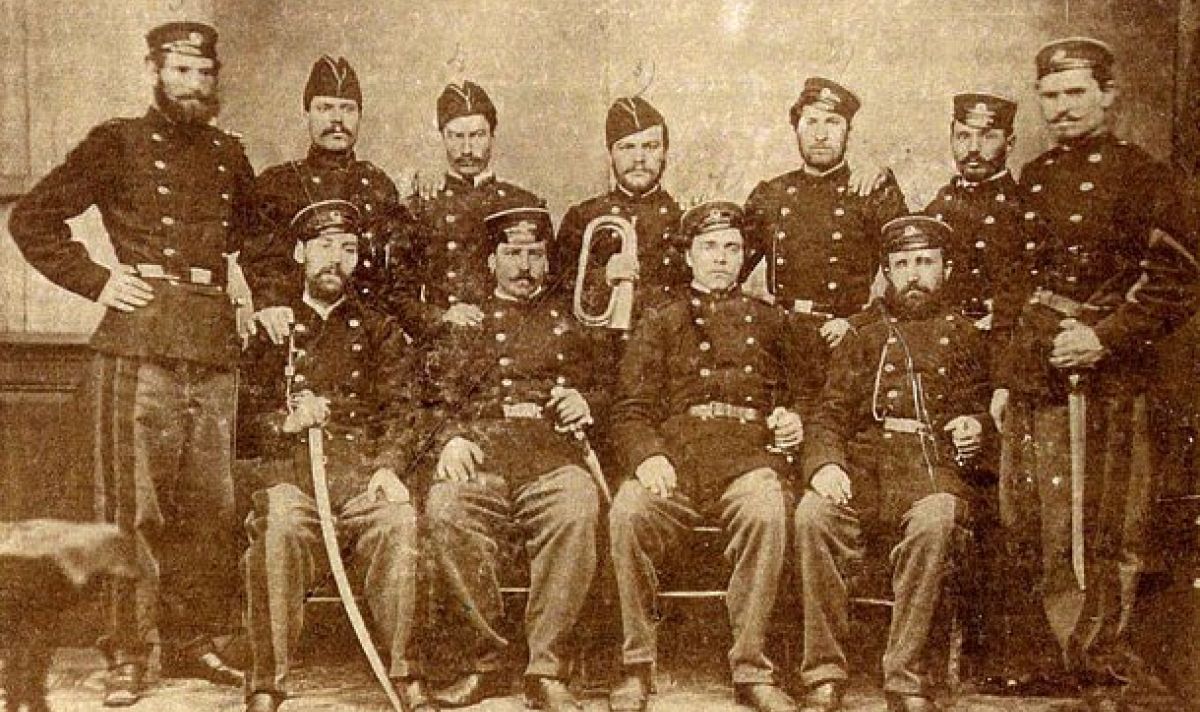

On June 3, old style (June 15, new style), 1862, the volunteers of the First Bulgarian Legion received their baptism of fire, entering into battle with the Turkish garrison in the Serbian capital Belgrade. The creation of the Bulgarian armed unit on Serbian territory is associated with the changed situation on the Balkan Peninsula in 1859-1860. Then the relations between Belgrade and Istanbul entered a phase filled with tension. The ruling circles in the Serbian capital organized massive anti-Turkish propaganda and began to prepare for a military campaign against the Ottoman Empire, recalls the Bulgarian National Radio.
The complicated international situation in the Balkans was skillfully assessed by Georgi Rakovski, who in 1860 arrives in Belgrade to begin the implementation of his ideas for the liberation of Bulgaria from Ottoman rule.
In the Serbian capital, the great Bulgarian patriot begins to publish “Danube Swan“ - the first revolutionary newspaper of our emigration. In Belgrade, Rakovski prepares a plan for the liberation of the Bulgarian people, according to which the future uprising in Bulgaria must be coordinated with a military campaign of the Serbian army against the Ottoman Empire. The famous Revivalist envisages the formation of a detachment of 1000 liberation fighters in Serbia, who, after the start of the war between Serbia and the Ottoman Empire, will enter Bulgarian territory.
They must pass along the ridge of the Stara Planina and reach the old capital of Tarnovo, where, with the assistance of a previously established local committee, they will liberate the city and declare the creation of a free Bulgarian state.
In 1862 Rakovski drafted a statute for a Provisional Government, which, according to his predictions, should lead the entire campaign. He entered into negotiations with the Serbian official authorities and received permission to organize a volunteer detachment, which would be composed of our compatriots. From the pages of the newspaper “Danube Swan“ he sent an appeal to Bulgarian patriots.
Thus, in the spring of 1862, about 600 people gathered in the Serbian capital, who became part of the First Bulgarian Legion. Among them were Vasil Levski, Stefan Karadzha, Ilyo Voivoda, Hristo Tsonev Brchkov, Vasil Drumev, Hristo Ivanov-Golemiya, Hristo Makedonski, Dimitar Berovski, and others. In June 1862, tensions in Belgrade between Serbs and Turks escalated. On June 3 (June 15, new style), a Serbian youth was killed by Turkish soldiers at one of the city fountains.
This was used as an excuse by the local Serbs to start pursuing all Turkish soldiers who were outside their garrison, located in the Belgrade Fortress. The armed clashes found Rakovski in the midst of preparing an uprising for the liberation of Bulgaria, but he, together with the Bulgarian volunteers, joined the fighting to help the Serbs. At first, the Serbian authorities tried to stop the conflict and Rakovski received an order to withdraw with his fighters, but the fighting continued throughout the night, with the most dramatic battles at Varoš Kapija and Vidin Kapija.
The Bulgarian volunteers also took an active part in them, showing great courage. Georgi Rakovski and Ilio Voivoda locked themselves in a Serbian house near Varosh Kapija and from there they fired at the retreating Turks, while another group of volunteers, together with the Serbs, chased the enemy to Kale Megdan. Bulgarian builders began to demolish every Turkish post with axes and pickaxes.
The Serbian rulers and foreign diplomatic representatives made efforts, as a result of which the fighting ceased on June 16.
The Bulgarian legionnaires went to Rakovski that same day with the captured enemy weapons. They strapped one of the captured swords to the waist of their leader, who greeted them with the words: “Hello young men“, and they responded with: “Hurray, hurray, long live Bulgaria and its brave soldiers!“
Until the morning of June 17, the situation was calm, but the Turkish artillery from the Belgrade Fortress began shelling the city. The shooting continued for four and a half hours, causing a complex diplomatic crisis. Fighting broke out again in the Serbian capital, in which Rakovski's volunteers also joined. According to eyewitness accounts, our patriot led the column of Bulgarians. They passed by the Prussian consulate in Belgrade, where they were greeted by the Prussian consul general, and then by Serbian soldiers with the greeting: “Long live Bulgaria and the Bulgarian Legion!“ War between Serbia and the Ottoman Empire did not occur, and at the insistence of the government in Belgrade, the legion was disbanded.
In 1867, when relations between Serbia and the Ottoman Empire deteriorated again and the Serbian government began to prepare for military action, the Second Bulgarian Legion was created. The formation of the two legions showed the Bulgarian revivalists that the creation of a center to lead the national liberation movement in other countries and the linking of the goals of our national revolution with the politics of other countries was risky. Nevertheless, the legions gave baptism of fire to a large number of the future leaders of our national liberation movement.