


102 years ago, on January 21, 1924, Vladimir Lenin, the founder and first leader of the Soviet state, died. A series of strokes in his final years changed Ilyich beyond recognition and became a compelling reason for his rivals to remove the Bolshevik leader from all business.
His end is described in detail in Lev Danilkin's book “Lenin“.
After the stroke on March 10, 1923, Lenin's illness took a terrible, heartbreaking form. This time the mirror of his entire life cracked; Finding himself in a ringing darkness, frightened, deafened, blinded and confused, he was in such great pain that he tried to initiate the protocol for "euthanasia", which had been under discussion since December 22 (in case the paralysis spread to speech, to obtain potassium cyanide "as a measure of humanity and in imitation of Lafargue", Marx's daughter and son-in-law, who committed suicide rather than live as old men).
At least until July 1923, he could not be left alone for a minute without a nurse: his psyche and motor skills were unstable.
He could not sleep and suffered from severe migraines; insomnia could last for several days and was particularly exhausting for both the intellect and the body. Sometimes, being carried around the room in a wheelchair seemed to help him.
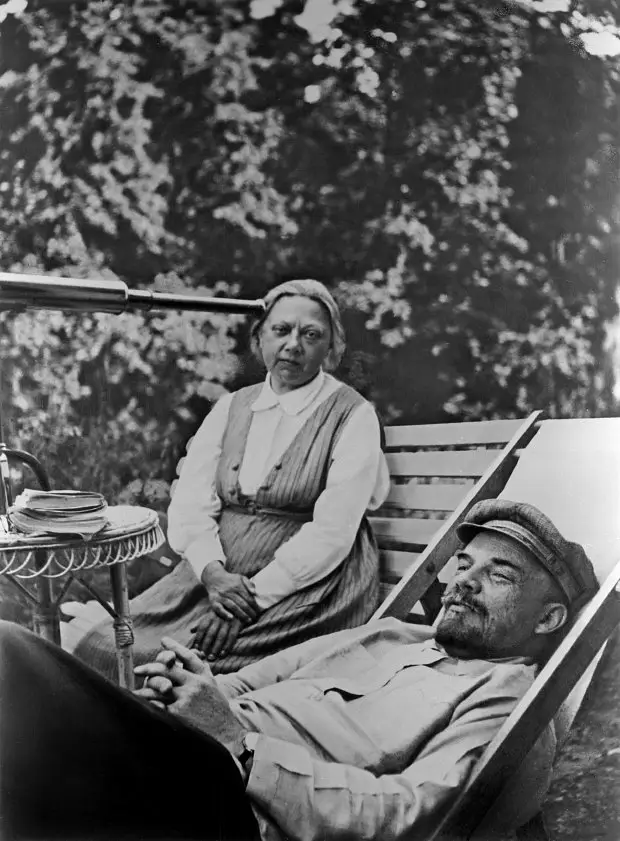
He experienced nervous excitement, anger, and it was often impossible to control his emotions. Sometimes he could not hold back his tears in public. He had moments when he would gesticulate feverishly, scream, sing, and so on, to the horror of his relatives, who had never seen anything like it.
At these moments he seemed crazy, possessed by demons, feeble-minded, mentally ill, an idiot.
He had nightmares and hallucinated. He would lose consciousness irregularly and quite often for 15-20 seconds. Sometimes these seizures were accompanied by painful convulsions.
His hearing and vision were impaired. He had speech disorders.
“He could not“, wrote one doctor, “express the simplest, most primitive thoughts relating to the most pressing physiological needs. He could not speak, but he could understand everything. This is terrible. His face was written with suffering and some shame, but his eyes shone with joy and gratitude for every thought understood without words.“
Sometimes he lost the ability not only to generate speech, but even to perceive the speech of others – apparently, realizing that they were addressing him, he could not decipher what they were saying, as if he were hearing words in a foreign language.
Almost all the time he retained the ability to use at least a few words, “speech remnants“, especially “almost about“ and “what-what“, but “he had the richest intonation, conveying every slightest nuance of thought, he had the richest facial expressions“ – so those who met him during this period, in their stories, without agreeing, claimed that Lenin "spoke" to them.
Sometimes he mumbles and grumbles, reminding Bulgakov's Sharik in a borderline animal-human state. Those who tried to make sense of his chatter hear something like:
“Help--the-devil-iodine-helped-if-this-iodine-alya-vodi-guten-morgen“
Some parts of the body - especially the limbs - go numb and stop bending. The entire right side of the body goes numb sporadically. This could happen both at rest and while walking; then he would fall to the ground, hitting himself painfully, and lie helpless for some time, unless someone was nearby to pick him up. The left side was more reliable.
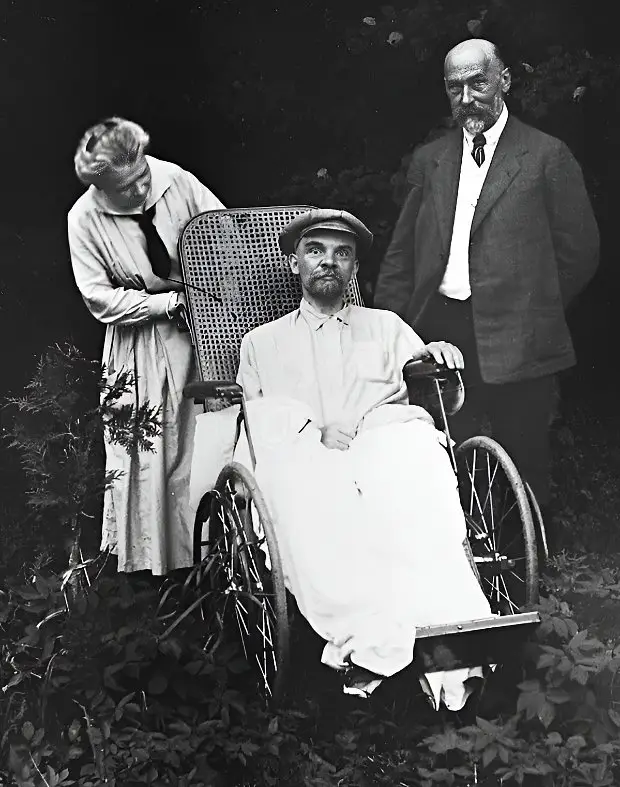
His temperature would rise and his breathing would quicken. Sometimes he would completely lose his appetite, sometimes he would suffer from nausea, heartburn, stomach discomfort, and vomit. Sometimes he would eat a lot and enjoy it, and in the morning he would drink coffee.
He would often “think“ and pretending to be absorbed in something, such as watching a movie, but in reality withdrawing into himself and starting to cry.
As early as 1922, on bad days, his complexion changed dramatically - doctors sometimes called it "yellowish", sometimes simply "bad"; this disfigurement was as visible evidence of suffering as the dilation of his pupils.
He voluntarily submitted to all forms of non-chemical treatment: massage, general and local baths - and took oral medication with apparent reluctance.
As early as 1922, after his first stroke, he was regularly given sleeping pills, bromine to reduce nervous excitement, analgesics, arsenic, and quinine.
They constantly tried to calm him down and, ideally, keep him asleep for as long as possible.
He was calmer in the morning. Nadezhda Krupskaya said that at these moments “Volodya is glad to see me, takes my hand and sometimes we talk silently about various things that don't have names anyway.“
He got irritated and offended when he felt that he was perceived as weak-minded - they would dissuade him from going to Moscow because the roads were supposedly muddy, or they would leave already cut mushrooms by the path they took him on walks along, knowing that he liked to find them.
The people around him - from some doctors to his wife and sister - sometimes lost favor and he would chase them away; N. K. “was desperate about it“. In his last months, V. I. refused to allow doctors anywhere near him, making it clear that no one in the world could cure his broken brain. Foerster and Osipov lived in the next room and watched him from there, despite the theatrical absurdity of such an arrangement. He obviously needed solitude, a system of screens: in this way he could hide his agnosia, which he considered his "deformation", his ugliness, his pathology, his monstrosity.
One July day he suddenly - of his own free will - left the main building for three days and stayed with A. A. Preobrazhensky, his acquaintance from Alakayev.
He was irritated when the nurses took care of him: he clearly felt uncomfortable.
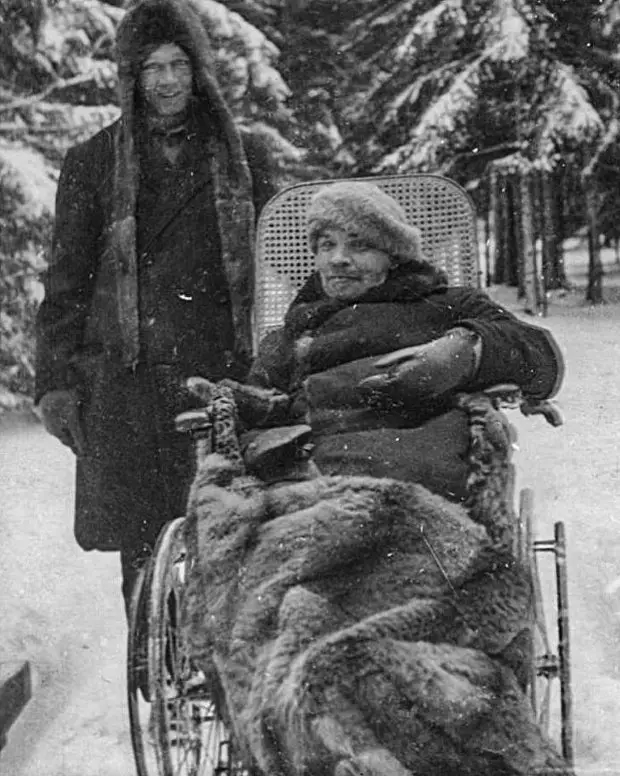
Since he remembers March and July as nightmares, he later tries to erase this period from his memory: “I didn't go to the room where he was lying, I didn't go to the balcony where they took him out in the first months, I tried to avoid meeting the nurses and doctors who were taking care of him then“ (Krupskaya).
It was much easier for him with the orderlies replacing the nurses. Lenin did not die all at once, but in cycles; "good" periods (during one of which he was transported from the Kremlin to Gorky in a car whose tires were filled with sand instead of air to keep them from shaking). In July, for a month, he suffered from unbearable pain, hallucinations and insomnia, and then again a "good" period followed from the end of July 1923 until the very end.
Apparently, on one of these days, he was seen by E. Preobrazhensky, who visited Gorky on weekends as a vacation home (Lenin was not the only inhabitant of the estate). One day he watched from the window as Lenin was being driven down the avenue in a carriage - and suddenly Vladimir Ilyich, who had developed farsightedness in one eye, noticed him and "began to press his hand to his chest and shout: "There, there!""
NK and MI tell him that once he had noticed him, he must leave. "I went, not knowing exactly how to behave or who I would actually see. I decided to keep a cheerful, happy face the whole time. I approached. He squeezed my hand tightly and I instinctively kissed him on the head. But his face! It took me a huge effort to keep my expression and not cry like a child. "There was so much suffering in him, but not so much suffering at that moment. It is as if all the suffering he has recently experienced has been photographed and frozen on his face."
Lenin's last months are not only the story of his illness, but also the story of his struggle against it.
He makes desperate attempts to collect himself, his shattered personality, from the ruins, in order to take advantage of those moments when his brain regains its strength and is able to command his body; he fights for his abilities and now believes, now does not believe in his own strength. One should not think that Lenin was doomed in 1923; he was 53 years old, a “strong man“ and neither his age nor the nature of his illness obliged him to die. He had experience in fighting diseases, he had the ability to learn new skills, and he had all the tools of modern medicine at his disposal. Neuropsychology is a "field of great wonders."
As trivial as it may sound, Jack London's "Love of Life," which N. K. read to him before his death and which now resides in Lenin's room, is as much a symbol of his final period as the wheelchair.
This was not a dying, as in “The Death of Ivan Ilyich“: the illness was not accompanied by a “resurrection of the soul“; V. I. did not believe, did not “repent“, did not “see the light“, did not make an alliance with the demons who pursued him. And yet, despite the lack of “fictional“ twists, the illness was extremely “dramatic“, if it is not blasphemous to say so. It was a kind of terrible and incomprehensible adventure that could end at any moment – or even end life; unable to control “his physiology“, he nevertheless saw that several times he managed to get out of the “carousel“ and gain a certain height; Judging by the stories of those close to him, whom one can trust, Lenin did not believe until his last day that the “collision with the earth“ was inevitable.
If we get to the essence, this was not a dying according to Tolstoy, but according to Chekhov – a long, conscious, very Russian: an official dies, in a Russian landscape, above a river and among the mounds of the Vyatichi, in a cocoon, around which is the Madness of the already Soviet “Department Number Six“.
Lenin enjoyed moving around the spaces available to him – from his room to Gorky Park, where he was driven along alleys and through fields; he enjoyed picking mushrooms and looking for pegs: last summer he devoured a book on growing boletus and porcini mushrooms; “When walking in the park, Vladimir Ilyich asked that a sign be placed at the place where a boletus was found, and that the cuttings be scattered, recording the date and month in which the boletus was found.“
The memorial stump of a barbarically cut down spruce reminded him that the conflict over the fate of the heritage of the past had never been resolved. Lenin's rage over a single spruce is understandable; every tree here is historical: the elm is four hundred years old, the oak is about eight hundred; the linden alley, along which he loved to walk, is at least a quarter of a millennium old. During the years that V.I. spent here, he got to know both the park and the surrounding area well; judging by his notes, he had drawn his own route, about ten kilometers long, to Pakhra, through the Burnt Stump, the Badger, the Black Grove, the Syanovsky Edge, the Juniper Glade and the Meshcherinsky Forest. Today's Gorky does not even give an idea of what this area was like in Lenin's time - picturesque areas, wild nature, where, as in Turgenev's hunting stories, foxes, hares and grouse lived; Now the space between the new buildings is being feverishly fenced off, drained and dumped, and it is unlikely that you will be able to hunt near the Burnt Stump, where V.I. last went in January 1924.
Already in the summer of 1922, he realized that his memory had the ability to regenerate and trained it intensively. His main reanimator was N.K., who at first read to him: first books, then selectively and newspapers. She also became his speech therapist and neuropsychologist: she arranged up to ten objects in front of him - matches, pieces of paper - and tried to help him count them. She kept an envelope with letters from which he formed words. In July, Lenin regained some of his mental reading ability. It did not seem like reading in the conventional sense; a page of a newspaper seemed to him like a collage by Basquiat, or perhaps like his own "Totemic Letters" to someone who did not know the code: fragments of type, images, silhouettes, individual words, fragmentary headlines turning into scribbles; something flowing, combining, connecting, blurring one another, arousing interest and therefore seeming mysterious and important - the very news that would suddenly explain everything. In this way, he "reviewed" Pravda, Izvestia, and “Economic Life“; several times they tried to shove old newspapers into his hands, but he would catch the fakes, expressing anger and indignation. Thus, from some signals he overheard, he learned about Martov, who died in April, and Vorovsky, who was killed in May.
From August onwards, reading in his mind became easier for him, as did communication. For example, he read about new names for children in Trotsky's book “Everyday Questions“ and, laughing, showed this fragment to his orderly, whose daughter was called Ikki Popova – “The Executive Committee of the Communist International“.
In August, V.I. himself asked to learn the alphabet by "pronouncing the sounds "a", "o", "i", "u", the paramedic recalls. He forgot the words, but he had the ability to learn them again or at least repeat after the speech therapist: "reflected speech". "Hand, foot, ear, cat..." The end of the summer was memorable because Lenin himself, without repeating after anyone, pronounced the word "duck". The daily norm of repeatedly pronounced words reached thirty; In total, he managed to repeat about fifteen hundred by January.
He could read or even name the objects and words depicted in the drawings shown to him: dog, “bau-bau“; he could combine a homemade drawing with an inscription that had to be chosen by others: “puppy“.
He could even copy some words with his left hand, although he could not write freely or record thoughts. He was happy when they understood what he wanted, and then he would smile and put his hand on his chest. “Exactly“, “what-what“, “yes-yes“, “uh-huh“ — it didn't matter; but those who watched him began to hope that soon — perhaps by next summer — he will speak freely again.
Source: lenta.ru