


After the Ukrainian operation "Spiderweb", as a result of which the Russian Aerospace Forces lost at least 20 strategic bombers, the Russian Ministry of Defense began to urgently transfer aircraft from airfields in the Irkutsk and Murmansk regions to other bases. But military analysts continue to comment on the attack. Major (ret.) Eng. Kalin Hristov, a member of the "Atlantic" SOR, spoke to FACT.

Kalin Hristov
- Mr. Hristov, the operation “Cobweb” conducted by the Security Service of Ukraine (SSU) caused a global response. Of course, there was a response from Russia. But how do you analyze the Ukrainian operation?
- I will allow myself to start with a historical reference, because when you make a surprise during a war, it means you know how to fight. It was a sunny and calm morning, but suddenly there is a rumble everywhere. 80 years ago, on December 7, 1941, Japan attacked “Pearl Harbor”. The attack by Japanese bombers came as a complete surprise to the soldiers at the American base and this changed the course of the war.
- Yes, many military analysts drew a parallel between the two attacks?
- That's right, because we are talking about for the surprise factor. We can make a comparison with the events of more than 80 years ago, although now we are talking about the “Special Military Operation“ (SVO), however, carried out by Ukraine against some of Russia's strategic bombers.
- What impresses you…
- The attacks were carried out in the Murmansk, Irkutsk, Ivanovo, Ryazansk and Amursk regions. Russia's air defense proved unable to repel the attacks. FPV drones were used for the operation. (b.r.- FPV is an abbreviation for FIRST PERSON VIEW, literally translated means “First Person View“. Drones with cameras that allow their operator to monitor the flight in real time) The attack was carried out from an area in the immediate vicinity of the airports, which led to the burning of several aircraft. This is according to a statement from the Russian Ministry of Defense. It is laconically said, that the fires have been extinguished and there are no reports of casualties. Some of the people involved in the attacks have been detained. But what is behind this telegraphic style?
- The strike was carried out on June 1, the day of Russian military transport aviation, which is an important holiday for the Russian armed forces and on the eve of the peace meeting in Istanbul. It is not just a date, but the occasion is sought…
- The Ukrainian troops carried out this bold, unprecedented and coordinated strike with quadcopters flying at close distances, but capable of carrying larger loads. Main strategic aviation bases located throughout Russian territory were attacked. No damage was reported only at the base in the Amur region. The affected aircraft, according to reports from the Ukrainian forces, make up about 34% of Russia's nuclear air fleet. They are capable of striking with cruise missiles at long distances and were used to terror and destruction in Ukraine. The scale and great distances from the front line are impressive. The Belaya air base in Irkutsk is about 4,300 km from the Ukrainian border, and the Olenya air base in southern Murmansk is about 1,800 km away.
Due to their special importance, these sites are protected by echeloned air defense, because they are of key importance for Russia's strategic aviation infrastructure. Their defense includes the Pantsir, S-300 installations, radio electronic countermeasure systems against drones and enhanced physical security. Probably no one even thought that such distant airfields could be attacked by drones, because Ukraine, in its 383rd separate drone brigade, only has the old Soviet Tu-141 and Tu-143 long-range aircraft. Previous deep strikes were carried out by modified propeller aircraft. In addition, these are sites thousands of kilometers from the border!
- The targets were chosen quite skillfully, but the fact that the bases that were hit are deep in Russian territory, what does that tell you?
- For strategy. Russia is using heavy aircraft in the total war that began in February 2022 to launch waves of cruise missile strikes against targets on the territory of Ukraine. In addition, these aircraft are part of Russia's nuclear triad, ensuring parity with the United States. It is obvious that this operation also seeks to have an effect of stopping or at least reducing cruise missile strikes. According to the strategic plans of the Russian military command, the aircraft are deployed throughout the territory, but are mainly concentrated in two zones of military operations. This is precisely what allows them to be used in the large-scale war against Ukraine. It is assumed that the aircraft will be completely safe in the Far East, because the Ukrainian army does not have weapons capable of reaching them. It is assumed that the idea was that after the flight resource expires and the aircraft enter the front line for routine inspections or repairs, others from the Far Eastern rear will be brought in on a rotational basis. These bases allow the Russian armed forces to use aircraft to strike from a safe distance, to carry out aerial surveillance and command. What are the bases:
1. Olenya Air Base (Murmansk Region)
Olenya Air Base is a long-range aviation airport (since 2011), and previously of the Naval Aviation. It is located on the Kola Peninsula, 92 km south of Murmansk, near the city of Olenegorsk, about 1900 km north of Ukraine. In May 2023, two Tu-160s and 14 Tu-95s were deployed to the air base. The bombers at the base were used to carry out strikes against Ukraine. As of June 1, it was home to the 40th Mixed Aviation Regiment, which includes a squadron of Tu-22M3 bombers. There are also a significant number of Tu-95MS strategic bombers, which were previously stationed elsewhere but have been relocated to this base. Experts believe that it is a vital launch point for long-range missile strikes against Ukraine. Due to its remote Arctic location, it was assumed to be inaccessible to Ukrainian attacks.
2. Diagilevo Air Base (Ryazan Oblast)
It is located on the western outskirts of Ryazan in the Diagilevo urban district, which is part of the Moscow Oblast prefecture. Diaghilev Air Base is home to the 43rd CBP PLS (Center for Combat Use and Retraining of Aircrew), armed with Tu-95MS, Tu-22M3, Tu-134UBL and An-26 aircraft, as well as the 203rd OGAP SC (Separate Guards Aviation Regiment of Tanker Aircraft), armed with Il-78 tanker aircraft. It is also home to the 360th Aircraft Repair Plant, which repairs Russian strategic aviation aircraft, including the Tu-95, Tu-160 and three Tu-22M3. This makes it the main center for combat training of strategic aviation crews. It is located approximately 470 km from the Ukrainian border. It is believed that the damage to this base not only affects active bomber units, but also disrupts pilot training and maintenance operations for Russia's long-range aircraft.
3. Belaya Air Base (Irkutsk Oblast)
Located deep in Siberia, more than 4,000 km from Ukraine, Belaya Air Base is a military airfield in Irkutsk Oblast, located 18 km northwest of the city of Usolye-Sibirskoye and 85 km northwest of Irkutsk. The airfield is currently home to the 200th Guards Heavy Bomber Aviation Brest Red Banner Regiment, part of the 326th Heavy Bomber Aviation Tarnopol Division of the 37th Air Army of the Supreme Command of the People's Commissars. The regiment is armed with Tu-22M3 supersonic bombers, which have long-range missiles. The base is considered untouchable by Ukrainian forces!
4. Ivanovo Air Base (Ivanovo Region)
Located about 700 km from the Ukrainian border, it is the main airbase for the Russian A-50 AWACS (Airborne Warning and Control System) aircraft, which are crucial to Russian air operations. These aircraft perform key functions such as detecting air defense systems, tracking air threats, and coordinating fighter operations. Since Russia has fewer than ten A-50s in total, the loss or damage of even one significantly impairs its situational awareness and command and control capabilities. It should be noted that in early 2024, two of these aircraft were shot down by Ukrainian forces.
5. Ukrainka Air Base (Amur Region)
Ukrainka is a large military airfield in Serishevsky District of Amur Oblast, 26 km north of the city of Belogorsk. The airfield is named after the nearest settlement, the village of Ukrainka. The airfield houses the command of the 326th Heavy Bomber Tarnopol Aviation Division, holder of the “Order of Kutuzov“, and two long-range aviation regiments. These are the 182nd Guards Heavy Bomber Aviation Sevastopol-Berlin Red Banner Regiment and the 79th Heavy Bomber Aviation Regiment, holder of the Order of the “Red Star“, as well as aircraft maintenance units. There is an exhibition museum on the territory of the airport.
For unknown reasons, the truck transporting the drones to the airport in the fifth Amur region exploded and no damage was reported.
- What and how modern are the aircraft in Russia's strategic bases?
- A strategic bomber is a combat aircraft capable of carrying specialized weapons (aircraft bombs, cruise and ballistic missiles), including nuclear weapons, designed to deliver bomb and/or missile strikes on strategically important targets located on the territory of a hostile state, usually outside the main theaters of hostilities, in order to undermine its military and industrial potential. In contrast to tactical bombers, which are designed to destroy enemy targets (mobile and stationary equipment, tactical bases and personnel) in the theater of hostilities. Strategic bombers have an intercontinental range, an increased payload, which can be conventional or nuclear (depending on the mission). These aircraft have more comfortable living conditions for the crew, in order to maintain their performance during long flights or on combat duty. Currently, only Russia, the US and China have combat aircraft of this class.
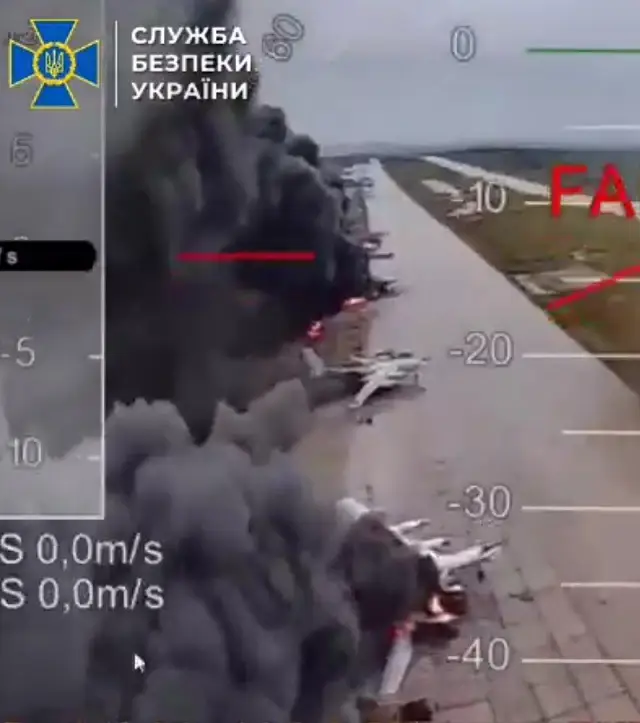
- What are these aircraft?
- I will try to make a fairly short and measured analysis to explain, but they are:
- Tu-9 is a Soviet-era strategic bomber, equipped with turboprop engines, used by Russia to launch long-range cruise missiles - such as the Kh-55, Kh-555, and the newer Kh-101/102. Each aircraft can carry up to 16 cruise missiles. Despite its age, the Tu-95 remains an important asset in Russia's long-range strike capability.
- Tu-22M3 is a long-range supersonic bomber capable of carrying Kh-22 cruise missiles, which pose a serious challenge to Ukrainian air defenses due to their high speed. The Tu-22M3 is part of Russia's conventional and nuclear strike forces.
- A-50 is an AWACS aircraft used by Russia to detect air defense systems, coordinate missile strikes, and guide fighter jets. Russia has fewer than ten A-50s in service, each estimated to cost around $350 million. Their loss severely limits Russia's situational awareness and air command capabilities.
- The Tu-160 is a supersonic strategic bomber with variable-sweep wings and the largest combat aircraft in the world. Capable of carrying both nuclear and conventional cruise missiles, including the Kh-101 and Kh-102. The Tu-160 serves as a key component of Russia's long-range strike and nuclear deterrence forces.
- And let's talk about the equipment used by the Ukrainians in Operation "Cobweb"...
- The Ukrainian side has not reported what drones it used in the operation. The photos shown from the abandoned warehouse in Chelyabinsk give us an idea of how the drones were placed and transported.
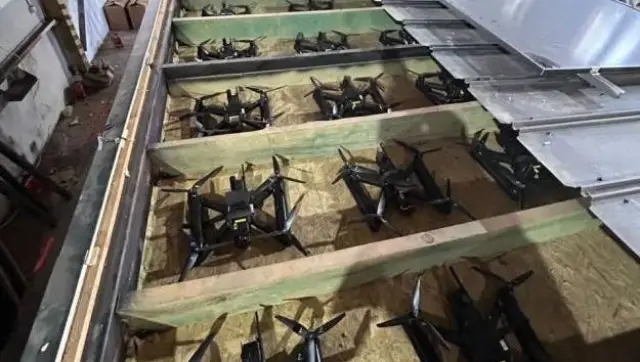
From public information it is clear that the quadcopters are under the roof of a container and after opening it they can take off.
Some experts believe that these are German FPV drones - "mini Taurus" from the Helsing company or a similar type,
modified in Ukraine. As reported by “Deutsche Welle“ Germany has provided Ukraine with 4,000 new combat drones with artificial intelligence. These are disposable kamikaze drones equipped with explosives. Helsing's unmanned aerial vehicles navigate the terrain with the help of artificial intelligence and can continue to move towards a target even in the event of a connection from Russian anti-drone defense (EDB) means. That is why in professional circles they are already called "mini Taurus", since the German TAURUS cruise missiles also use autonomous guidance systems. This type of drone uses artificial intelligence to recognize targets during the flight. It is programmed to identify Russian military equipment, but not only that. Artificial intelligence provides additional capabilities even compared to such powerful Western weapons as HIMARS, since the Russians have learned in the meantime not only to jam radio frequencies, but also to interfere with the GPS satellite navigation system used by HIMARS. It is not known how far these drones can fly, but considering that the range of a standard FPV drone is on average from 7 to 10 kilometers,
it is assumed that the range of the "mini Taurus" can reach about 40 kilometers.
According to the Bulgarian information center of the Ministry of Defense, Ukraine is already using fiber-optic drones with a range of 20 kilometers. These devices can also perform tasks without being affected by electronic warfare (EW) equipment.
I am mentioning these types of drones because they are an example of the possibilities for implementing such a complex operation of controlling unmanned aerial vehicles thousands of kilometers away. Experts believe that due to signal delay and high dynamics, it is difficult to do without artificial intelligence. A number of publications indicate that Ukraine has demonstrated a hybrid approach to drone warfare, which combines remote human control with elements of autonomy and functionality, supported precisely by artificial intelligence. Footage of the attack shows drones perched on the antennas of the A-50s, as well as other vulnerable spots on the bombers, supporting this claim.
The available evidence suggests that artificial intelligence likely played a supporting role in both flight stability and guidance, particularly in ensuring precision strikes on vulnerable spots on Russian bombers and guidance aircraft.
Most likely, the drones used in the operation were remotely controlled via Russian mobile telecommunications networks, including 4G and LTE (Long Term Evolution) connections. They provided sufficient bandwidth to support real-time video transmission and command transmission over vast distances, allowing Ukrainian operators to control drone flights outside Russian territory.
- Doesn't this configuration eliminate the need for physical ground control stations or nearby operators...
- It can be assumed that to achieve stable control over long distances over mobile networks, drones relied on a software-hardware system built around ArduPilot. ArduPilot is a reliable, universal open-source autopilot system supporting many types of vehicles: multicopters, traditional helicopters, fixed-wing aircraft, boats, submarines, rovers, and others. The source code was developed by a large community of professionals and enthusiasts. The system provides advanced flight stabilization, waypoint navigation, safe routines, and programmable operation profiles. In our case, each drone is probably integrated with a compact Raspberry Pi-type on-board computer connected to a webcam and an LTE modem via Ethernet or satellite Internet. The cameras are used for visual navigation, while control signals are routed through the ArduPilot interface, allowing operators to control the drone remotely, even when faced with significant signal delays. The flexibility of ArduPilot makes it suitable for missions operating over unstable or high-latency connections, such as mobile internet, as it can independently control the orientation, course and altitude of the drone, ensuring flight stability while waiting for commands from the operator. In addition to manual control, it appears that the drones’ attack logic integrates artificial intelligence guidance, which is provided by “mini Taurus” class aircraft. According to intelligence information and open source reports, Ukrainian security forces have studied the design and visual profiles of the target aircraft, including the Tu-95MS, Tu-22M3 and A-50 models. These models are stored in Ukrainian aviation museums, such as the Poltava Museum of Long-Range and Strategic Aviation. The drones’ memory is programmed with the exact weak points of the respective aircraft. Such models could help operators identify key structural weak points such as underwing missile mounts, wing-body attachment points, and fuel tank locations, allowing for confident destruction of the equipment and precise targeting in the final stage of the attack.
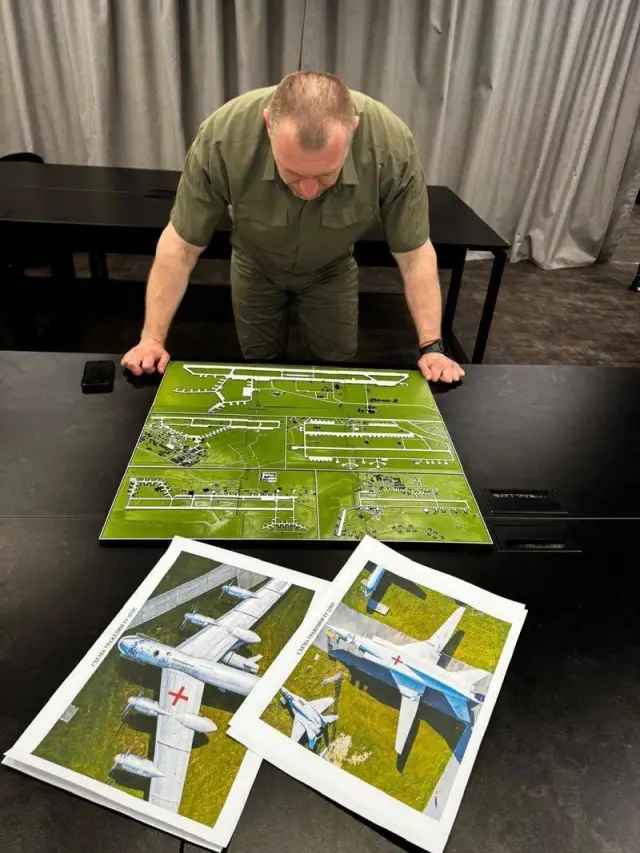
Images released by Ukrainian services confirm that specific locations on the aircraft were identified as targets during the preparation phase, and later official footage shows drones attacking precisely these designated areas. From the analysis of the video footage of the destroyed aircraft, other experts suggest that the drone was on a fiber optic cable, due to the large volume of data. We have already indicated that Ukraine also has such devices. The conclusion is that the drones acted as precision weapons - remotely controlled, but also capable of performing final actions with the help of artificial intelligence. The operation probably used a combination of software that allows remote control, 4G/LTE communications and guidance with artificial intelligence. This was carried out using open source platforms and tools developed in Ukraine. The success of the mission did not depend only on technological innovations, but rather on organizational ingenuity, successful intelligence and logistical mastery, which allowed Ukraine to strike at the core of Russia's strategic aviation assets - far beyond the front line.
To be continued…

Major (ret.) Kalin Hristov told FACT: It is believed that German mini Taurus drones were used in Operation Spiderweb
These are single-use kamikaze drones, says the expert
Jun 16, 2025 13:40 2 987
