


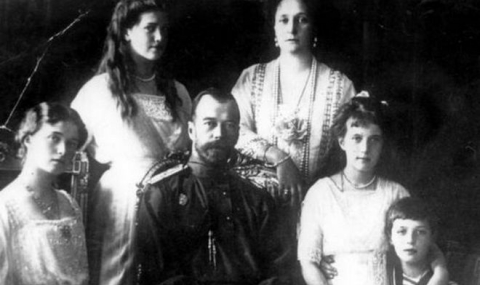

On July 17, 1918, Lenin's Bolsheviks executed the royal family. This put an end to the centuries-old rule of the Romanov dynasty, which played a key role in Europe and Asia.
For this reason, Nicholas II is the richest man of his time. He himself was not pretentious, he wore his suits to the point of tears. However, his relatives valued luxury. They even tried to amass even more wealth through dirty deals.
On the night of July 17, 1918, when the Romanov family (50-year-old Tsar Nicholas II, his wife Alexandra, their daughters Olga, Tatyana, Maria and Anastasia, as well as Crown Prince Alexei) was executed, bullets bounced off the girls' bodies, Deutsche Welle writes.
This caused the execution command to change the instructions to shoot straight at the heart. 70 years later, the autopsy of the skeletons showed that the daughters had been shot again at point-blank range and at close range. The first shots did not initially hit them because pearls, jewelry and other valuables were hidden under their clothes. A total of eight kilograms of diamonds were removed from the women's corsets, as recorded in the secret report of the commander of the executioners, Yakov Yurovsky. Did the Romanovs hope to redeem themselves? Or did they want to save at least some of their wealth?
Half a year after the October Revolution, the end came not only for the tsar and his family, but also for the Romanov rule after more than 300 years of power. The dynasty managed to unite Russia and turn it into an empire that stretched across two continents. In 1894, when Alexander III, the father of Nicholas II, died of kidney disease, the 26-year-old prince took over the reign of one of the great European powers.
Russia was significantly larger than its neighboring countries; at the beginning of World War I, its gold reserves were the largest in the world. Although rich, the country was severely lagging behind in its development. The entire world around it was changing - technology, the economy, the way of waging war, the forms of government. However, Nicholas II was determined not to adapt his country to modern times, but to continue to follow the principles of absolutism, following his father's example.
The wealth of the Russian royal court is legendary - Nicholas is even considered the richest man of his time. The royal family owned 70 percent of the land, which means that Nicholas could call one tenth of the earth's territory his own. According to economists' calculations, all the lands, gold, jewelry, palaces and works of art owned by the royal family totaled over 45 billion dollars.
The tsar himself was not pretentious - he wore his suits until they fell apart. But while the people starved and rebelled desperately, the elite lived more than luxuriously - speaking French, English or German and spending their money happily in the great European capitals. The Tsar's children had an annual pension of 280,000 rubles, and nieces and nephews received one million rubles each upon reaching adulthood - as much as the princesses' dowries. The 60 members of the Tsar's family could not be brought to court, disputes were resolved by the Tsar himself - as a rule, with maximum indulgence. It got to the point that relatives began to take advantage of their position at court to amass even more wealth through corruption.
Nicholas' ministers recorded in their diaries their despair at the reigning corruption and cronyism. For example, one Grand Duke pocketed millions by preventing the establishment of a monopoly on alcoholic beverages. The Minister of War Sukhomlinov wrote in his memoirs: "The irresponsible influence of the grand dukes is like a cancer that affects the entire organism of the state".
Huge funds were allocated for the security of the tsar. The assassination of Alexander II in 1881 was strongly imprinted in Nicholas's memory, instilling in him the belief that liberal reforms lead to anarchy and terror. He lived in constant fear of assassination. When he traveled throughout his vast empire, two identical trains traveled one after the other, and it was never known which one the tsar was traveling in. The train itself resembled a castle on wheels: in the seven carriages, along with Nicholas's office, there were two bedrooms, a bathroom, a nursery, a dining room, and a living room with a piano.
Although he lived detached from Russian reality, Nicholas II felt closely connected to his people. According to the principles of absolutism, the God-chosen tsar and his people form a unity. There is therefore no need for institutions expressing the will of the people, such as parliaments, which had already been introduced by other monarchies in Europe. The more the Duma's interference in the country grew after the civil revolution of 1905, the more Nicholas II saw salvation in the simple peasant people, who bowed to icons and were baptized when the tsar's train passed. The traveling preacher Grigory Rasputin managed to occupy a high position at court, partly because he was considered a representative of this ordinary people.
Since the October Revolution, the world has been wondering what happened to the tsar's incredible wealth. Was it taken abroad? Or is it still at the bottom of Lake Baikal? Three days before the execution of the Romanovs, the Bolsheviks nationalized all the property of the royal family. And just three years later, almost nothing remained of the country's vast gold reserves.