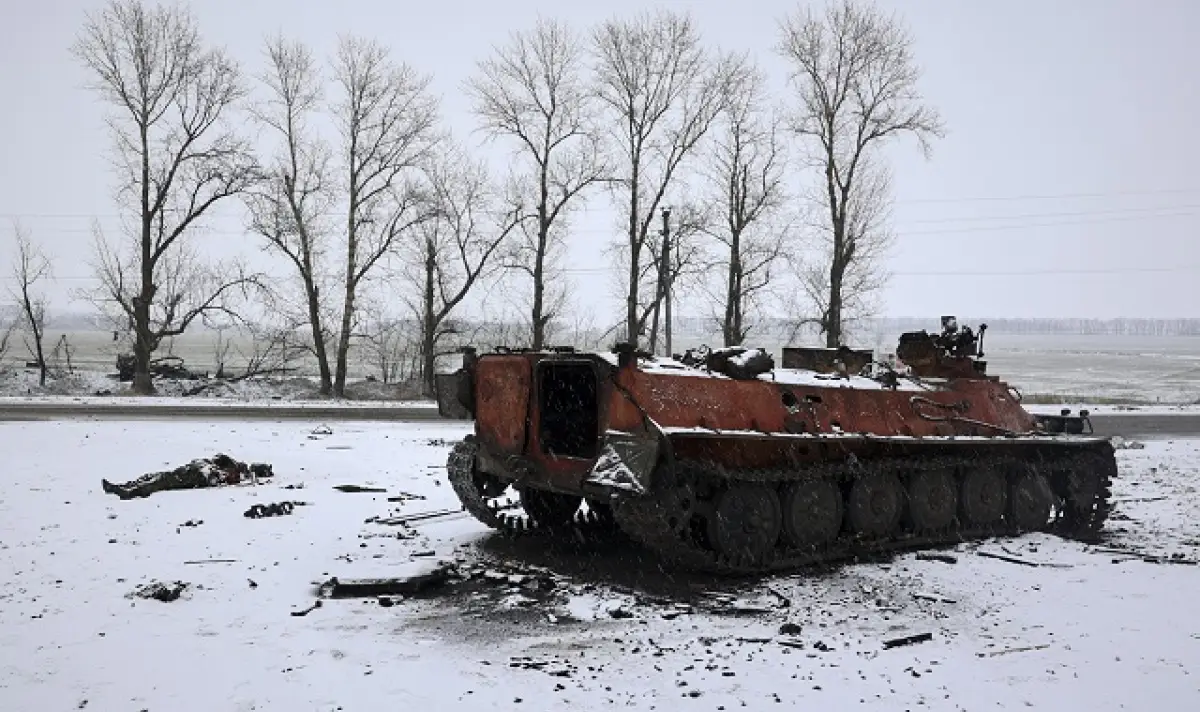
Satellite images of several Russian armored vehicle repair plants show that Russia continues to rely on the restoration of its Soviet-era armored vehicles, analysts from the Institute for the Study of War (ISW) write in a new report.
ISW analysts drew attention to OSINT findings published on the social platform X, which track equipment in Russian military warehouses and repair bases using satellite imagery.
An updated analysis of photos from Russian armored vehicle repair plants (ARPs), which repair damaged armored vehicles and restore "canned" equipment, showed that most of the armored fighting vehicles (ABMs) that Russia is taking out of storage for conservation are no longer in good enough condition to be immediately deployed to the front - as Russia did at the start of a full-scale war.
An OSINT analyst quoted by ISW estimated that the 81st Armored Fighting Vehicle Plant in Armavir (Krasnodar Krai, Russia) is likely to upgrade up to 200 BTR-70/80/82s per year, starting in 2023. This plant repairs and modernizes BTR-70/80 armored personnel carriers from old warehouses, and probably also repairs damaged armored personnel carriers from the battlefield.
The 144th BTRZ in Yekaterinburg (Sverdlovsk Oblast, Russian Federation) is the only plant in Russia that restores older BMD amphibious combat vehicles, as well as repairs BMP-2 and airborne combat vehicles (BMD-2). This plant probably refurbishes between 100 and 150 BMD-2 and modified airborne combat vehicles (BTR-D) annually.
The Arzamas Machine-Building Plant in Arzamas (Nizhny Novgorod Oblast, Russia) is believed to produce over 500 BTR-82 armored personnel carriers annually. At the same time, satellite images have recorded the concentration of armored vehicles at this location. This could indicate that the plant is either increasing production volumes or repairing damaged armored personnel carriers. Arzamas' production capacity remains undetermined, but is likely high given the large number of BTR-80/82s that Russian forces are losing in Ukraine, and given how quickly Russian forces are replenishing their stockpiles of these vehicles.
OSINT analysts also estimate that Kurganmashzavod in the Kurgan Oblast of the Russian Federation is likely producing 100 to 120 BMD-4Ms, approximately 360 BMP-3s, and 20 to 30 BTR-MDMs annually.
The ISW adds that throughout the war, Russia relied on Soviet-era armored vehicles in its offensive operations to compensate for high losses. However, this resource is limited and is approaching the point of diminishing availability, experts emphasize.
ISW uses the term "point of diminishing availability", which is close to the economic concept of "point of diminishing returns" in industrial production and other areas. This is the point at which the same costs or resources spent lead to a smaller and smaller increase in output or benefit.
Experts from the Institute for the Study of War add that Russian troops are increasingly using motorcycles and buggies instead of armored vehicles on the front line in Ukraine precisely because of the large losses of equipment in late 2023 and 2024. The British International Institute for Strategic Studies (IISS) estimated in February 2025 that Russian troops lost over 3,700 infantry fighting vehicles and armored personnel carriers in 2024 alone.

ISW: Russian Army Depletes Soviet Armored Vehicles to Critical Point
Russian troops are increasingly using motorcycles and buggies instead of armored vehicles on the front lines in Ukraine precisely because of the large losses of equipment in late 2023 and 2024.
Jun 27, 2025 21:18 1 342