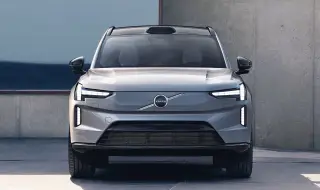
Volvo Cars is about to introduce one of its most key products in the mid-size premium SUV segment - the all-electric Volvo EX60. Amidst increasingly fierce competition from German manufacturers, we reached out to Mr. Bayard, Managing Director of Volvo Cars Imports for EMEA, to find out what the Swedish brand has in store for the hearts of consumers. Although Mr. Bayard is keeping a tight lid on the details of the EX60 (which is set to make its global debut on January 21, 2026), the available information about the model's architecture suggests a serious technological advantage over the competition, especially compared to German offerings. Here is his opinion on the matter:
Volvo is about to introduce one of its most important products - the all-electric EX60. We already know that the car will be progressive in many ways. But the competition from German premium manufacturers is stronger than ever. What are Volvo's weapons in this battle for consumers?
Volvo Cars believes that the future is all-electric and our goal is to achieve a 90-100% “electrified” portfolio by 2030, which includes both Plug-In Hybrids (PHEV) and all-electric models. Of course, we realize that for some customers around the world, the transition is not yet possible or desirable, which is why we maintain a balanced portfolio of PHEV and BEV (pure electric) products.
The upcoming EX60 is a new product in one of the most competitive segments, especially in Europe. The EX60, like all our models, will have safety at its core and will feature a recognizable Scandinavian design. Technology will play a key role. Thanks to a modern central computer architecture and Over-the-Air (OTA) updates, the car will only get better over time. The EX60 will also debut a new multi-adaptive seatbelt, named TIME Magazine's "Best Invention of 2025." It is designed to better protect people by adapting to road conditions and the wearer, using real-time data from the car's sensors.
The EX60 will be equipped with the NVIDIA Drive Thor computer with its massive computing power and third-generation power modules with 93% efficiency. How will this combination of hardware affect the car's real-world range under different driving conditions, and how does Volvo plan to use this unparalleled computing power in the early years of the market before full autonomous driving is fully implemented?
It's too early to give a concrete answer for the EX60. But if we take our flagship EX90 as an example, its central computing architecture already allows owners to receive new features and capabilities via OTA updates, as the car improves over time. Every step at Volvo Cars is aimed at creating safer cars for both passengers and others, and we will only develop technologies if they fulfill this goal.
Mr. Bayar, Volvo is world-renowned for its reputation as one of the safest cars in the world. What does the future of safety and security hold for the brand?
Safety is and will remain our top priority. We have always strived to protect people and what is important to them. We set our own safety standards based on knowledge gained from real-world accident research since the 1970s. The next level of active safety relies on advanced technologies that require the ability to use the power of data, software and artificial intelligence to create safer cars.
Polestar is no longer co-owned by Volvo. How do you see cooperation with them in the future?
Volvo Cars sees great opportunities for cooperation and use of synergies within the wider Geely Group - this is an advantage that most competitors do not have. Polestar is one of the "brand sisters" in the Geely Group, in which Volvo Cars currently owns 18% (ed. note - after the sale of shares in May 2024). A great example of our collaboration is that the future Polestar 7, scheduled for launch in 2028, will be produced at our all-electric plant in Košice, Slovakia.
You launched the Volvo XC70 Hybrid with a 200-kilometer electric range (CLTC). When will we see it in Europe? Are you planning a similar upgrade for your other PHEV models?
The XC70 was launched first in China as we see strong demand for this type of vehicle in that market. Volvo Cars plans to introduce the model in Europe at a later stage, as we continue to assess market conditions and customer demand. We are taking a pragmatic approach to creating a balanced portfolio that meets customer needs. We will continue to invest in our highly successful PHEV models that we offer today, but we cannot confirm future products at this time.
Give us one reason why customers should choose Volvo over the German competition?
Of course, I can only speak for Volvo Cars and what we do. I believe we have a pretty unique and compelling proposition here, based on our consistent and strong focus on safety, user experience and Scandinavian design.
Volvo Cars doesn't add more technology or bigger screens for the sake of it - we equip our cars with technology that is truly useful to the user. A great example is the driver understanding system in our cars on the SPA2 platform, which uses real-time sensors to understand whether the driver is distracted, tired or impaired, so that the car can intervene and provide support when needed.
Another example is the “multi-adaptive seatbelt“, an innovation that will be introduced with our upcoming mid-size SUV EX60. Using real-time data from advanced internal and external sensors, the belt is designed to better protect people by adapting to road conditions and the person who wears it - including factors such as height, weight, body shape and seating position.
Both innovations - the Driver Understanding System and the Multi-Adaptive Seatbelt - were recognized by TIME magazine in their lists of “Best Inventions“ for 2024 and 2025, respectively.
Last but not least, as you focus on electrification, will you completely abandon internal combustion engines or, like BMW, continue to offer the same models with such engines? What is the future of internal combustion engines in the Volvo brand?
For Volvo Cars, it is about a balanced portfolio of plug-in hybrids and fully electric models that meets the needs of our customers around the world. We recognize that some of our customers are not yet ready to transition to fully electric vehicles, and our Plug-In Hybrids will continue to play an important role in this regard. Moreover, we will not completely abandon internal combustion engines and will continue to offer them for some time to come.