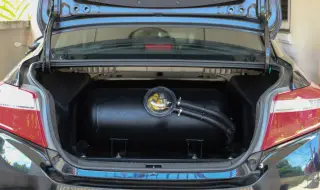
The long-standing dispute between fans of diesel and gasoline often finds its unexpected, but extremely practical, consensus in the face of automotive gas systems (AGU). Switching to propane-butane (LPG) is more than a fashion; it is a smart financial move that significantly reduces operating costs. However, the key to success lies in choosing the right engine. Not every gasoline unit "loves" gas, and some are simply created for it. I present to you the five engines that tolerate gasification with impressive ease and reliability.
1. Toyota 1.6 / 1.8 VVT-i (1ZZ-FE and 3ZZ-FE Series)
The Japanese from Toyota have long earned a reputation as manufacturers of indestructible engines, and their atmospheric units with variable valve timing VVT-i are real diamonds for installing AGU. The 1ZZ-FE series and the smaller 3ZZ-FE, which are found in large numbers in models such as Corolla and Avensis, are an example of uncompromising durability. Their massive valves and relatively simple cylinder head design perfectly tolerate the higher combustion temperature of propane-butane. Even after serious mileage, these engines demonstrate enviable durability, making them the first choice for anyone looking for long-term economy without unnecessary headaches.
2. Opel 1.6 / 1.8 Ecotec (Series Z16XEP, Z18XER and A-versions)
German engineering, although sometimes controversial, has its unconditional hits. Opel's naturally aspirated Ecotec engines, which find their place in bestsellers such as Astra and Vectra, are among the most frequently gasified in Europe. These units usually have hydraulic lifters, which is a huge advantage - the system automatically compensates for valve clearances, preventing the need for frequent and expensive manual adjustment, which is the “Achilles heel” of gasified engines without hydraulics. Simple, reliable and proven to be tolerant to LPG - What more could a person want?
3. BMW R6 – M52/M54 Series (2.0, 2.5, 2.8, 3.0 liters)
Who says economy has to be boring? BMW's legendary inline six-cylinder engines from the M52 and M54 series (known from the E39, E46, E60, etc.) are an example of how a high-tech unit can be perfectly compatible with AGU. Their cast iron block (in the M52) and the overall strength of the structure make them extremely resistant to thermal loads. Even the newer M54, although with an aluminum block, retains this feature. These engines offer excellent power and remarkable smoothness of operation, and their gasification, although more expensive because of the six cylinders, pays off quickly, turning a premium car into a surprisingly economical "long-distance runner".
4. Ford 2.0 / 2.3 Duratec (Focus, Mondeo)
Ford's Duratec engine family was developed in collaboration with Mazda and deserves a place on this list for its simplicity and lack of a turbocharger. Specifically, the atmospheric versions with a volume of 2.0 and 2.3 liters, which are installed in Mondeo, Focus and even some Mazda models (MZR), are distinguished by their exceptional unpretentiousness. They often have reinforced valve seats, which makes them resistant to wear caused by the drier combustion of gas. These are workhorses that do not require attention, but simply maintenance, and they reward themselves with a long and trouble-free life on LPG.
5. Renault K7M / K4M (1.6 liters)
Renault's K-series engines have become synonymous with reliability and low maintenance costs, especially the 1.6-liter eight-valve (K7M) and sixteen-valve (K4M) versions. These engines, familiar from Logan, Sandero and Megane, are of simple design and do not feature direct injection, eliminating the need for an expensive, latest-generation gas system. More importantly, their components are built to last, and potential valve problems with the K4M can be easily avoided by more frequent adjustment or the use of an oil additive (Flashlube). Considered one of the easiest and cheapest to gasify, they are the ideal choice for the budget-minded driver.
Conclusion
Choosing one of these five engines for installing an AGU is not a guarantee of eternal life, but it significantly increases the chances of successful and long-term operation of propane-butane. The key, as always, is in the quality installation by an authorized service center and strict adherence to the service intervals of the gas system itself. A smartly gasified car is an investment that not only pays off, but fundamentally changes the equation of your daily fuel costs.