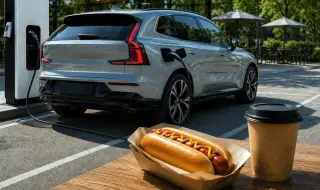
Electric vehicles are gradually and surely breaking the shackles of the old and well-known nightmare associated with limited range. However, according to strategic analyses by the Swedish automotive giant Volvo, a completely new psychological phenomenon is rapidly taking its place. It turns out that modern drivers are massively wasting time and money by leaving their cars on the cable much longer than their route actually requires. The company, with a dose of humor, named this new phenomenon “hot dog anxiety“.
The term was launched quite unexpectedly by Volvo Cars' technical director, Anders Bell, during the glamorous American presentation of the new Volvo EX60 model in New York. In fact, the engineer did not mean the quality of food at gas stations, but the classic scenario of stopping at a fast charging station. The driver plugs in the car's connector and hops off to the toilet or for a quick snack. During this time, however, the modern battery absorbs a huge amount of energy, which far exceeds the needs to reach the final destination. The result? The final electricity bill swells noticeably and completely pointlessly.
The Swedish power plant is adamant that electricity owners urgently need to readjust their consumption habits. While at the dawn of electric mobility the main fear was not getting stuck in the middle of the road, which made people charge “to the top” at every opportunity, today the reality is radically different. With the introduction of batteries with higher capacity and super-powerful charging terminals, the question is no longer whether the electricity will be enough, but exactly how many kilowatt-hours we need at a given moment.
A striking example of this technological transformation is the new Volvo EX60. This modern electric crossover is capable of filling its battery capacity from 10% to 80% in a record 16 minutes, as long as it is connected to a 350 kW terminal. At such a lightning pace, long stops become absolutely unnecessary. If you have only 150 kilometers to go to your home and you have a guaranteed charge there, there is no point in waiting for the battery to reach the standard 80% at a public charging station.
Anders Bell illustrates the situation with simple mathematics: if you are only a few minutes late at a retail outlet while your car is on the cable, it can draw electricity for another $ 25. Thus, an innocent bite of a pie imperceptibly turns into the most expensive hot dog of your life.
Of course, this rule should not be taken as an absolute axiom for every electric vehicle on the road. Volvo does not share large-scale statistics, and the phenomenon mainly affects owners of the most high-tech machines on the market. Models built on a modern 800-volt architecture literally "suck" hundreds of kilometers of range in negative time. Cars like the Hyundai Ioniq 5 and KIA EV6 do the exercise from 10% to 80% in about 20 minutes, the next-generation BMW iX3 adds nearly 300 km in a modest 10 minutes, and the brutal Mercedes-AMG GT is ready to accept peak power up to a mind-boggling 600 kW.
For the mass fleet of electric vehicles, however, things still look more traditional. In older Tesla modifications and a number of other popular city models, the coveted filling up to 80% takes between 30 and 40 minutes, so the risk of unintentional and expensive recharging during a short break is minimal. The Swedes' advice is unlikely to appeal to people living in city apartments without access to their own garage. For them, the public station remains the main source of energy, which is why the desire to stock up on the maximum reserve of kilometers is completely logical and justified.