Although the global electric car market may seem vast and crowded, the real distribution of power shows a startling concentration at the top. According to the International Energy Agency, over 2,500 modifications of passenger cars are rolling on the roads of the planet, of which over 630 are powered entirely by batteries. However, simple arithmetic reveals a shocking fact - only five specific models hold a colossal 20 percent share of absolutely all global sales.
As expected, the absolute ruler Tesla Model Y parades above all, taking a staggering nearly 8% of the global market for pure electric vehicles. Immediately after it is its smaller sibling, the Tesla Model 3, with a market share of 3.6%. Despite the onslaught of dozens of new brands, American pioneer Elon Musk continues to hold the reins of global electrification thanks to his golden duo.
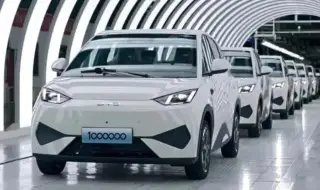
However, the remaining three positions in the prestigious five speak pure Chinese. Bronze goes to the cute Geely Geome Xingyuan, which bites 3.5% of the market. Close behind it with 3.1% is the legendary urban cube Wuling HongGuang Mini, and the top five is closed by the budget BYD Seagull with a round 3%.
However, here comes the key! The main weapon of the Chinese trio against the American hegemon is not the mind-blowing horsepower or the luxurious interior, but the shamelessly low price. On home soil in China, all three Asian minis start at base prices below the psychological $10,000 mark.
To put it more clearly: the Geely Geome Xingyuan costs just $9,700 and in its top versions offers a 40-kilowatt-hour battery for a range of up to 410 km (on the Chinese CLTC cycle). The BYD Seagull opens the offers at a ridiculous $8,000 with similar parameters, and the spartan Wuling HongGuang Mini is a real market shock with a starting price of $6,500. For comparison, the cheapest Tesla Model Y in the States costs just under $40,000, and in China - around $36,700.
This brutal price gap explains why cheap Asian “pocket” cars manage to compete in volume with Musk's global bestseller. Buyers are starting to think with their wallets en masse, looking not for the most sophisticated technological toy, but for the cheapest and most practical ticket to the world of electromobility.
In China, nearly 30 percent of electrified vehicles sold cost less than $20,000. In America, the picture is radically different and turned upside down - only a fifth of electric vehicles there fall below $40,000, and the lion's share of 85% is held by huge, energy-hungry SUVs and pickup trucks.
That is why the electric revolution is moving along two completely different paths. While the rich West is betting on heavy and expensive crossovers, in Asia and emerging markets the real engine of progress is small, affordable city cars with compact batteries. However, the market has no intention of stopping - If in 2020 there were only 440 wired models on the market, now their number has swelled significantly, and forecasts indicate that by the end of the decade the assortment will reach an impressive 1,250 offerings.