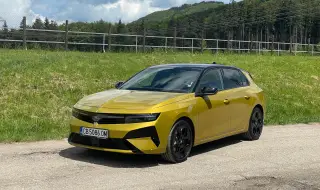
Nearly five years ago, Opel introduced the all-new 6th generation of one of its most iconic models - the Astra, and at the end of last year, the hatchback and its long-roof sibling received a facelift to keep them relevant on the market. The updated model retains the familiar look of the model, while adding some subtle changes and, perhaps most importantly for fans of the brand, retains the “Made in Germany” label, which Opel proudly presents in some of its advertising materials. After debuting at the Brussels Motor Show, the first units of the updated Astra began to roll off the assembly line at the end of May, and our team had the opportunity to be one of the first in the country to touch the updated model.
Exterior
As expected for a facelift, the Astra largely retains the look of its predecessor, with the biggest difference being noticeable at the front, where the characteristic Opel Vizor grille has a new look, characterized by an illuminated emblem, minimal changes to the cooling vents, as well as a new light signature on the headlights. In all equipment levels, they now rely on LED technology, and in higher levels or for an additional fee, they can also be Matrix LED with over 50 thousand LEDs that illuminate the road better. There are also changes in the front bumper, where the fog lights have been permanently removed, and in their place Opel designers have added panels that imitate cooling vents.
The side line has remained unchanged, and you can recognize the facelift by the new wheels in sizes of 16, 17 or 18 inches. An interesting note that I can make about the rims and that made a good impression on me are their names, with each design bearing the name of a classic Opel model, such as “Admiral”, “Kadett” and “Rekord”. The dimensions are almost identical to those before the facelift, with the length reaching 4374mm for the hatchback and 4642mm for the station wagon, while the width is 2062mm, regardless of the version. The wheelbase is 2675mm for the hatchback and 2732mm for the station wagon version. The height reaches 1480mm for the station wagon version.
There are no changes at the rear, as Opel designers have retained one of the characteristic elements of the model, namely the third brake light of the “shark fin“ type, which is built into the spoiler. As with the previous generation, the lack of a visible exhaust tip makes it almost impossible to distinguish between the electric version and the conventional one, with the only clue being a small plate on the right side of the trunk.
Interior
Stepping into the interior of the new Astra, the changes compared to the pre-facelift model are rather minimal and you have to compare the two cars side by side to find them. Typically for any new car, the dashboard is dominated by a pair of displays, which here have a diagonal of 10 inches, but to the delight of fans of physical controls, some of them have been retained. The climate system is controlled precisely through them, as well as the media settings. The graphics of the operating system are new, as well as the graphics on the dashboard in front of the driver, although Opel lags behind in terms of the different configurations and looks they offer. The quality of the materials is at a good level, with some places where harder plastics can be found.
The seats, which are already with the Intelli-Seats technology so advertised by Opel, are already available from the basic equipment level. Opel boasts that this type of seat has a central recess, which is specially designed to reduce pressure on the coccyx and, accordingly, reduce the load on longer distances. Eschewing advertising and sharing their pure experience, the seats offer solid lateral support and are truly comfortable, offering a variety of settings for maximum configuration. In higher trim levels, electric adjustments can also be found, as well as a massage function.
Engine and drivetrain
And while Opel pleases its die-hard fans with production in Germany, under the hood they are not entirely German, but rather go slightly west to France. However, to the joy of the Bulgarian, the diesel version has been retained, offering a 1.5-liter engine with a power of 130 horsepower and a maximum torque of 300 Newton meters. Along with it, a plug-in hybrid is also offered, combining a 1.6-liter gasoline engine with 150 horsepower and an electric motor with 125 horsepower, equaling a maximum system power of 196 horsepower. The range, according to official data, reaches about 100 kilometers in urban conditions according to the WLTP standard and about 80 kilometers in mixed driving.
A fully electric version is also available, which retains the familiar drive with an electric motor on the front axle and a power of 156 horsepower, but receives a new battery with a capacity of 58 kWh, which increases the electric range to over 450 kilometers according to the combined WLTP cycle. In addition, the electric model for the first time receives Vehicle-to-Load (V2L) functionality, which allows the car's large battery to power or charge external devices such as electric bicycles or scooters via an adapter.
And after listing almost all the variations of the new Astra, we come to the last one that we drove during our test and will probably be the best-selling one, namely the version with a 1.2-liter three-cylinder gasoline engine with a 48-volt mild hybrid system (MHEV), combined with an automatic dual-clutch transmission. And while the engine is the well-known 1.2 from Stellantis, it is not directly carried over from the previous model. Power has now increased to 136 horsepower for the gasoline engine, and the electric motor adds another 21 horsepower for a system power of 145 horsepower. Unlike the previous model, the transmission is no longer eight-speed, but six, but honestly, this is something you will hardly notice while driving, as the gearbox shifts extremely smoothly and you often do not feel when it changes gears.
As for the dynamics, the updated Astra feels dynamic, providing enough power for relaxed driving and overtaking in urban and suburban conditions. The road behavior is on the firmer side of the spectrum, which gives more stability and a better feel in corners, but it can be a little more unpleasant on bumps in the road. Fuel consumption according to official data is about 4.5 liters per 100 kilometers in extra-urban driving, but in our test, it was more like 6 liters per 100 kilometers, although it is important to note that the car has a mileage of about 600 kilometers since leaving the factory.
In summary, the new Astra offers some changes in the drivetrain and appearance of the model introduced in 2021, but retains the spirit of the model. Prices in our country start at 26,849 euros for the diesel version in the Edition level and reach 39,689 euros for the electric hatchback. The station wagon is offered at a price of 27,767 euros and reaches 40,536 euros for the electric version, while the top GS levels start at 28,352 euros for the hatchback and 29,270 euros for the station wagon, respectively.